Department of Biomedical, Metabolic and Neural Sciences, University of Modena and Reggio Emilia, 41125 Modena, Italy.
Department of Life Sciences, University of Modena and Reggio Emilia, 41125 Modena, Italy.
Oxid Med Cell Longev. 2018 Mar 27;2018:2389523. doi: 10.1155/2018/2389523. eCollection 2018.
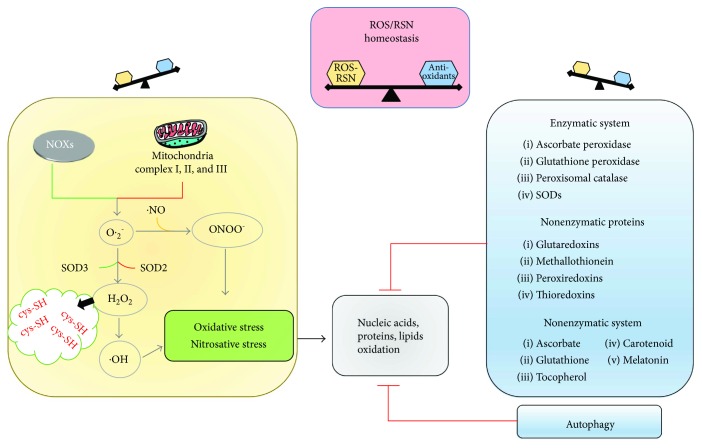
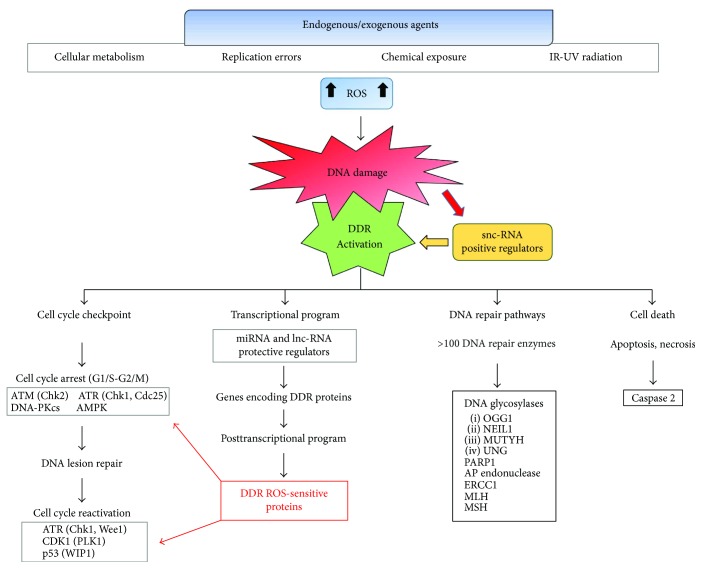
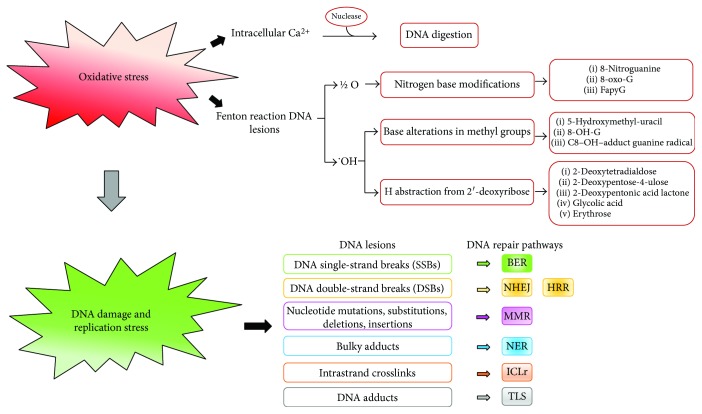
Cancer is a death cause in economically developed countries that results growing also in developing countries. Improved outcome through targeted interventions faces the scarce selectivity of the therapies and the development of resistance to them that compromise the therapeutic effects. Genomic instability is a typical cancer hallmark due to DNA damage by genetic mutations, reactive oxygen and nitrogen species, ionizing radiation, and chemotherapeutic agents. DNA lesions can induce and/or support various diseases, including cancer. The DNA damage response (DDR) is a crucial signaling-transduction network that promotes cell cycle arrest or cell death to repair DNA lesions. DDR dysregulation favors tumor growth as downregulated or defective DDR generates genomic instability, while upregulated DDR may confer treatment resistance. Redox homeostasis deeply and capillary affects DDR as ROS activate/inhibit proteins and enzymes integral to DDR both in healthy and cancer cells, although by different routes. DDR regulation through modulating ROS homeostasis is under investigation as anticancer opportunity, also in combination with other treatments since ROS affect DDR differently in the patients during cancer development and treatment. Here, we highlight ROS-sensitive proteins whose regulation in oxidatively induced DDR might allow for selective strategies against cancer that are better tailored to the patients.
癌症是经济发达国家的主要致死原因,在发展中国家也呈增长趋势。通过靶向干预提高疗效面临治疗方法选择有限和耐药性发展的问题,这影响了治疗效果。基因组不稳定性是癌症的一个典型标志,其原因是遗传突变、活性氧和氮物种、电离辐射和化疗药物导致的 DNA 损伤。DNA 损伤可诱导和/或支持多种疾病,包括癌症。DNA 损伤反应 (DDR) 是一个关键的信号转导网络,可促进细胞周期停滞或细胞死亡以修复 DNA 损伤。DDR 失调有利于肿瘤生长,因为下调或有缺陷的 DDR 会产生基因组不稳定性,而上调的 DDR 可能会导致治疗耐药性。氧化还原平衡深刻地影响 DDR,因为 ROS 激活/抑制 DDR 中健康细胞和癌细胞的蛋白质和酶,尽管途径不同。通过调节 ROS 平衡来调节 DDR 作为抗癌机会正在研究中,也与其他治疗方法联合使用,因为 ROS 在癌症发展和治疗过程中对 DDR 的影响在患者中不同。在这里,我们强调了 ROS 敏感蛋白,其在氧化诱导的 DDR 中的调节可能允许针对癌症的选择性策略,这些策略更适合患者。