Department of Otorhinolaryngology, Head and Neck Surgery, Inha University College of Medicine, Incheon, Republic of Korea.
Department of Biological Engineering, Inha University, Incheon, Republic of Korea.
PLoS One. 2018 May 17;13(5):e0197594. doi: 10.1371/journal.pone.0197594. eCollection 2018.
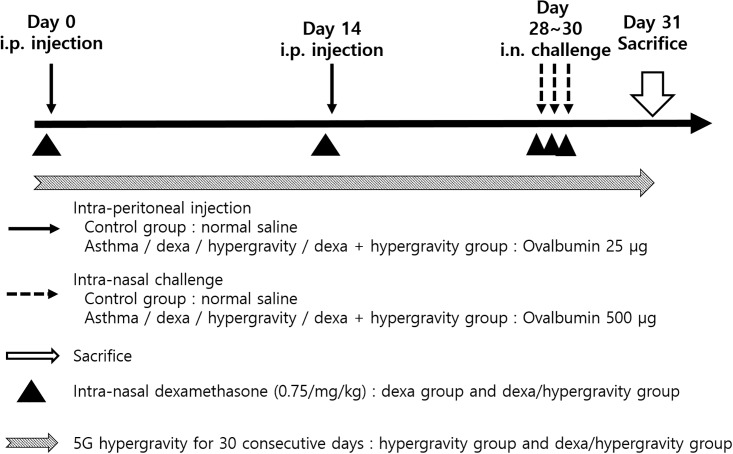
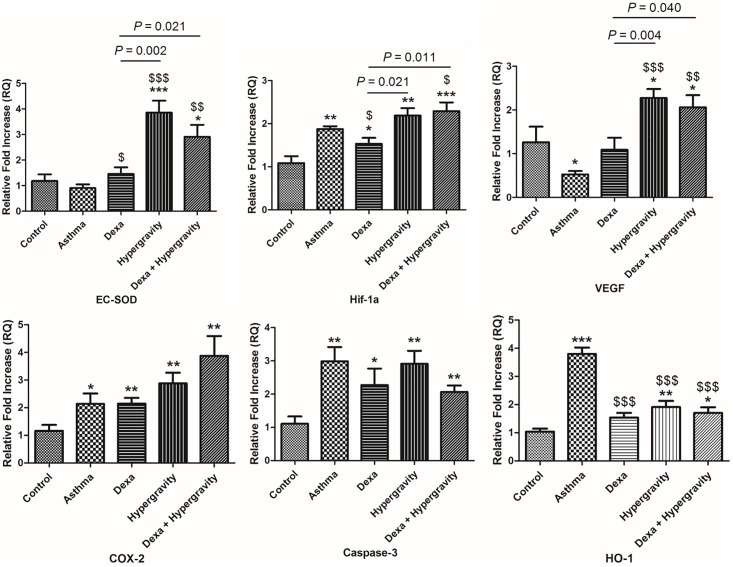
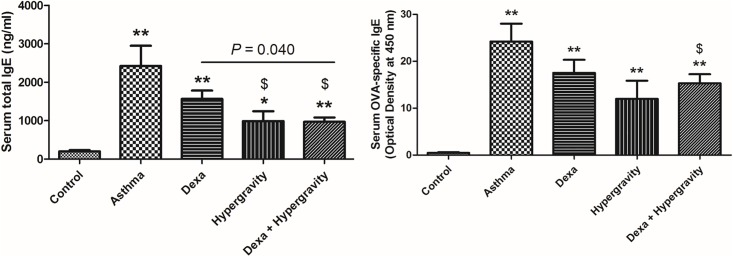
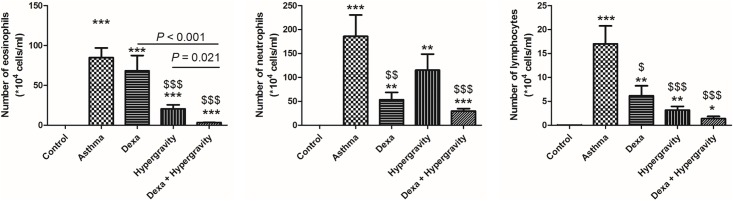
We investigated whether the therapeutic effects of dexamethasone for allergic asthma and rhinitis were enhanced in mice when exposed to hypergravity. Forty mice were divided into 5 groups (n = 8/group): Control group received saline intraperitoneally (i.p.) and intranasally (i.n.); Asthma group received i.p./i.n. ovalbumin (OVA) for inducing allergic asthma/rhinitis; Dexa group received i.n. dexamethasone (0.75 mg/kg) 30 minutes before each OVA challenge; Hypergravity group was subjected to allergic asthma/rhinitis as well as exposed to 5 G hypergravity for 30 days; Finally in Dexa/Hypergravity group, hypergravity and dexamethasone were used simultaneously during induction of allergic asthma/rhinitis. Dexa group and Hypergravity group showed a significant decrease in serum total IgE levels compared to the Asthma group (p<0.05). Dexa/Hypergravity group showed greater IgE decrease compared with Dexa group (p = 0.040). Compared with the monotherapy groups, Dexa/Hypergravity group showed significantly fewer eosinophils in BAL fluid (p<0.05). Dexa/Hypergravity group showed significantly decreased eosinophilic infiltration into the lungs and nasal cavity (p<0.05). EC-SOD (extracellular superoxide dismutase) expression was significantly upregulated in the Hypergravity group and Dexa/Hypergravity group, compared with the Dexa group (p<0.05). In conclusion, hypergravity enhanced the therapeutic effect of dexamethasone in a murine model of allergic asthma and rhinitis. Therefore, combination could be a promising strategy, and one of its mechanisms could be up-regulation of EC-SOD expression.
我们研究了在超重力环境下,地塞米松治疗过敏性哮喘和鼻炎的疗效是否会增强。将 40 只小鼠分为 5 组(n = 8/组):对照组经腹腔(i.p.)和鼻腔(i.n.)给予生理盐水;哮喘组接受 i.p./i.n.卵清蛋白(OVA)诱导过敏性哮喘/鼻炎;地塞米松组在每次 OVA 攻击前 30 分钟接受 i.n.地塞米松(0.75mg/kg);超重力组接受过敏性哮喘/鼻炎,同时暴露于 5G 超重力 30 天;最后,在 Dexa/Hypergravity 组中,在诱导过敏性哮喘/鼻炎期间同时使用超重力和地塞米松。与哮喘组相比,地塞米松组和超重力组的血清总 IgE 水平显著降低(p<0.05)。与地塞米松组相比,Dexa/Hypergravity 组 IgE 降低更显著(p = 0.040)。与单药治疗组相比,Dexa/Hypergravity 组 BAL 液中的嗜酸性粒细胞明显减少(p<0.05)。Dexa/Hypergravity 组肺和鼻腔嗜酸性粒细胞浸润明显减少(p<0.05)。与地塞米松组相比,超重力组和 Dexa/Hypergravity 组细胞外超氧化物歧化酶(EC-SOD)表达显著上调(p<0.05)。总之,超重力增强了地塞米松治疗过敏性哮喘和鼻炎的疗效。因此,联合治疗可能是一种很有前途的策略,其机制之一可能是上调 EC-SOD 表达。