Alexopoulos Harry, Akrivou Sofia, Mastroyanni Sotiria, Antonopoulou Maria, Dinopoulos Argirios, Giorgi Melpo, Konstantinou Kostas, Kouremenos Evangelos, Lariou Maria, Naoumis Dimitrios, Pavlidou Efterpi, Pavlou Evaggelos, Voudris Konstantinos, Vlachoyiannopoulos Panayotis, Dalakas Marinos C
Department of Pathophysiology, National and Kapodistrian University of Athens, Athens, Greece.
Department of Neurology, 'P & A Kyriakou' Children's Hospital, Athens, Greece.
Ther Adv Neurol Disord. 2018 Apr 23;11:1756286418768778. doi: 10.1177/1756286418768778. eCollection 2018.
Recent evidence suggests that patients with herpes simplex virus (HSV) encephalitis may relapse because of autoimmunity against the N-methyl-D-aspartate receptor (NMDAR). We present a case series of post-HSV relapsing encephalopathy associated with antibodies to central nervous system (CNS) synaptic antigens.
PATIENT/METHODS: Sera and cerebrospinal fluid (CSF) from five patients with HSV encephalitis who relapsed after antiviral therapy were tested for anti-NMDAR, gamma-aminobutyric acid b receptor (GABAbR), α-amino-3-hydroxy-5-methyl-4-isoxazolepropionic acid receptor (AMPAR), Leucine-rich, glioma inactivated 1 (LGI1), anti -contactin-associated protein-like 2 (CASPR2) and dipeptidyl-peptidase-like protein-6 (DDPX) antibodies using cell-based assays.
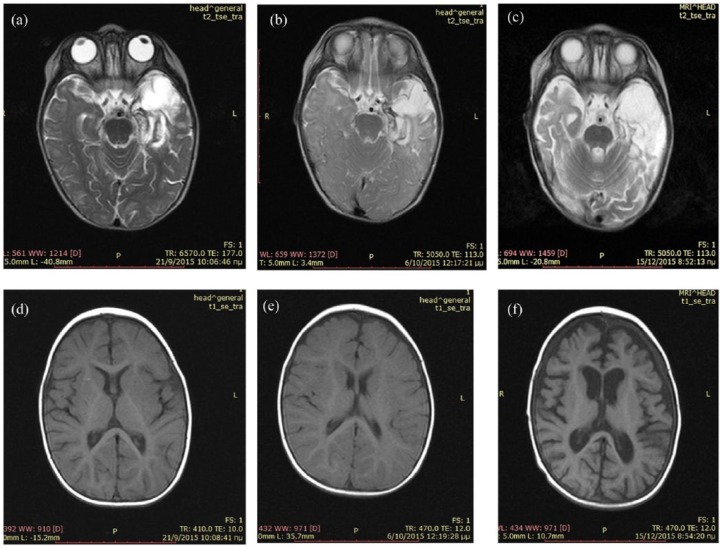
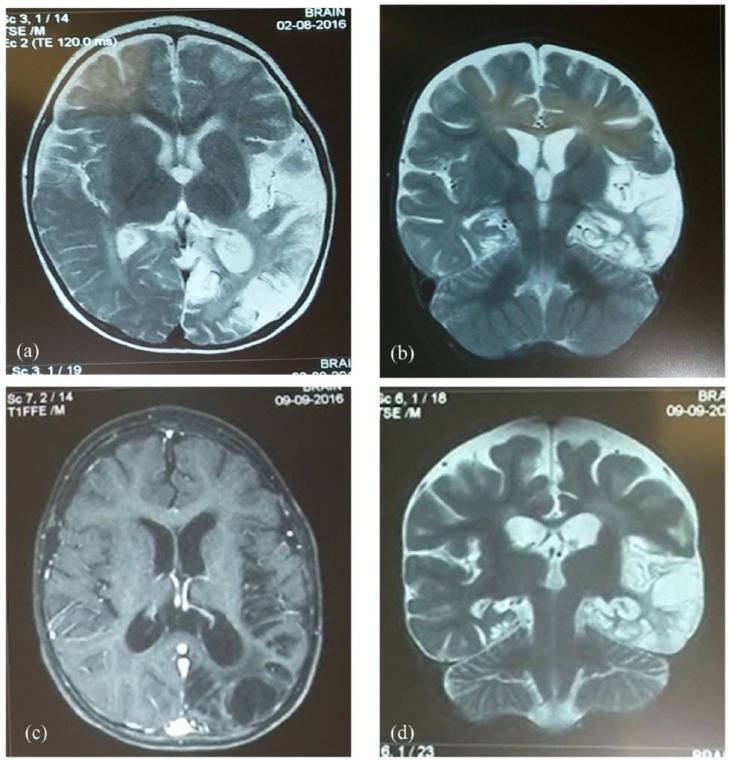
Five patients (two infants, one child and two adults) developed post-HSV autoimmune encephalitis. The infants, aged 9 months and 10 months, after prompt and seemingly successful anti-HSV therapy, were readmitted with typical signs of NMDAR-encephalitis evolving within days, with NMDAR antibodies detected in both serum and CSF. Although they were promptly treated with intravenous immunoglobulin (IVIg) and with IVIg followed by rituximab, respectively, they were both left with psychomotor deficits. A 14-year-old girl with seizures due to HSV encephalitis improved with anti-HSV therapy. Later, she manifested intractable seizures and she was found positive for anti-NMDAR antibodies which persist. The two adults were women, aged 58 and 33 years. The first recovered after anti-HSV therapy and remained asymptomatic for 6 months, until she developed generalized seizures with persisting CSF anti-NMDAR antibodies; the second, who continued to be encephalopathic after 2 weeks of anti-HSV therapy, tested positive for anti-NMDAR antibodies in the serum and anti-GABAbR antibodies in the serum and CSF. She recovered fully following IVIg therapy but her serum anti-GABAbR antibodies persist 34 months later.
Infection of the CNS with HSV can trigger CNS autoimmunity associated not only with anti-NMDAR but also with anti-GABAbR antibodies. These antibodies can persist in the serum, even without associated symptoms, but their presence in the CSF is firmly associated with disease development. In contrast to children and adults who responded well to therapies, the infants had an incomplete recovery with severe psychomotor deficits probably due to the interference of anti-NMDAR antibodies with neuro-developmental processes.
近期证据表明,单纯疱疹病毒(HSV)脑炎患者可能因针对N-甲基-D-天冬氨酸受体(NMDAR)的自身免疫反应而复发。我们报告了一系列与中枢神经系统(CNS)突触抗原抗体相关的HSV后复发性脑病病例。
患者/方法:对5例抗病毒治疗后复发的HSV脑炎患者的血清和脑脊液(CSF)进行检测,采用基于细胞的检测方法检测抗NMDAR、γ-氨基丁酸b受体(GABAbR)、α-氨基-3-羟基-5-甲基-4-异恶唑丙酸受体(AMPAR)、富含亮氨酸的胶质瘤失活蛋白1(LGI1)、抗接触蛋白相关蛋白样2(CASPR2)和二肽基肽酶样蛋白6(DDPX)抗体。
5例患者(2例婴儿、1例儿童和2例成人)发生HSV后自身免疫性脑炎。9个月和10个月大的婴儿在迅速且看似成功的抗HSV治疗后,数天内再次入院,出现典型的NMDAR脑炎症状,血清和脑脊液中均检测到NMDAR抗体。尽管分别立即接受了静脉注射免疫球蛋白(IVIg)治疗以及IVIg联合利妥昔单抗治疗,但两人均遗留精神运动功能障碍。一名因HSV脑炎发作的14岁女孩经抗HSV治疗后病情好转。后来,她出现难治性癫痫发作,发现抗NMDAR抗体呈阳性且持续存在。两名成年女性,年龄分别为58岁和33岁。第一名患者抗HSV治疗后康复,6个月无症状,之后出现全身性癫痫发作,脑脊液中抗NMDAR抗体持续存在;第二名患者抗HSV治疗2周后仍有脑病症状,血清中抗NMDAR抗体呈阳性,血清和脑脊液中抗GABAbR抗体呈阳性。她经IVIg治疗后完全康复,但34个月后血清中抗GABAbR抗体仍持续存在。
HSV感染中枢神经系统可引发中枢神经系统自身免疫反应,不仅与抗NMDAR抗体有关,还与抗GABAbR抗体有关。这些抗体可在血清中持续存在,即使没有相关症状,但它们在脑脊液中的存在与疾病发展密切相关。与对治疗反应良好的儿童和成人不同,婴儿恢复不完全,伴有严重的精神运动功能障碍,可能是由于抗NMDAR抗体干扰神经发育过程所致。