Division of Gastrointestinal Oncology, Shizuoka Cancer Center, Shizuoka, Japan.
Division of Gastrointestinal Oncology, Shizuoka Cancer Center, 1007 Shimonagakubo, Nagizumi-cho, Sunto-gun, Shizuoka, 411-0934, Japan.
BMC Cancer. 2018 May 18;18(1):573. doi: 10.1186/s12885-018-4486-3.
Standard treatment for unresectable esophageal squamous cell carcinoma (ESCC) without distant metastasis is definitive chemoradiotherapy (dCRT), in which the incidence of esophageal fistula (EF) is reported to be 10-12%. An ad hoc analysis of JCOG0303, a phase II/III trial of dCRT for patients with unresectable ESCC (including non-T4b), suggested that esophageal stenosis is a risk factor for EF. However, risk factors for EF in patients limited to T4b ESCC treated with dCRT have yet to be clarified. The aim of this study was to investigate risk factors for EF in T4b thoracic ESCC treated with dCRT.
We retrospectively analyzed the data of consecutive T4b thoracic ESCC patients who were treated with dCRT (cisplatin and fluorouracil) at Shizuoka Cancer Center between April 2004 and September 2015.
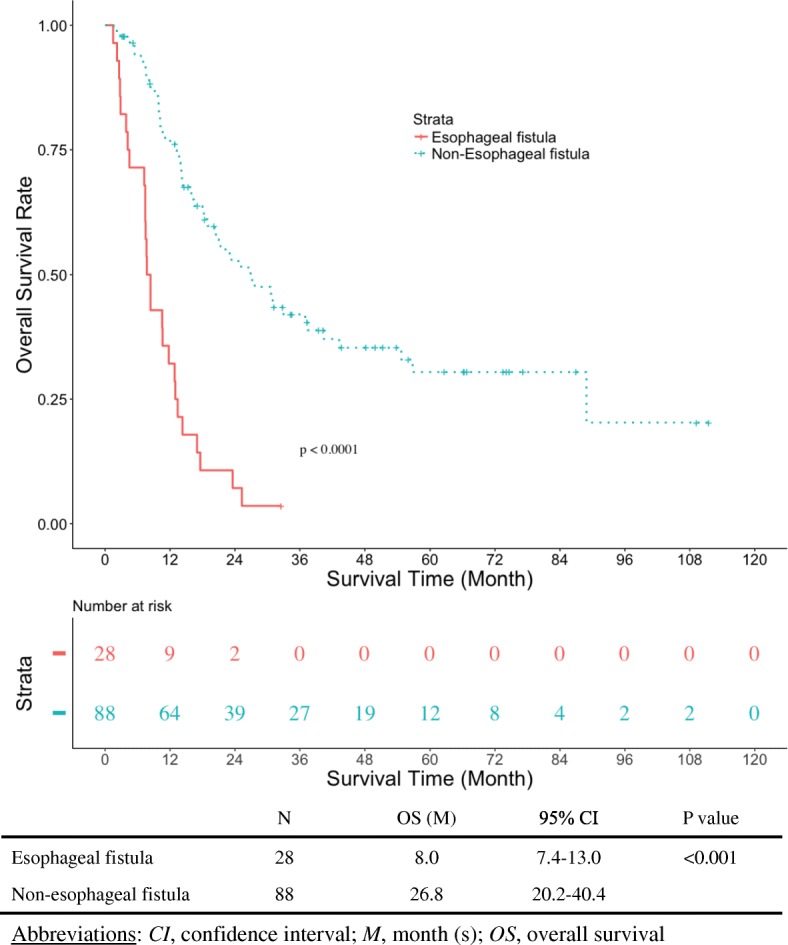
Excluding 8 patients with esophageal fistula clearly attributable to other iatrogenic interventions, the data of 116 patients who met the inclusion criteria were analyzed. Esophageal fistula was observed in 28 patients (24%). Although the fistula was closed in 5 patients, overall survival was significantly shorter in patients who experienced esophageal fistula (8.0 vs. 26.8 months; p < 0.0001). Among four potential variables extracted in univariate analysis, namely, total circumferential lesion, elevated CRP level, elevated white blood cell count, and anemia, the first two were revealed as risk factors for esophageal fistula in multivariate analysis.
This study demonstrated that total circumferential lesion and CRP ≥1.00 mg/dL are risk factors for esophageal fistula in T4b thoracic ESCC treated with dCRT.
This study was retrospectively registered.
无远处转移的不可切除食管鳞癌(ESCC)的标准治疗方法是根治性放化疗(dCRT),据报道,这种方法导致食管瘘(EF)的发生率为 10-12%。JCOG0303 的一项分析显示,dCRT 治疗不可切除的 ESCC(包括非 T4b 期)患者中,食管狭窄是 EF 的一个危险因素。然而,接受 dCRT 治疗的 T4b 期 ESCC 患者 EF 的危险因素尚未阐明。本研究旨在探讨 dCRT 治疗 T4b 期胸段 ESCC 患者 EF 的危险因素。
我们回顾性分析了 2004 年 4 月至 2015 年 9 月在静冈癌症中心接受 dCRT(顺铂和氟尿嘧啶)治疗的连续 T4b 期胸段 ESCC 患者的数据。
排除 8 例明显归因于其他医源性干预的食管瘘患者后,分析了符合纳入标准的 116 例患者的数据。28 例(24%)患者发生食管瘘。尽管 5 例患者的瘘口已闭合,但发生食管瘘的患者总生存率明显更短(8.0 个月与 26.8 个月;p<0.0001)。在单因素分析中提取的四个潜在变量中,总环形病变、CRP 水平升高、白细胞计数升高和贫血,前两个在多因素分析中被揭示为食管瘘的危险因素。
本研究表明,dCRT 治疗 T4b 期胸段 ESCC 时,总环形病变和 CRP≥1.00mg/dL 是食管瘘的危险因素。
本研究为回顾性注册。