Institute of Psychology and Transfer, University of Bremen, Bremen, Germany.
University of Limerick, Limerick, Ireland.
BMC Psychiatry. 2018 May 18;18(1):137. doi: 10.1186/s12888-018-1704-0.
Deep transcranial magnetic stimulation (DTMS) is a non-invasive method of stimulating widespread cortical areas and, presumably, deeper neural networks. The current study assessed the effects of DTMS in the treatment of substance use disorders (SUD) using a systematic review.
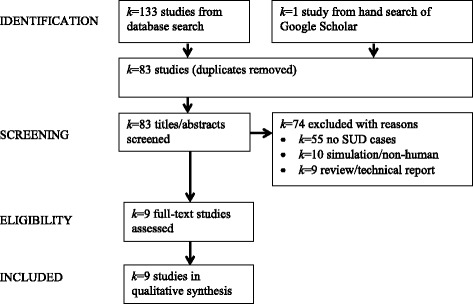
Electronic literature search (PsycInfo, Medline until April 2017) identified k = 9 studies (k = 4 randomized-controlled trials, RCTs, with inactive sham and k = 5 open-label studies). DTMS was most commonly applied using high frequency/intensity (10-20 Hz/100-120% of the resting motor threshold, MT) protocols for 10-20 daily sessions in cases with alcohol, nicotine or cocaine use disorders. The outcome measures were craving and dependence (according to standardized scales) or consumption (frequency, abstinence or results of biological assays) at the end of the daily treatment phases and at the last follow-up.
Acute and longer-term (6-12 months) reductions in alcohol craving were observed after 20 sessions (20 Hz, 120% MT) relative to baseline in k = 4 open-label studies with comorbid SUD and major depressive disorder (MDD). In k = 2 RCTs without MDD, alcohol consumption acutely decreased after 10-12 sessions (10-20 Hz, 100-120% MT) relative to baseline or to sham. Alcohol craving was reduced only after higher frequency/intensity DTMS (20 Hz, 120% MT) relative to sham in k = 1 RCT. Nicotine consumption was reduced and abstinence was increased after 13 sessions (10 Hz, 120% MT) and at the 6-month follow-up relative to sham in k = 1 RCT. Cocaine craving was reduced after 12 sessions (15 Hz, 100% MT) and at the 2-month follow-up relative to baseline in k = 1 open-label study while consumption was reduced after 12 sessions (10 Hz, 100% MT) relative to baseline but not to sham in k = 1 RCT.
High-frequency DTMS may be effective at treating some SUD both acutely and in the longer-term. Large RCTs with inactive sham are required to determine the efficacy and the optimal stimulation parameters of DTMS for the treatment of SUD.
深度经颅磁刺激(DTMS)是一种非侵入性的刺激广泛皮质区域的方法,据推测,还可以刺激更深的神经网络。本研究通过系统评价评估了 DTMS 在治疗物质使用障碍(SUD)中的作用。
电子文献检索(PsycInfo,截至 2017 年 4 月的 Medline)确定了 k=9 项研究(k=4 项随机对照试验,RCT,使用非活动假刺激和 k=5 项开放标签研究)。DTMS 最常使用高频/高强度(10-20 Hz/100-120%静息运动阈值,MT)方案,每天治疗 10-20 次,用于治疗酒精、尼古丁或可卡因使用障碍。在每日治疗阶段结束和最后一次随访时,使用标准量表评估渴求程度和依赖性(或消费频率、禁欲或生物检测结果)。
在 4 项伴有 SUD 和重性抑郁障碍(MDD)的开放标签研究中,在 20 次治疗(20 Hz,120% MT)后,与基线相比,观察到酒精渴求的急性和长期(6-12 个月)降低。在没有 MDD 的 2 项 RCT 中,与基线或假刺激相比,在 10-12 次治疗(10-20 Hz,100-120% MT)后,急性酒精消费减少。仅在 1 项 RCT 中,与假刺激相比,使用更高频率/强度的 DTMS(20 Hz,120% MT)后,酒精渴求减少。在 1 项 RCT 中,在 13 次治疗(10 Hz,120% MT)后,与假刺激相比,吸烟减少,6 个月随访时戒断增加。在 1 项开放标签研究中,在 12 次治疗(15 Hz,100% MT)后和 2 个月随访时,与基线相比,可卡因渴求减少,而在 1 项 RCT 中,与基线相比,在 12 次治疗(10 Hz,100% MT)后消费减少,但与假刺激相比没有减少。
高频 DTMS 可能对急性和长期治疗某些 SUD 有效。需要进行大型、无活性假刺激的 RCT,以确定 DTMS 治疗 SUD 的疗效和最佳刺激参数。