Department of Pediatric Hematology and Oncology, University Hospital Münster, Albert-Schweitzer-Campus 1, 48149, Münster, Germany.
Present address: Department of Medicine A, Hematology, Oncology and Pneumology, University Hospital Münster, Albert-Schweitzer-Campus 1, 48149, Münster, Germany.
Cell Commun Signal. 2018 May 18;16(1):21. doi: 10.1186/s12964-018-0233-2.
The CXCR4 receptor antagonist plerixafor (AMD3100) is raising interest as an anti-cancer agent that disrupts the CXCL12-CXCR4 chemokine - receptor interaction between neoplastic cells and their microenvironment in tumor progression and metastasis. Here, we investigated plerixafor for anti-cancer activity in Ewing sarcoma, a rare and aggressive cancer of bone and soft tissues.
We used a variety of methods such as cell viability and migration assays, flow cytometry, phospho-tyrosine arrays and western blotting to determine plerixafor effects on five characterized Ewing sarcoma cell lines and a low-passage culture in vitro.
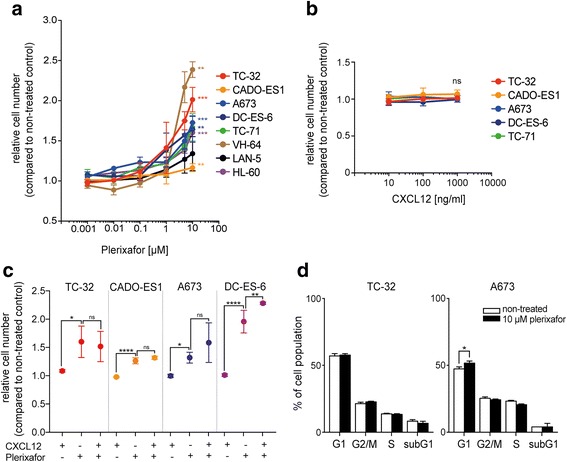
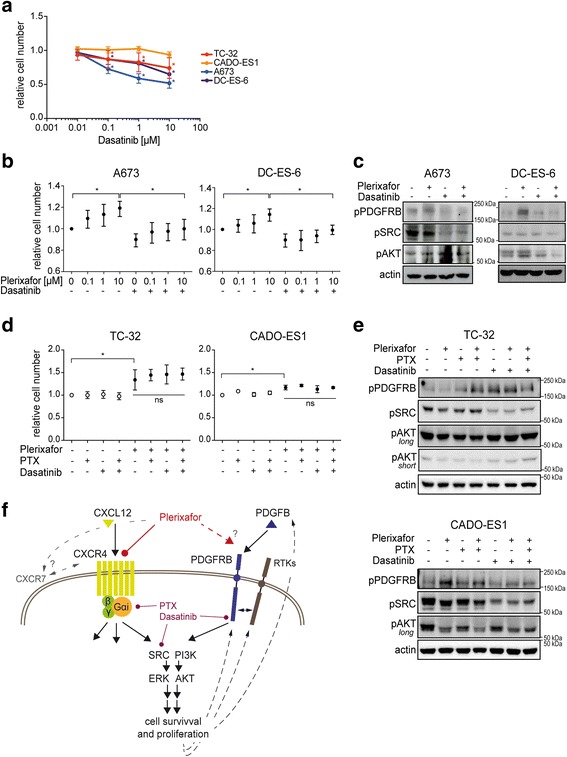
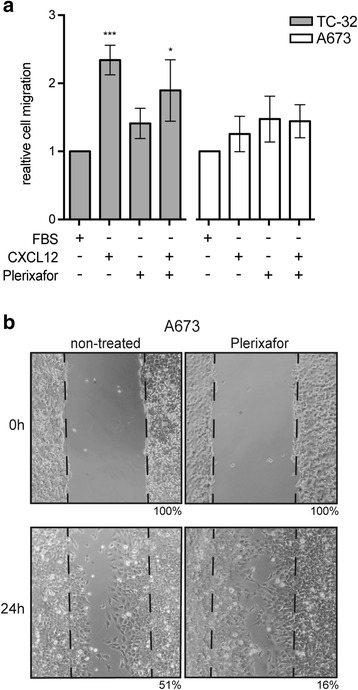
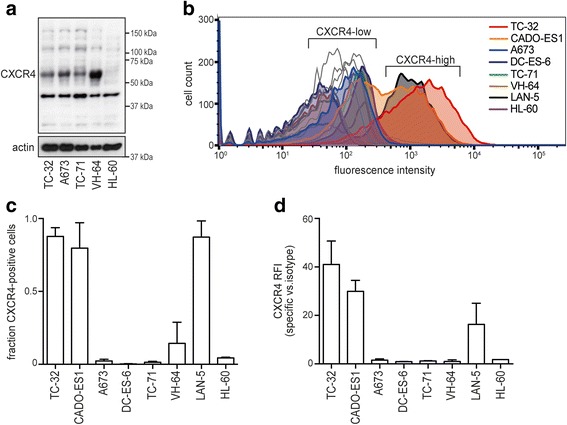
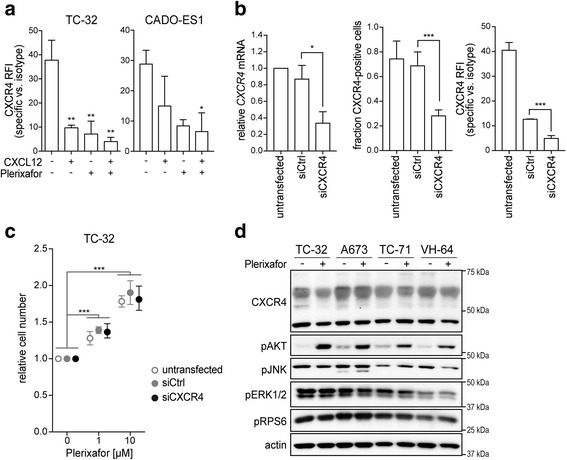
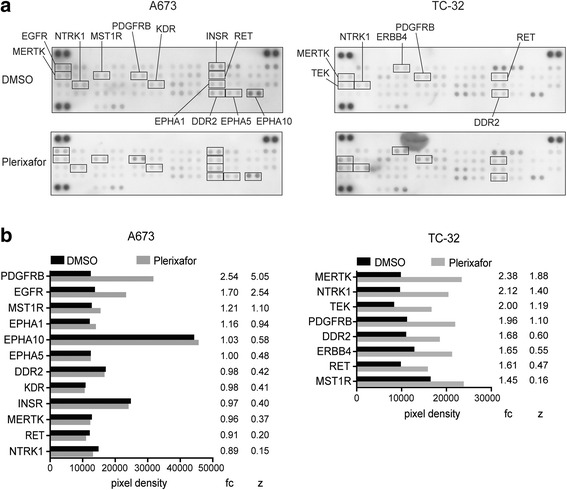
Unexpectedly, plerixafor led to an increase in cell viability and proliferation in standard cell growth conditions, and to chemotactic migration towards plerixafor. Exploring potential molecular mechanisms underlying this effect, we found that Ewing sarcoma cell lines divided into classes of high- and low-level CXCR4 surface expression. Proliferative plerixafor responses were observed in both groups, maintained despite significant CXCR4 down-regulation or inhibition of Gαi-protein signal transduction, and involved activation of multiple receptor tyrosine kinases (DDR2, MERTK, MST1R, NTRK1, RET), the most prominent being platelet-derived growth factor receptor beta (PDGFRB). PDGFRB was activated in response to inhibition of the CXCL12-CXCR4 axis by plerixafor and/or pertussis toxin (Gαi-protein inhibitor). Dasatinib, a multi-kinase inhibitor of both PDGFRB and the CXCR4 downstream kinase SRC, counteracted this activation in some but not all cell lines.
These data suggest a feedback interaction between the CXCR4 chemokine receptor and RTK signaling cascades that elicits compensatory cell survival signaling and can shift the net effect of plerixafor towards proliferation. PDGFRB was identified as a candidate driver RTK and potential therapeutic co-target for CXCR4 in Ewing sarcoma. Although as yet limited to in vitro studies, these findings call for further investigation in the cancer - microenvironment interplay in vivo.
趋化因子受体 4(CXCR4)拮抗剂plerixafor(AMD3100)作为一种抗癌药物引起了人们的兴趣,它可以破坏肿瘤进展和转移过程中肿瘤细胞与其微环境之间的趋化因子 CXCL12-CXCR4 相互作用。在这里,我们研究了 plerixafor 在尤文肉瘤中的抗癌活性,尤文肉瘤是一种罕见且侵袭性的骨和软组织癌症。
我们使用了多种方法,如细胞活力和迁移测定、流式细胞术、磷酸酪氨酸阵列和 Western blotting,以确定 plerixafor 对五种特征性尤文肉瘤细胞系和体外低传代培养的影响。
出乎意料的是,plerixafor 在标准细胞生长条件下导致细胞活力和增殖增加,并向 plerixafor 趋化迁移。探索这种作用的潜在分子机制,我们发现尤文肉瘤细胞系分为高和低水平 CXCR4 表面表达的两类。在这两组中都观察到增殖性 plerixafor 反应,尽管 CXCR4 显著下调或 Gαi-蛋白信号转导抑制,仍能维持这种反应,并涉及多个受体酪氨酸激酶(DDR2、MERTK、MST1R、NTRK1、RET)的激活,其中最突出的是血小板衍生生长因子受体β(PDGFRB)。PDGFRB 的激活是对 plerixafor 和/或百日咳毒素(Gαi-蛋白抑制剂)抑制 CXCL12-CXCR4 轴的反应。多激酶抑制剂 dasatinib 可同时抑制 PDGFRB 和 CXCR4 下游激酶 SRC,在一些而不是所有细胞系中拮抗这种激活。
这些数据表明,CXCR4 趋化因子受体和 RTK 信号级联之间存在反馈相互作用,引发代偿性细胞存活信号,并可将 plerixafor 的净效应转变为增殖。PDGFRB 被确定为尤文肉瘤中 CXCR4 的候选驱动 RTK 和潜在治疗性共靶标。尽管这些发现迄今为止仅限于体外研究,但它们呼吁在体内进一步研究癌症-微环境相互作用。