Wisconsin Surgical Outcomes Research Program, Department of Surgery, University of Wisconsin-Madison, Madison, WI, USA.
Department of Surgical Oncology, The University of Texas MD Anderson Cancer Center, Houston, TX, USA.
Ann Surg Oncol. 2018 Sep;25(9):2587-2595. doi: 10.1245/s10434-018-6496-4. Epub 2018 May 17.
Although not guideline recommended, studies suggest 50% of locoregional breast cancer patients undergo systemic imaging during follow-up, prompting its inclusion as a Choosing Wisely measure of potential overuse. Most studies rely on administrative data that cannot delineate scan intent (prompted by signs/symptoms vs. asymptomatic surveillance). This is a critical gap as intent is the only way to distinguish overuse from appropriate care.
Our aim was to assess surveillance systemic imaging post-breast cancer treatment in a national sample accounting for scan intent.
A stage-stratified random sample of 10 women with stage II-III breast cancer in 2006-2007 was selected from each of 1217 Commission on Cancer-accredited facilities, for a total of 10,838 patients. Registrars abstracted scan type (computed tomography [CT], non-breast magnetic resonance imaging, bone scan, positron emission tomography/CT) and intent (cancer-related vs. not, asymptomatic surveillance vs. not) from medical records for 5 years post-diagnosis. Data were merged with each patient's corresponding National Cancer Database record, containing sociodemographic and tumor/treatment information.
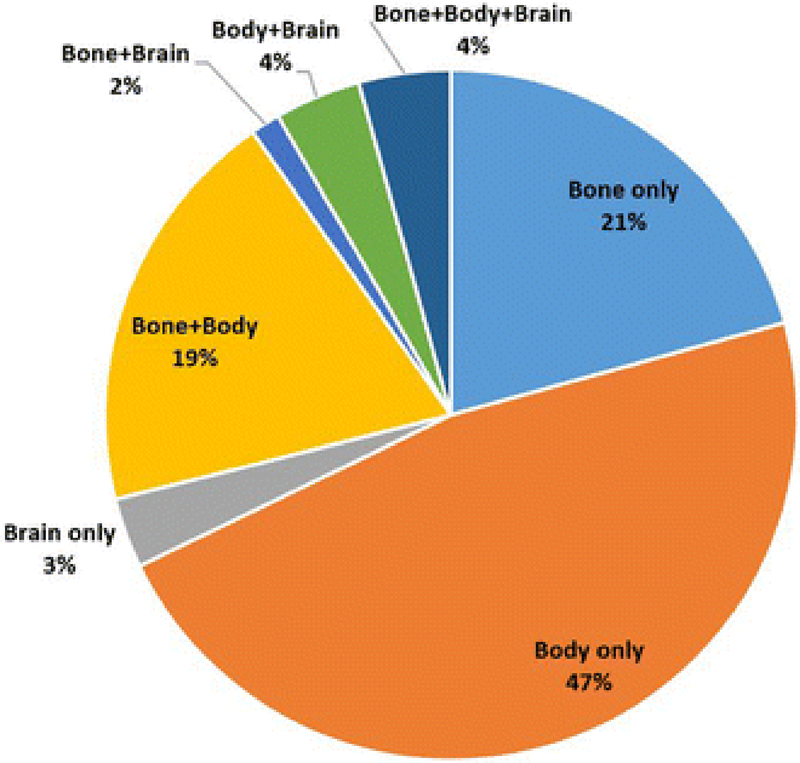
Of 10,838 women, 30% had one or more, and 12% had two or more, systemic surveillance scans during a 4-year follow-up period. Patients were more likely to receive surveillance imaging in the first follow-up year (lower proportions during subsequent years) and if they had estrogen receptor/progesterone receptor-negative tumors.
Locoregional breast cancer patients undergo asymptomatic systemic imaging during follow-up despite guidelines recommending against it, but at lower rates than previously reported. Providers appear to use factors that confer increased recurrence risk to tailor decisions about systemic surveillance imaging, perhaps reflecting limitations of data on which current guidelines are based. ClinicalTrials.gov Identifier: NCT02171078.
尽管未被指南推荐,但研究表明,50%的局部区域性乳腺癌患者在随访期间接受全身影像学检查,这促使其被纳入过度医疗的明智选择措施。大多数研究依赖于无法区分扫描意图(由症状/体征引起与无症状监测引起)的行政数据。这是一个关键的差距,因为意图是区分过度使用与适当护理的唯一方法。
我们的目的是在全国样本中评估乳腺癌治疗后监测全身影像学检查,同时考虑扫描意图。
从 2006 年至 2007 年每个 1217 个肿瘤委员会认证机构中选择 10 名患有 II-III 期乳腺癌的女性,每个机构 10 名,总共 10838 名患者,进行分层随机抽样。登记员从病历中提取诊断后 5 年内的扫描类型(计算机断层扫描[CT]、非乳腺磁共振成像、骨扫描、正电子发射断层扫描/CT)和意图(与癌症相关与不相关、无症状监测与不相关)。数据与每位患者的相应国家癌症数据库记录合并,包含社会人口统计学和肿瘤/治疗信息。
在 10838 名女性中,有 30%的人在 4 年随访期间进行了一次或多次全身监测扫描,有 12%的人进行了两次或更多次全身监测扫描。患者在第一年的随访中更有可能接受监测成像(随后几年的比例较低),如果他们的雌激素受体/孕激素受体阴性肿瘤。
尽管指南建议不要进行,但局部区域性乳腺癌患者在随访期间会进行无症状全身影像学检查,但比例低于之前的报告。提供者似乎使用增加复发风险的因素来决定是否进行全身监测成像,这可能反映了当前指南所依据的数据的局限性。临床试验.gov 标识符:NCT02171078。