Department of Psychology, College of Sciences, San Diego State University, San Diego, CA 92182-4611, United States.
Biology Department, College of Sciences, San Diego State University, San Diego, CA 92182-4611, United States.
Alcohol. 2018 Aug;70:51-60. doi: 10.1016/j.alcohol.2018.01.002. Epub 2018 Jan 8.
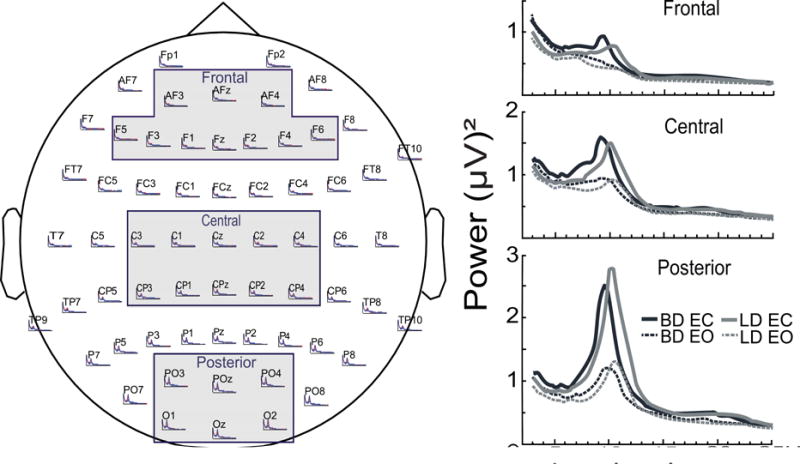
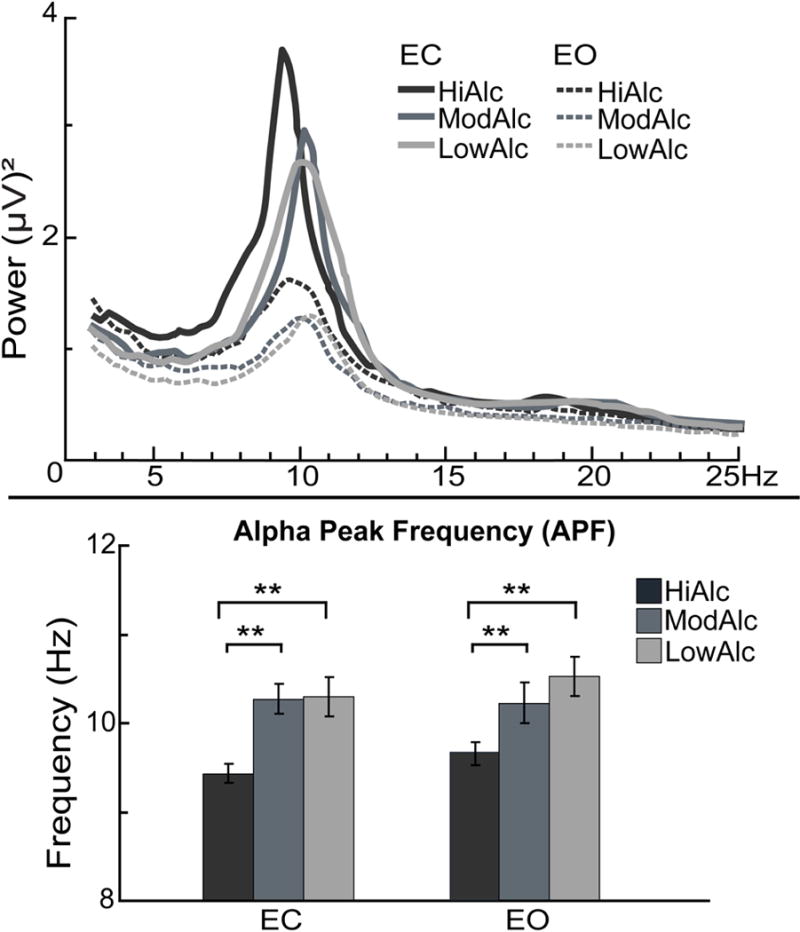
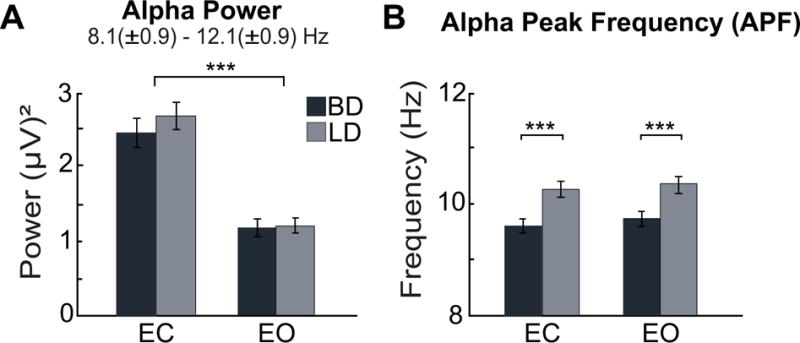
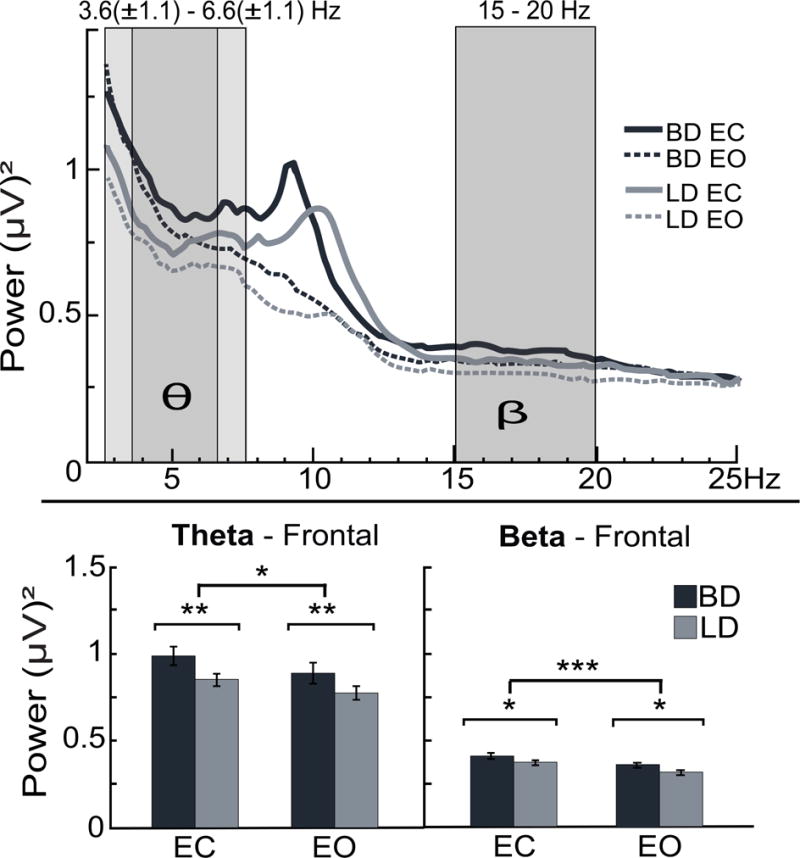
Heavy episodic alcohol consumption (also termed binge drinking) contributes to a wide range of health and cognitive deficits, but the associated brain-based indices are poorly understood. The current study used electroencephalography (EEG) to examine spontaneous neural oscillations in young adults as a function of quantity, frequency, and the pattern of their alcohol consumption. Sixty-one young adults (23.4 ± 3.4 years of age) were assigned to binge drinking (BD) and light drinking (LD) groups that were equated on gender, race/ethnic identity, age, educational background, and family history of alcoholism. EEG activity was recorded during eyes-open and eyes-closed resting conditions. Each participant's alpha peak frequency (APF) was used to calculate absolute power in individualized theta and alpha frequency bands, with a canonical frequency range used for beta. APF was slower by 0.7 Hz in BD, especially in individuals engaging in high-intensity drinking, but there were no changes in alpha power. BD also exhibited higher frontal theta and beta power than LD. Alpha slowing and increased theta power in BD remained after accounting for depression, anxiety, and personality characteristics, while elevated beta power covaried with sensation seeking. Furthermore, APF slowing and theta power correlated with various measures of alcohol consumption, including binge episodes and blackouts, but not with measures of working and episodic memory, cognitive flexibility, processing speed, or personality variables, suggesting that these physiological changes may be modulated by high-intensity alcohol intake. These results are consistent with studies of alcohol-use disorder (AUD) and support the hypothesis that binge drinking is a transitional stage toward alcohol dependence. The observed thalamocortical dysrhythmia may be indicative of an excitatory-inhibitory imbalance in BD and may potentially serve as an index of the progressive development of AUD, with a goal of informing possible interventions to minimize alcohol's deleterious effects on the brain.
重度间歇性饮酒(也称为狂饮)会导致广泛的健康和认知缺陷,但相关的大脑指标知之甚少。本研究使用脑电图(EEG)检查年轻人的自发神经振荡,作为数量、频率和饮酒模式的函数。61 名年轻人(23.4±3.4 岁)被分配到狂饮(BD)和轻度饮酒(LD)组,两组在性别、种族/民族身份、年龄、教育背景和酗酒家族史方面相匹配。在睁眼和闭眼休息状态下记录 EEG 活动。每位参与者的α峰值频率(APF)用于计算个体化θ和α频段的绝对功率,β频段使用典型频率范围。BD 的 APF 慢 0.7Hz,尤其是在高强度饮酒者中,但α功率没有变化。BD 的额叶θ和β功率也高于 LD。在考虑抑郁、焦虑和人格特征后,BD 仍表现出较慢的α波和增加的θ波功率,而升高的β波功率与感觉寻求有关。此外,APF 减慢和θ波功率与各种饮酒量测量值相关,包括狂欢发作和健忘症,但与工作和情节记忆、认知灵活性、处理速度或人格变量的测量值无关,表明这些生理变化可能受到高强度酒精摄入的调节。这些结果与酒精使用障碍(AUD)的研究一致,并支持狂饮是酒精依赖的过渡阶段的假设。观察到的丘脑皮质节律紊乱可能表明 BD 中兴奋性抑制失衡,并可能潜在地作为 AUD 进展的指标,旨在为可能的干预措施提供信息,以最小化酒精对大脑的有害影响。