Department of Mathematics, Applied Mathematics and Statistics, Case Western Reserve University, Cleveland, Ohio, United States of America.
Center for Global Health and Diseases, School of Medicine, Case Western Reserve University, Cleveland, Ohio, United States of America.
PLoS Negl Trop Dis. 2018 May 21;12(5):e0006514. doi: 10.1371/journal.pntd.0006514. eCollection 2018 May.
Schistosomiasis is a chronic parasitic trematode disease that affects over 240 million people worldwide. The Schistosoma lifecycle is complex, involving transmission via specific intermediate-host freshwater snails. Predictive mathematical models of Schistosoma transmission have often chosen to simplify or ignore the details of environmental human-snail interaction in their analyses. Schistosome transmission models now aim to provide better precision for policy planning of elimination of transmission. This heightens the importance of including the environmental complexity of vector-pathogen interaction in order to make more accurate projections.
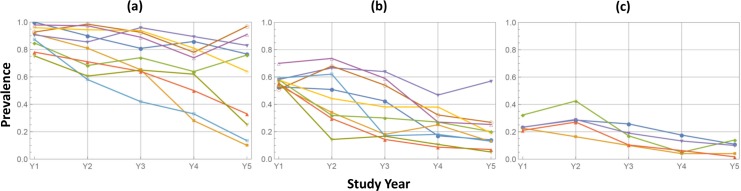
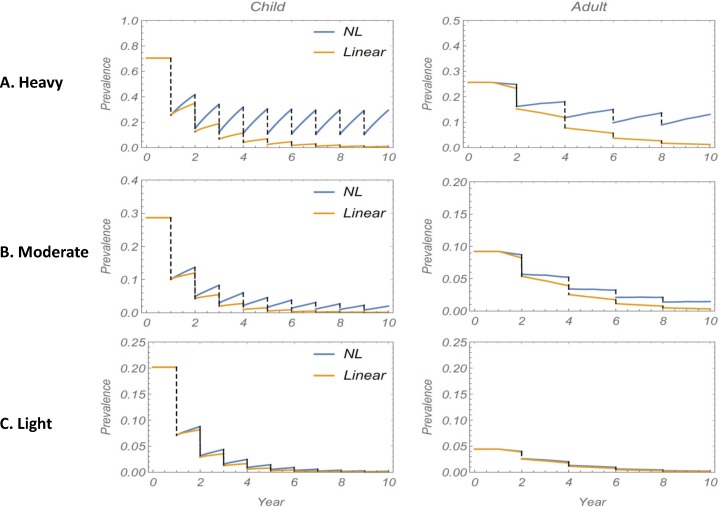
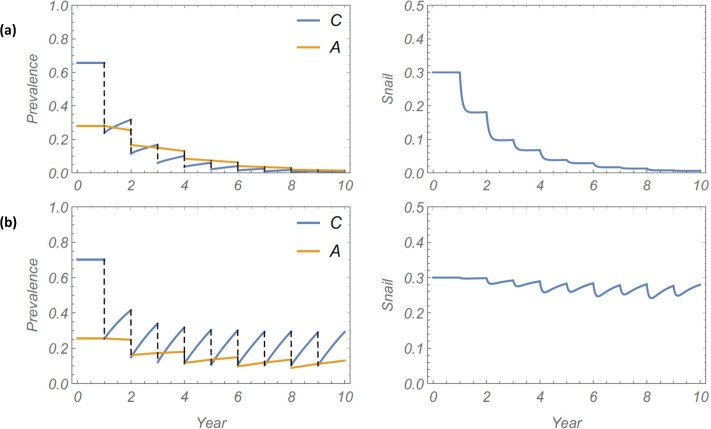
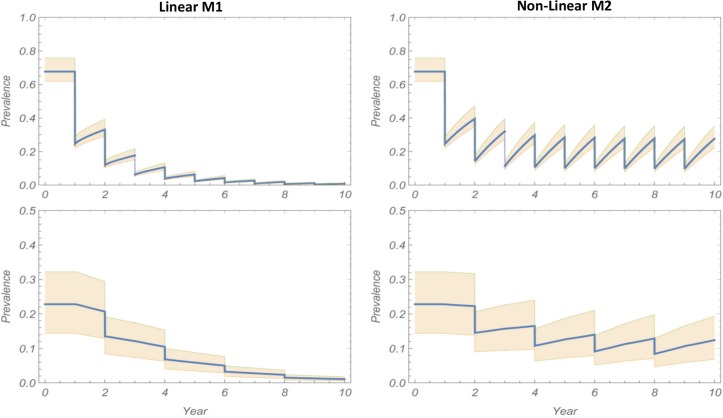
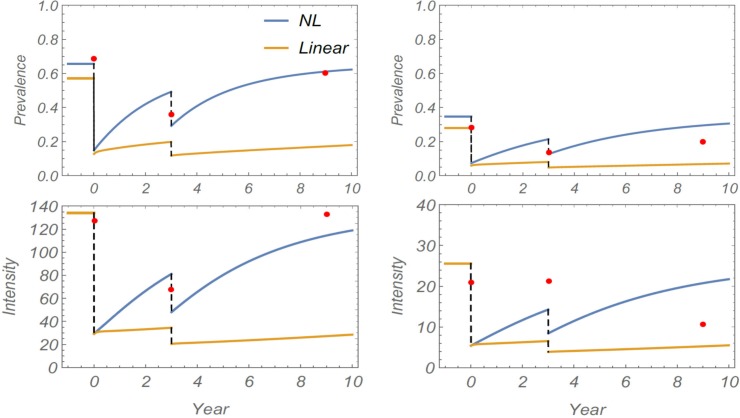
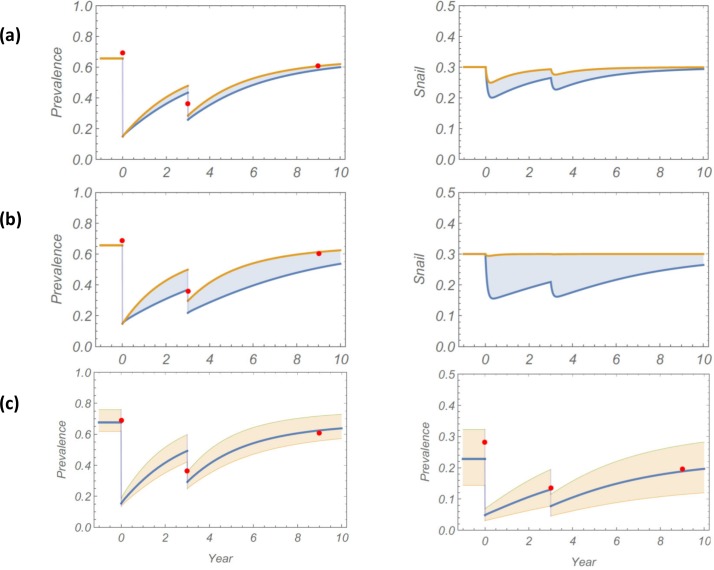
We propose a nonlinear snail force of infection (FOI) that takes into account an intermediate larval stage (miracidium) and snail biology. We focused, in particular, on the effects of snail force of infection (FOI) on the impact of mass drug administration (MDA) in human communities. The proposed (modified) model was compared to a conventional model in terms of their predictions. A longitudinal dataset generated in Kenya field studies was used for model calibration and validation. For each sample community, we calibrated modified and conventional model systems, then used them to model outcomes for a range of MDA regimens. In most cases, the modified model predicted more vigorous post-MDA rebound, with faster relapse to baseline levels of infection. The effect was pronounced in higher risk communities. When compared to observed data, only the modified system was able to successfully predict persistent rebound of Schistosoma infection.
The observed impact of varying location-specific snail inputs sheds light on the diverse MDA response patterns noted in operational research on schistosomiasis control, such as the recent SCORE project. Efficiency of human-to-snail transmission is likely to be much higher than predicted by standard models, which, in practice, will make local elimination by implementation of MDA alone highly unlikely, even over a multi-decade period.
血吸虫病是一种慢性寄生虫性吸虫病,影响全球超过 2.4 亿人。血吸虫的生命周期很复杂,涉及通过特定的中间宿主淡水螺传播。血吸虫传播的预测数学模型在其分析中经常选择简化或忽略环境与人-螺相互作用的细节。血吸虫病传播模型现在旨在为消除传播的政策规划提供更好的精度。这提高了在矢量-病原体相互作用中包含环境复杂性的重要性,以便更准确地进行预测。
我们提出了一种非线性螺蚴感染力(FOI),考虑了中间幼虫阶段(尾蚴)和螺的生物学。我们特别关注螺蚴感染力(FOI)对人类社区大规模药物治疗(MDA)的影响。所提出的(改进的)模型在其预测方面与传统模型进行了比较。使用在肯尼亚实地研究中生成的纵向数据集对模型进行了校准和验证。对于每个样本社区,我们校准了改进和传统的模型系统,然后使用它们对一系列 MDA 方案的结果进行建模。在大多数情况下,改进后的模型预测了更强烈的 MDA 后反弹,感染更快地恢复到基线水平。这种影响在高风险社区中更为明显。当与观察数据进行比较时,只有改进后的系统能够成功预测血吸虫感染的持续反弹。
观察到的不同位置特定螺蚴输入的影响揭示了血吸虫病控制的运营研究中注意到的各种 MDA 反应模式,例如最近的 SCORE 项目。人类向螺的传播效率可能比标准模型预测的要高得多,在实践中,即使在几十年的时间里,仅仅通过实施 MDA 来实现局部消除也极不可能。