Department of Gynecology, National Hospital Organization Shikoku Cancer Center, Minamiumemoto-cho, Matsuyama-city, Ehime Prefecture, 791-0280, Japan.
Counseling Room of Familial Neoplasm, National Hospital Organization Shikoku Cancer center, Minamiumemoto-cho, Matsuyama-city, Ehime Prefecture, 791-0280, Japan.
BMC Cancer. 2018 May 21;18(1):576. doi: 10.1186/s12885-018-4489-0.
Lynch syndrome is an autosomal dominant inherited disease caused by germline mutations in mismatch repair genes. Analysis for microsatellite instability (MSI) and immunohistochemistry (IHC) of protein expressions of disease-associated genes is used to screen for Lynch syndrome in endometrial cancer patients. When losses of both MLH1 and PMS2 proteins are observed by IHC, MLH1 promoter methylation analysis is conducted to distinguish Lynch syndrome-associated endometrial cancer from sporadic cancer.
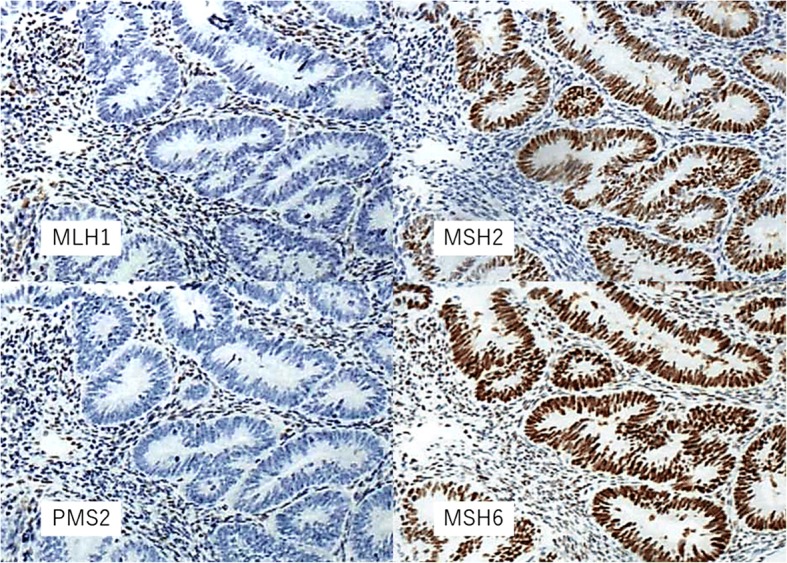
Here we report a woman who developed endometrial cancer at the age of 49 years. She had a family history of colorectal cancer (first-degree relative aged 52 years) and stomach cancer (second-degree relative with the age of onset unknown). No other family history was present, and she failed to meet the Amsterdam II criteria for the diagnosis of Lynch syndrome. Losses of MLH1 and PMS2, but not MSH2 and MSH6, proteins were observed by IHC in endometrial cancer tissues. Because MLH1 promoter hypermethylation was detected in endometrial cancer tissue samples, the epigenetic silencing of MLH1 was suspected as the cause of the protein loss. However, because of the early onset of endometrial cancer and the positive family history, a diagnosis of Lynch syndrome was also suspected. Therefore, we provided her with genetic counseling. After obtaining her consent, MLH1 promoter methylation testing and genetic testing of peripheral blood were performed. MLH1 promoter methylation was not observed in peripheral blood. However, genetic testing revealed a large deletion of exon 5 in MLH1; thus, we diagnosed the presence of Lynch syndrome.
Both MLH1 germline mutation and MLH1 promoter hypermethylation may be observed in endometrial cancer. Therefore, even if MLH1 promoter hypermethylation is detected, a diagnosis of Lynch syndrome cannot be excluded.
林奇综合征是一种常染色体显性遗传性疾病,由错配修复基因的种系突变引起。分析微卫星不稳定性(MSI)和疾病相关基因蛋白表达的免疫组织化学(IHC)用于筛选子宫内膜癌患者中的林奇综合征。当 IHC 观察到 MLH1 和 PMS2 蛋白丢失时,进行 MLH1 启动子甲基化分析以将林奇综合征相关的子宫内膜癌与散发性癌症区分开来。
我们在此报告一位 49 岁女性,患有子宫内膜癌。她有结直肠癌(一级亲属,年龄 52 岁)和胃癌(二级亲属,发病年龄不详)家族史。无其他家族史,不符合林奇综合征的阿姆斯特丹 II 标准。子宫内膜癌组织的 IHC 观察到 MLH1 和 PMS2 蛋白丢失,但 MSH2 和 MSH6 蛋白丢失。因为在子宫内膜癌组织样本中检测到 MLH1 启动子超甲基化,所以怀疑 MLH1 蛋白丢失的原因是表观遗传沉默。然而,由于子宫内膜癌的发病年龄较早且家族史阳性,也怀疑存在林奇综合征。因此,我们为她提供了遗传咨询。在获得她的同意后,进行了 MLH1 启动子甲基化检测和外周血的基因检测。在外周血中未观察到 MLH1 启动子甲基化。然而,基因检测显示 MLH1 外显子 5 的大片段缺失;因此,我们诊断存在林奇综合征。
子宫内膜癌中可能同时存在 MLH1 种系突变和 MLH1 启动子甲基化。因此,即使检测到 MLH1 启动子甲基化,也不能排除林奇综合征的诊断。