Columbia Center for Children's Environmental Health, Mailman School of Public Health, Columbia University, New York, NY 10032, USA; Department of Environmental Health Sciences, Mailman School of Public Health, Columbia University, New York, NY 10032, USA.
Columbia Center for Children's Environmental Health, Mailman School of Public Health, Columbia University, New York, NY 10032, USA; Department of Child and Adolescent Psychiatry, Columbia University, New York, NY 10032, USA.
Environ Int. 2018 Sep;118:9-16. doi: 10.1016/j.envint.2018.05.004. Epub 2018 May 26.
Prenatal and childhood exposure to polybrominated diphenyl ether (PBDE) flame retardants has been inversely associated with cognitive performance, however, few studies have measured PBDE concentrations in samples collected during both prenatal and postnatal periods.
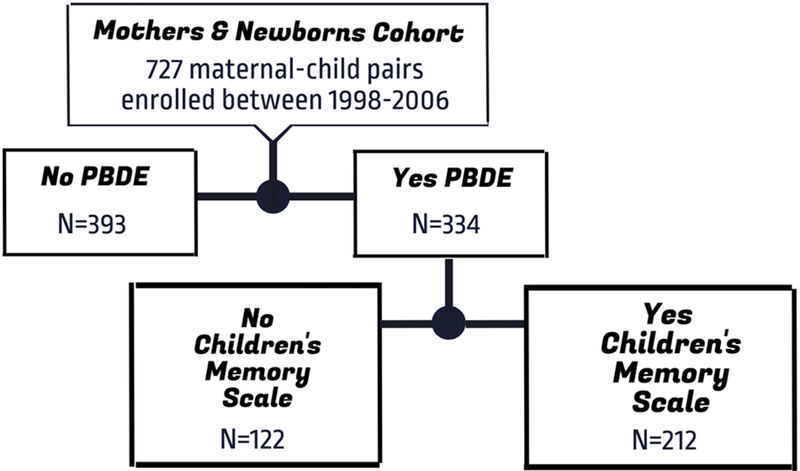
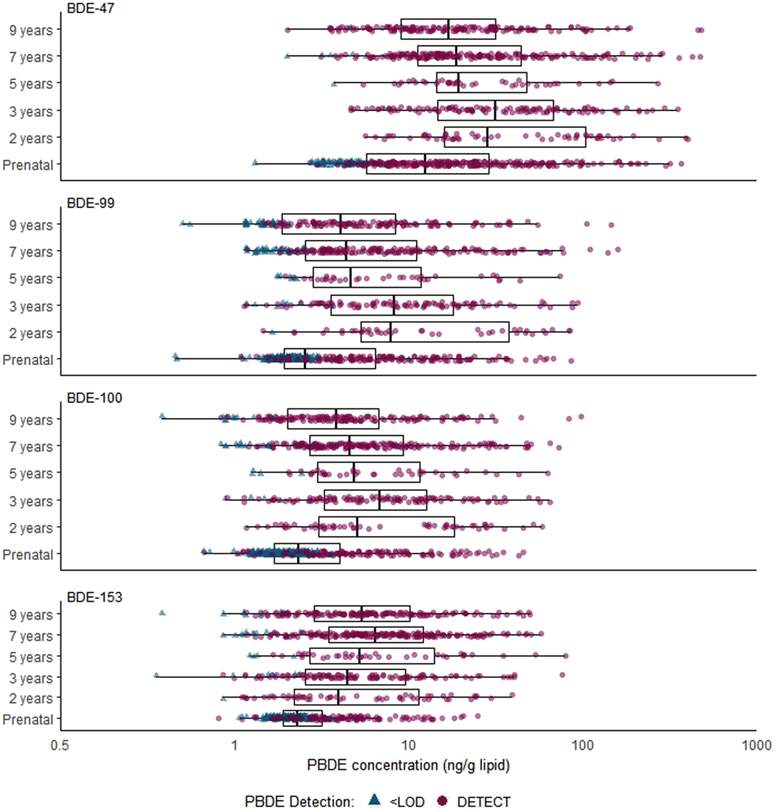
We examined prenatal (cord) and childhood (ages 2, 3, 5, 7 and 9 years) plasma PBDE concentrations in relation to memory outcomes assessed between the ages of 9 and 14 years. The study sample includes a subset (n = 212) of the African American and Dominican children enrolled in the Columbia Center for Children's Environmental Health Mothers and Newborns birth cohort. We used multivariable linear regression to examine associations between continuous log-transformed PBDE concentrations and performance on tests of visual, verbal and working memory in age-stratified models. We additionally used latent class growth analysis to estimate trajectories of exposure across early life, which we analyzed as a categorical variable in relation to memory outcomes. We examined interactions between PBDE exposure and sex using cross-product terms.
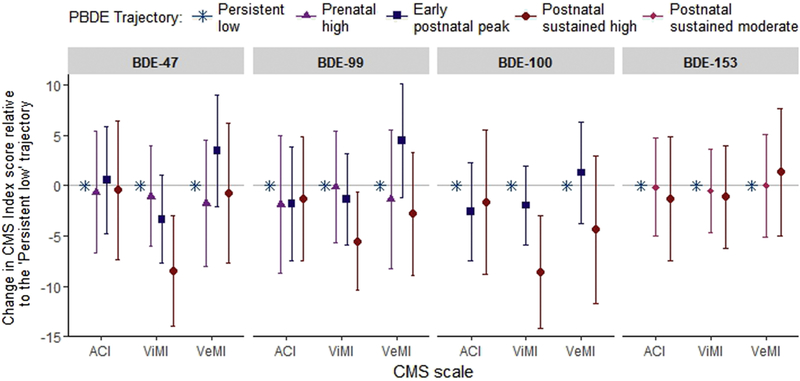
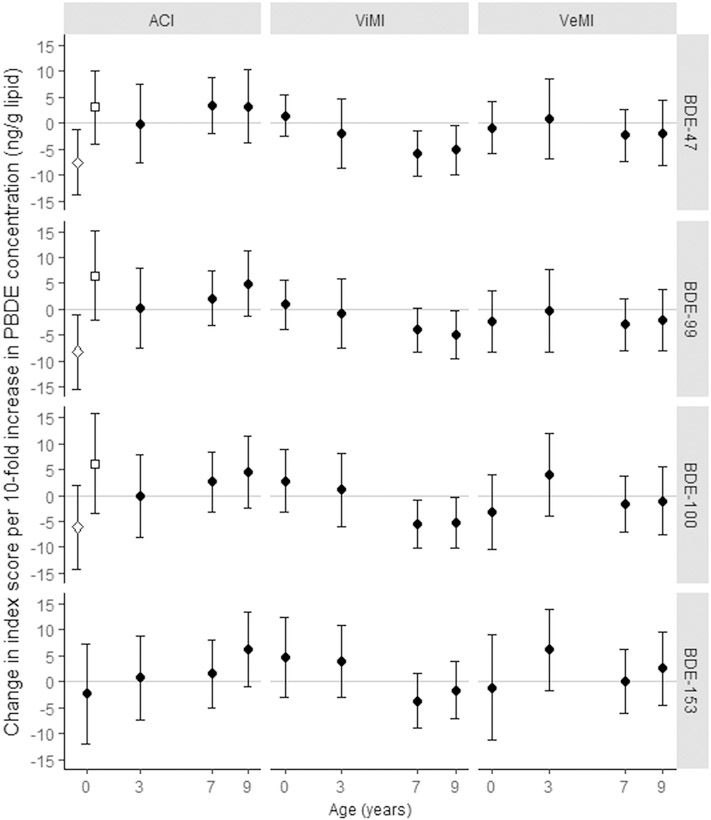
Associations between prenatal exposure and working memory significantly varied by sex (p-interaction = 0.02), with inverse relations observed only among girls (i.e. β = -7.55, 95% CI: -13.84, -1.24). Children with sustained high concentrations of BDEs-47, 99 or 100 across childhood scored approximately 5-8 standard score points lower on tests of visual memory. Children with PBDE plasma concentrations that peaked during toddler years performed better on verbal domains, however, these associations were not statistically significant.
Exposure to PBDEs during both prenatal and postnatal periods may disrupt memory domains in early adolescence. These findings contribute to a substantial body of evidence supporting the developmental neurotoxicity of PBDEs and underscore the need to reduce exposure among pregnant women and children.
产前和儿童时期接触多溴二苯醚(PBDE)阻燃剂与认知表现呈负相关,但很少有研究测量过产前和产后期间采集的样本中的 PBDE 浓度。
我们研究了与 9 至 14 岁期间评估的记忆结果相关的产前(脐带血)和儿童时期(2、3、5、7 和 9 岁)血浆 PBDE 浓度。该研究样本包括哥伦比亚儿童环境健康中心母亲和新生儿出生队列中入组的非裔美国儿童和多米尼加儿童的一个亚组(n=212)。我们使用多变量线性回归来研究连续对数转换的 PBDE 浓度与年龄分层模型中视觉、言语和工作记忆测试表现之间的关联。我们还使用潜在类别增长分析来估计整个生命早期的暴露轨迹,我们将其作为一个分类变量进行分析,与记忆结果相关。我们使用交叉乘积项来检查 PBDE 暴露与性别的相互作用。
产前暴露与工作记忆之间的关联因性别而异(p 交互=0.02),仅在女孩中观察到负相关(即 β=-7.55,95%CI:-13.84,-1.24)。儿童在整个童年时期持续高浓度的 BDE-47、99 或 100 时,在视觉记忆测试中的得分约低 5-8 个标准分数点。在幼儿期达到 PBDE 血浆浓度峰值的儿童在言语领域表现更好,但这些关联没有统计学意义。
产前和产后期间接触 PBDEs 可能会破坏青春期早期的记忆领域。这些发现为支持 PBDE 发育神经毒性的大量证据做出了贡献,并强调了减少孕妇和儿童接触 PBDEs 的必要性。