University of Maryland Institute for Bioscience and Biotechnology Research, Rockville, MD 20850, USA.
Department of Cell Biology and Molecular Genetics, University of Maryland, College Park, MD 20742, USA.
Nucleic Acids Res. 2018 Jul 2;46(W1):W396-W401. doi: 10.1093/nar/gky432.
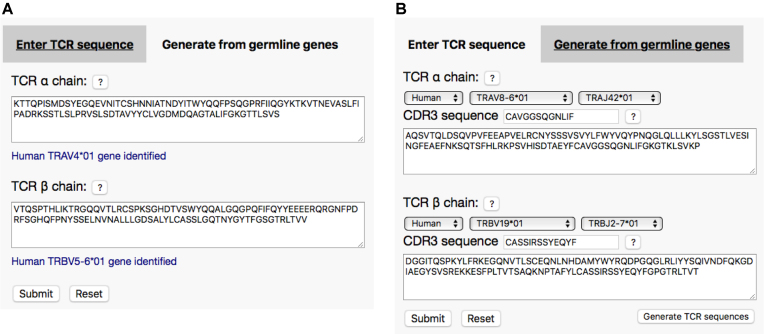
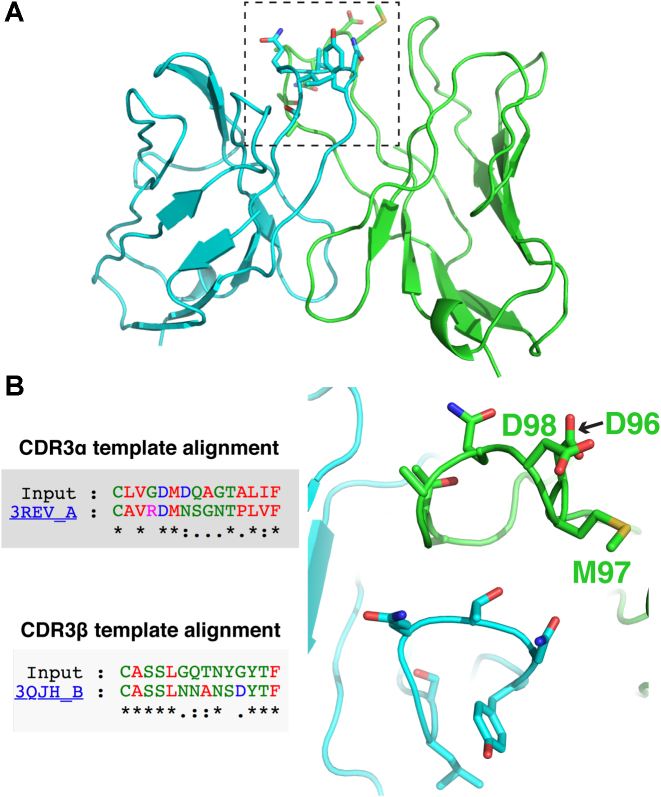
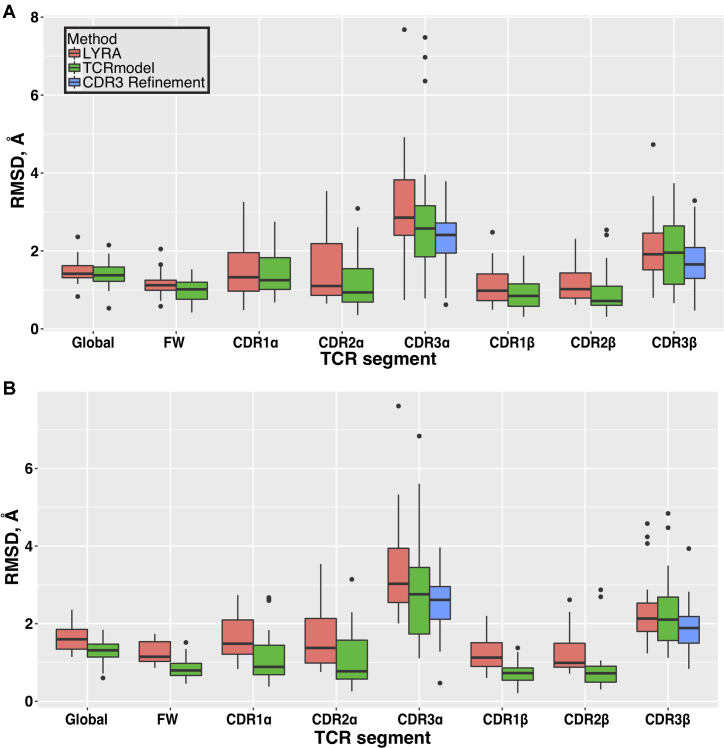
T cell receptors (TCRs), along with antibodies, are responsible for specific antigen recognition in the adaptive immune response, and millions of unique TCRs are estimated to be present in each individual. Understanding the structural basis of TCR targeting has implications in vaccine design, autoimmunity, as well as T cell therapies for cancer. Given advances in deep sequencing leading to immune repertoire-level TCR sequence data, fast and accurate modeling methods are needed to elucidate shared and unique 3D structural features of these molecules which lead to their antigen targeting and cross-reactivity. We developed a new algorithm in the program Rosetta to model TCRs from sequence, and implemented this functionality in a web server, TCRmodel. This web server provides an easy to use interface, and models are generated quickly that users can investigate in the browser and download. Benchmarking of this method using a set of nonredundant recently released TCR crystal structures shows that models are accurate and compare favorably to models from another available modeling method. This server enables the community to obtain insights into TCRs of interest, and can be combined with methods to model and design TCR recognition of antigens. The TCRmodel server is available at: http://tcrmodel.ibbr.umd.edu/.
T 细胞受体 (TCRs) 与抗体一起负责适应性免疫反应中的特定抗原识别,估计每个个体中存在数百万种独特的 TCR。了解 TCR 靶向的结构基础对疫苗设计、自身免疫以及癌症的 T 细胞疗法都有影响。鉴于深度测序的进展导致免疫受体水平 TCR 序列数据的出现,需要快速准确的建模方法来阐明这些分子的共享和独特的 3D 结构特征,这些特征导致它们的抗原靶向和交叉反应。我们在 Rosetta 程序中开发了一种从序列建模 TCR 的新算法,并在一个名为 TCRmodel 的网络服务器中实现了此功能。这个网络服务器提供了一个易于使用的界面,并且可以快速生成模型,用户可以在浏览器中进行调查并下载。使用一组最近发布的 TCR 晶体结构对该方法进行基准测试表明,模型是准确的,并且与另一种可用建模方法的模型相比具有优势。该服务器使社区能够深入了解感兴趣的 TCR,并可以与建模和设计 TCR 识别抗原的方法结合使用。TCRmodel 服务器可在:http://tcrmodel.ibbr.umd.edu/ 获得。