Jinno Shunta, Tachibana Hidenobu, Moriya Shunsuke, Mizuno Norifumi, Takahashi Ryo, Kamima Tatsuya, Ishibashi Satoru, Sato Masanori
Radiological Sciences, Graduate Division of Health Sciences, Komazawa University, Tokyo, Japan.
Particle Therapy Division, Research Center for Innovative Oncology, National Cancer Center Hospital East, Chiba, Japan.
J Radiat Res. 2018 Jul 1;59(4):490-500. doi: 10.1093/jrr/rry039.
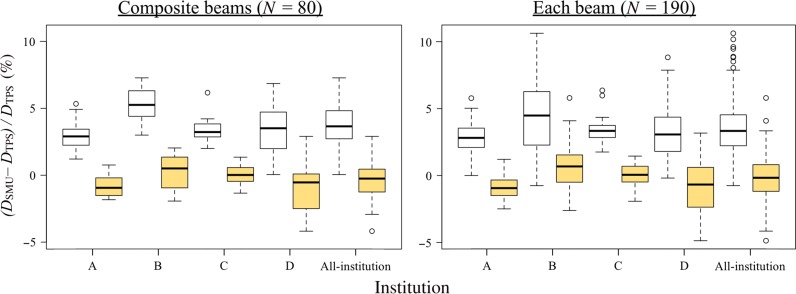
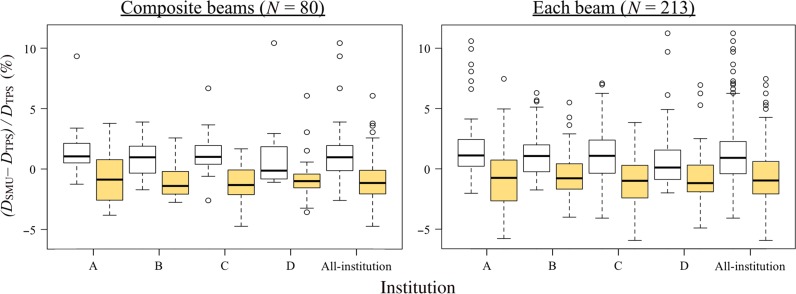
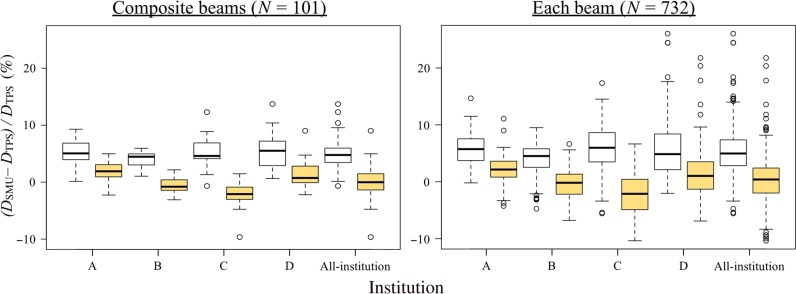
In inhomogeneous media, there is often a large systematic difference in the dose between the conventional Clarkson algorithm (C-Clarkson) for independent calculation verification and the superposition-based algorithms of treatment planning systems (TPSs). These treatment site-dependent differences increase the complexity of the radiotherapy planning secondary check. We developed a simple and effective method of heterogeneity correction integrated with the Clarkson algorithm (L-Clarkson) to account for the effects of heterogeneity in the lateral dimension, and performed a multi-institutional study to evaluate the effectiveness of the method. In the method, a 2D image reconstructed from computed tomography (CT) images is divided according to lines extending from the reference point to the edge of the multileaf collimator (MLC) or jaw collimator for each pie sector, and the radiological path length (RPL) of each line is calculated on the 2D image to obtain a tissue maximum ratio and phantom scatter factor, allowing the dose to be calculated. A total of 261 plans (1237 beams) for conventional breast and lung treatments and lung stereotactic body radiotherapy were collected from four institutions. Disagreements in dose between the on-site TPSs and a verification program using the C-Clarkson and L-Clarkson algorithms were compared. Systematic differences with the L-Clarkson method were within 1% for all sites, while the C-Clarkson method resulted in systematic differences of 1-5%. The L-Clarkson method showed smaller variations. This heterogeneity correction integrated with the Clarkson algorithm would provide a simple evaluation within the range of -5% to +5% for a radiotherapy plan secondary check.
在非均匀介质中,用于独立计算验证的传统克拉克森算法(C - Clarkson)与治疗计划系统(TPS)基于叠加的算法之间,剂量往往存在很大的系统差异。这些与治疗部位相关的差异增加了放射治疗计划二次检查的复杂性。我们开发了一种与克拉克森算法相结合的简单有效的不均匀性校正方法(L - Clarkson),以考虑横向维度上不均匀性的影响,并进行了一项多机构研究来评估该方法的有效性。在该方法中,根据从参考点延伸到每个扇形区域的多叶准直器(MLC)或颌式准直器边缘的线,将从计算机断层扫描(CT)图像重建的二维图像进行划分,并在二维图像上计算每条线的放射路径长度(RPL),以获得组织最大比和体模散射因子,从而计算剂量。从四个机构收集了总共261个常规乳腺和肺部治疗以及肺部立体定向体部放射治疗的计划(1237束射线)。比较了现场TPS与使用C - Clarkson和L - Clarkson算法的验证程序之间的剂量差异。L - Clarkson方法在所有部位的系统差异均在1%以内,而C - Clarkson方法导致的系统差异为1% - 5%。L - Clarkson方法显示出较小的变化。这种与克拉克森算法相结合的不均匀性校正方法可为放射治疗计划二次检查在 - 5%至 + 5%的范围内提供简单评估。