Division of Preparedness and Emerging Infections, National Center of Emerging & Zoonotic Diseases, CDC, Atlanta, Georgia, United States of America.
Poxvirus And Rabies Branch, Division of High-Consequence Pathogens and Pathology National Center of Emerging & Zoonotic Diseases, CDC, Atlanta, Georgia, United States of America.
PLoS Negl Trop Dis. 2018 May 23;12(5):e0006490. doi: 10.1371/journal.pntd.0006490. eCollection 2018 May.
Dog rabies annually causes 24,000-70,000 deaths globally. We built a spreadsheet tool, RabiesEcon, to aid public health officials to estimate the cost-effectiveness of dog rabies vaccination programs in East Africa.
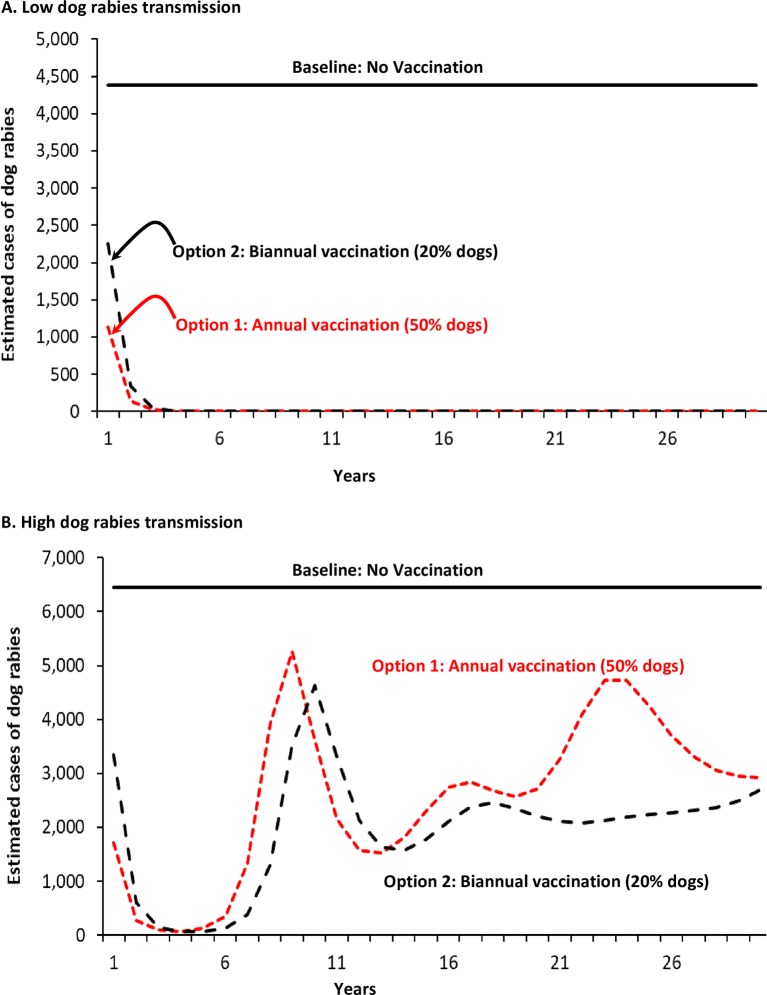
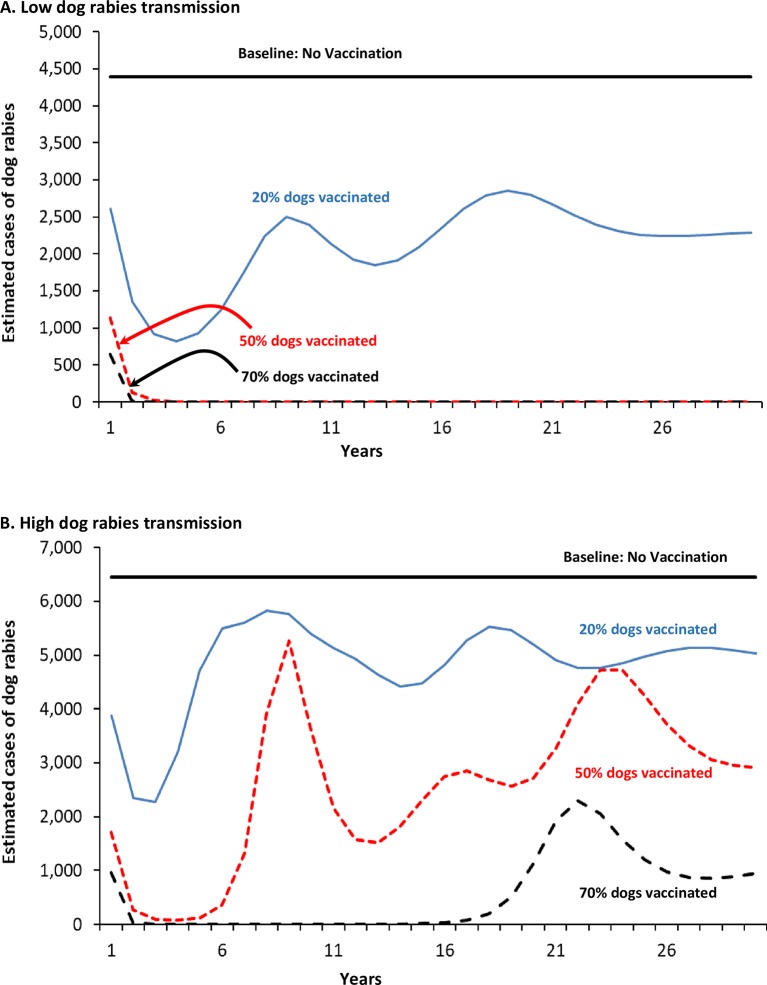
RabiesEcon uses a mathematical model of dog-dog and dog-human rabies transmission to estimate dog rabies cases averted, the cost per human rabies death averted and cost per year of life gained (YLG) due to dog vaccination programs (US 2015 dollars). We used an East African human population of 1 million (approximately 2/3 living in urban setting, 1/3 rural). We considered, using data from the literature, three vaccination options; no vaccination, annual vaccination of 50% of dogs and 20% of dogs vaccinated semi-annually. We assessed 2 transmission scenarios: low (1.2 dogs infected per infectious dog) and high (1.7 dogs infected). We also examined the impact of annually vaccinating 70% of all dogs (World Health Organization recommendation for dog rabies elimination).
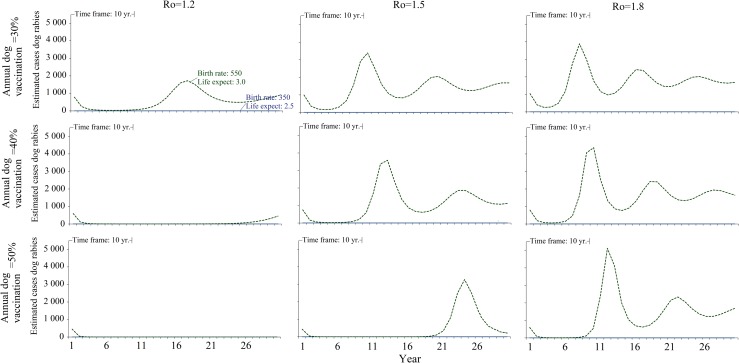
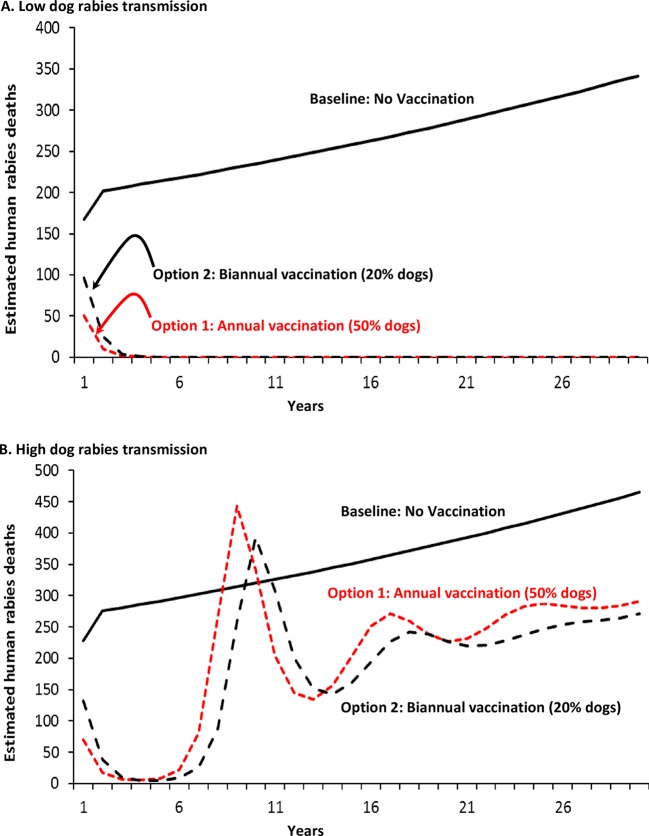
Without dog vaccination, over 10 years there would a total of be approximately 44,000-65,000 rabid dogs and 2,100-2,900 human deaths. Annually vaccinating 50% of dogs results in 10-year reductions of 97% and 75% in rabid dogs (low and high transmissions scenarios, respectively), approximately 2,000-1,600 human deaths averted, and an undiscounted cost-effectiveness of $451-$385 per life saved. Semi-annual vaccination of 20% of dogs results in in 10-year reductions of 94% and 78% in rabid dogs, and approximately 2,000-1,900 human deaths averted, and cost $404-$305 per life saved. In the low transmission scenario, vaccinating either 50% or 70% of dogs eliminated dog rabies. Results were most sensitive to dog birth rate and the initial rate of dog-to-dog transmission (Ro).
Dog rabies vaccination programs can control, and potentially eliminate, dog rabies. The frequency and coverage of vaccination programs, along with the level of dog rabies transmission, can affect the cost-effectiveness of such programs. RabiesEcon can aid both the planning and assessment of dog rabies vaccination programs.
狗狂犬病每年在全球导致 24000-70000 人死亡。我们开发了一个名为 RabiesEcon 的电子表格工具,以帮助公共卫生官员估计东非地区狗狂犬病疫苗接种计划的成本效益。
RabiesEcon 使用狗-狗和狗-人狂犬病传播的数学模型来估计因狗狂犬病疫苗接种而避免的狂犬病病例数、每避免一例人狂犬病死亡的成本以及因狗狂犬病疫苗接种而获得的每年生命年数(2015 年美国美元)。我们使用了 100 万东非人(约三分之二居住在城市地区,三分之一居住在农村地区)的人口数据。我们考虑了三种疫苗接种方案,即不接种疫苗、每年接种 50%的狗和每年接种 20%的半接种疫苗的狗,使用文献中的数据。我们评估了两种传播情景:低(每只感染狗感染 1.2 只狗)和高(每只感染狗感染 1.7 只狗)。我们还研究了每年为所有狗接种 70%的疫苗(世界卫生组织消除狗狂犬病的建议)的影响。
如果不进行狗狂犬病疫苗接种,在 10 年内,将总共出现约 44000-65000 只狂犬病狗和 2100-2900 人死亡。每年接种 50%的狗可使狂犬病狗的 10 年减少 97%和 75%(低和高传播情景分别),大约可避免 2000-1600 人死亡,每挽救一条生命的成本效益为 451-385 美元。每年接种 20%的半接种疫苗可使狂犬病狗的 10 年减少 94%和 78%,大约可避免 2000-1900 人死亡,每挽救一条生命的成本效益为 404-305 美元。在低传播情景下,接种 50%或 70%的狗都可以消除狗狂犬病。结果对狗的出生率和狗-狗传播的初始率(Ro)最为敏感。
狗狂犬病疫苗接种计划可以控制并有可能消除狗狂犬病。疫苗接种的频率和覆盖范围以及狗狂犬病传播的程度都会影响此类计划的成本效益。RabiesEcon 可以帮助规划和评估狗狂犬病疫苗接种计划。