Biophysics Group, Department of Physics, Faculty of Science, Mahidol University, Bangkok, Thailand.
Songkhla Provincial Livestock Office, Muang, Songkhla, Thailand.
PLoS Negl Trop Dis. 2022 May 10;16(5):e0010397. doi: 10.1371/journal.pntd.0010397. eCollection 2022 May.
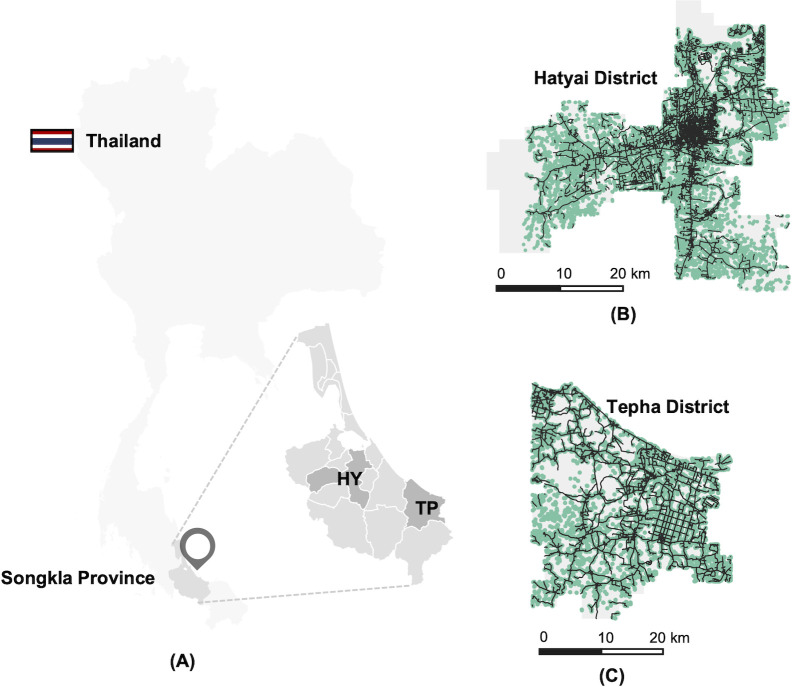
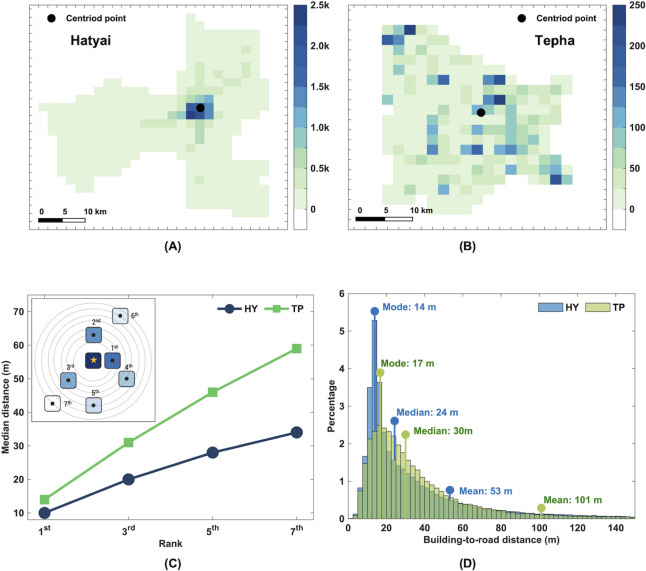
Rabies is a fatal disease that has been a serious health concern, especially in developing countries. Although rabies is preventable by vaccination, the spread still occurs sporadically in many countries, including Thailand. Geographical structures, habitats, and behaviors of host populations are essential factors that may result in an enormous impact on the mechanism of propagation and persistence of the disease. To investigate the role of geographical structures on the transmission dynamics of canine rabies, we developed a stochastic individual-based model that integrates the exact configuration of buildings and roads. In our model, the spatial distribution of dogs was estimated based on the distribution of buildings, with roads considered to facilitate dog movement. Two contrasting areas with high- and low-risk of rabies transmission in Thailand, namely, Hatyai and Tepha districts, were chosen as study sites. Our modeling results indicated that the distinct geographical structures of buildings and roads in Hatyai and Tepha could contribute to the difference in the rabies transmission dynamics in these two areas. The high density of buildings and roads in Hatyai could facilitate more rabies transmission. We also investigated the impacts of rabies intervention, including reducing the dog population, restricting owned dog movement, and dog vaccination on the spread of canine rabies in these two areas. We found that reducing the dog population alone might not be sufficient for preventing rabies transmission in the high-risk area. Owned dog confinement could reduce more the likelihood of rabies transmission. Finally, a higher vaccination coverage may be required for controlling rabies transmission in the high-risk area compared to the low-risk area.
狂犬病是一种致命疾病,一直是严重的健康问题,尤其是在发展中国家。虽然狂犬病可以通过疫苗接种来预防,但在许多国家,包括泰国,仍然会零星发生传播。地理结构、宿主种群的栖息地和行为是导致疾病传播和持续存在的巨大影响的重要因素。为了研究地理结构对犬狂犬病传播动力学的影响,我们开发了一个随机的基于个体的模型,该模型整合了建筑物和道路的确切布局。在我们的模型中,根据建筑物的分布来估计狗的空间分布,而道路被认为可以促进狗的移动。我们选择了泰国两个具有高和低狂犬病传播风险的对比地区,即合艾和帖帕地区作为研究地点。我们的建模结果表明,合艾和帖帕地区建筑物和道路的明显地理结构可能导致这两个地区狂犬病传播动力学的差异。合艾地区高密度的建筑物和道路可以促进更多的狂犬病传播。我们还研究了狂犬病干预措施的影响,包括减少狗的数量、限制家养狗的活动范围和给狗接种疫苗,以控制这两个地区的犬狂犬病传播。我们发现,仅减少狗的数量可能不足以预防高风险地区的狂犬病传播。限制家养狗的活动范围可能会减少狂犬病传播的可能性。最后,与低风险地区相比,高风险地区可能需要更高的疫苗接种覆盖率来控制狂犬病的传播。