Arêas G P T, Caruso F C R, Simões R P, Castello-Simões V, Jaenisch R B, Sato T O, Cabiddu R, Mendes R, Arena R, Borghi-Silva A
Departamento de Ciências Fisiológicas, Instituto de Ciências Biológicas, Universidade Federal do Amazonas, Manaus, AM, Brasil.
Departamento de Fisioterapia, Pós Graduação em Fisioterapia, Universidade Federal de São Carlos, São Carlos, SP, Brasil.
Braz J Med Biol Res. 2018;51(6):e6962. doi: 10.1590/1414-431x20186962. Epub 2018 May 21.
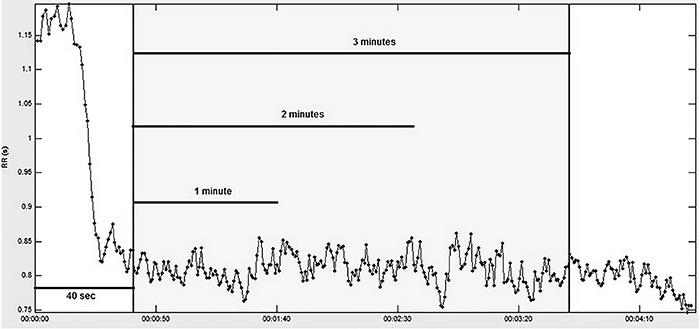
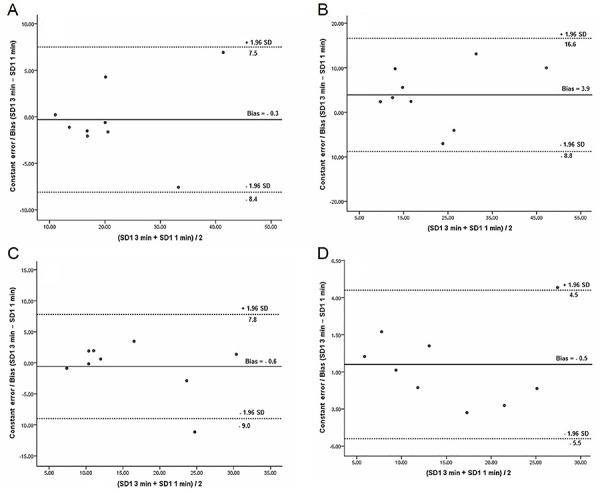
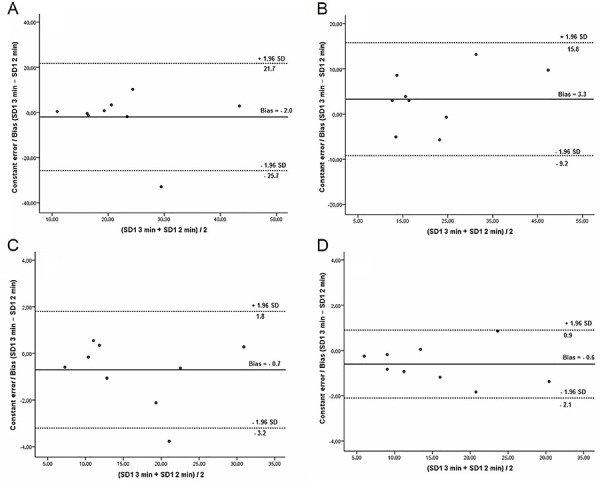
Despite the appeal of ultra-short-term heart rate variability (HRV) methods of analysis applied in the clinical and research settings, the number of studies that have investigated HRV by analyzing R-R interval (RRi) recordings shorter than 5 min is still limited. Moreover, ultra-short-term HRV analysis has not been extensively validated during exercise and, currently, no indications exist for its applicability during resistance exercise. The aim of the present study was to compare ultra-short-term HRV analysis with standard short-term HRV analysis during low-intensity, dynamic, lower limb resistance exercise in healthy elderly subjects. Heart rate (HR) and RRi signals were collected from 9 healthy elderly men during discontinuous incremental resistance exercise consisting of 4-min intervals at low intensities (10, 20, 30, and 35% of 1-repetition maximum). The original RRi signals were segmented into 1-, 2-, and 3-min sections. HRV was analyzed in the time domain (root mean square of the of differences between adjacent RRi, divided by the number of RRi, minus one [RMSSD]), RRi mean value and standard deviation [SDNN] (percentage of differences between adjacent NN intervals that are greater than 50 ms [pNN50]), and by non-linear analysis (short-term RRi standard deviation [SD1] and long-term RRi standard deviation [SD2]). No significant difference was found at any exercise intensity between the results of ultra-short-term HRV analysis and the results of standard short-term HRV analysis. Furthermore, we observed excellent (0.70 to 0.89) to near-perfect (0.90 to 1.00) concordance between linear and non-linear parameters calculated over 1- and 2-min signal sections and parameters calculated over 3-min signal sections. Ultra-short-term HRV analysis appears to be a reliable surrogate of standard short-term HRV analysis during resistance exercise in healthy elderly subjects.
尽管超短期心率变异性(HRV)分析方法在临床和研究环境中颇具吸引力,但通过分析短于5分钟的R-R间期(RRi)记录来研究HRV的研究数量仍然有限。此外,超短期HRV分析在运动期间尚未得到广泛验证,目前也没有其在抗阻运动期间适用性的相关指征。本研究的目的是在健康老年受试者进行低强度、动态、下肢抗阻运动期间,将超短期HRV分析与标准短期HRV分析进行比较。在由低强度(1次重复最大值的10%、20%、30%和35%)的4分钟间隔组成的不连续递增抗阻运动期间,从9名健康老年男性收集心率(HR)和RRi信号。将原始RRi信号分割为1分钟、2分钟和3分钟的片段。在时域中分析HRV(相邻RRi之间差值的均方根,除以RRi数量减1 [RMSSD])、RRi平均值和标准差 [SDNN](相邻NN间期差值大于50毫秒的百分比 [pNN50]),并通过非线性分析(短期RRi标准差 [SD1] 和长期RRi标准差 [SD2])进行分析。在任何运动强度下,超短期HRV分析结果与标准短期HRV分析结果之间均未发现显著差异。此外,我们观察到在1分钟和2分钟信号片段上计算的线性和非线性参数与在3分钟信号片段上计算的参数之间具有极佳(0.70至0.89)至近乎完美(0.90至1.00)的一致性。在健康老年受试者的抗阻运动期间,超短期HRV分析似乎是标准短期HRV分析的可靠替代方法。