Luvizutto Gustavo José, Moliga Augusta Fabiana, Rizzatti Gabriela Rizzo Soares, Fogaroli Marcelo Ortolani, Moura Neto Eduardo de, Nunes Hélio Rubens de Carvalho, Resende Luiz Antônio de Lima, Bazan Rodrigo
Departamento de Fisioterapia Aplicada, Universidade Federal do Triangulo Mineiro (UFTM), Uberaba, MG, BR.
Departamento de Reabilitacao, Faculdade de Medicina de Botucatu (UNESP), Botucatu, SP, BR.
Clinics (Sao Paulo). 2018 May 21;73:e131. doi: 10.6061/clinics/2018/e131.
The aim of this study was to assess the relationship between the degree of unilateral spatial neglect during the acute phase of stroke and long-term functional independence.
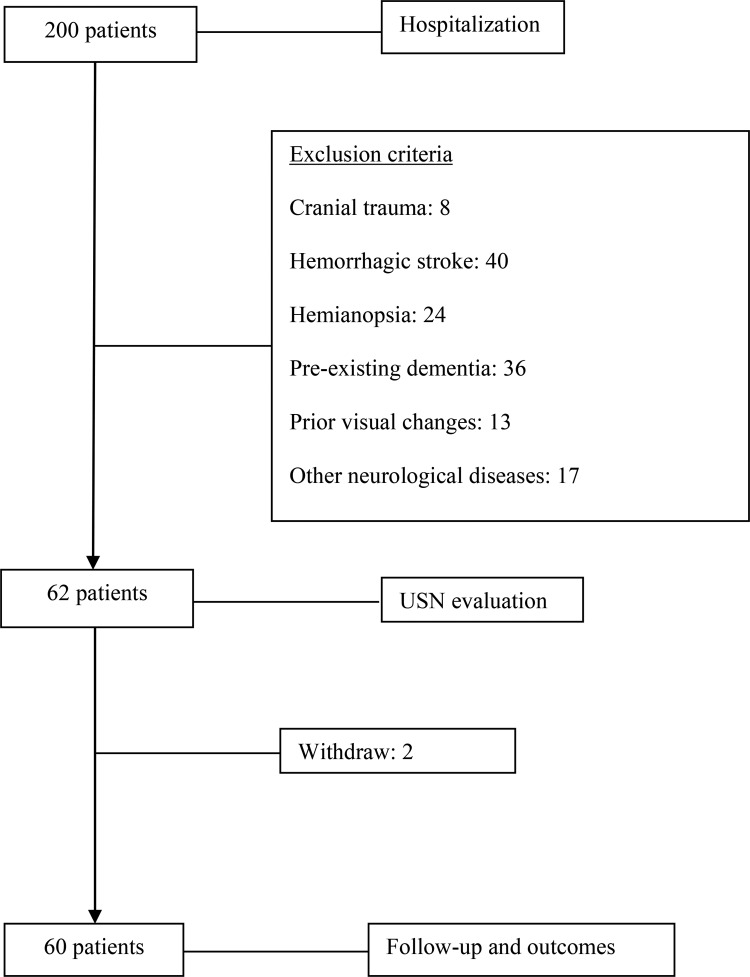
This was a prospective study of right ischemic stroke patients in which the independent variable was the degree of spatial neglect and the outcome that was measured was functional independence. The potential confounding factors included sex, age, stroke severity, topography of the lesion, risk factors, glycemia and the treatment received. Unilateral spatial neglect was measured using the line cancellation test, the star cancellation test and the line bisection test within 48 hours of the onset of symptoms. Functional independence was measured using the modified Rankin and Barthel scales at 90 days after discharge. The relationship between unilateral spatial neglect and functional independence was analyzed using multiple logistic regression that was corrected for confounding factors.
We studied 60 patients with a median age of 68 (34-89) years, 52% of whom were male and 74% of whom were Caucasian. The risk for moderate to severe disability increased with increasing star cancellation test scores (OR=1.14 [1.03-1.26], p=0.01) corrected for the stroke severity, which was a confounding factor that had a statistically positive association with disability (OR=1.63 [1.13-2.65], p=0.01). The best chance of functional independence decreased with increasing star cancellation test scores (OR=0.86 [0.78-0.96], p=0.006) corrected for the stroke severity, which was a confounding factor that had a statistically negative association with independence (OR=0.66 [0.48-0.92], p=0.017).
The severity of unilateral spatial neglect in acute stroke worsens the degree of long-term disability and functional independence.
本研究旨在评估脑卒中急性期单侧空间忽视程度与长期功能独立性之间的关系。
这是一项针对右半球缺血性脑卒中患者的前瞻性研究,其中自变量为空间忽视程度,所测量的结果为功能独立性。潜在的混杂因素包括性别、年龄、脑卒中严重程度、病变部位、危险因素、血糖水平以及所接受的治疗。在症状发作后48小时内,使用线段划消试验、星形划消试验和直线二等分试验测量单侧空间忽视。在出院后90天,使用改良Rankin量表和Barthel指数测量功能独立性。使用经混杂因素校正的多重逻辑回归分析单侧空间忽视与功能独立性之间的关系。
我们研究了60例患者,中位年龄为68(34 - 89)岁,其中52%为男性,74%为白种人。在校正作为与残疾具有统计学正相关的混杂因素的脑卒中严重程度后,中度至重度残疾的风险随着星形划消试验得分的增加而升高(比值比 = 1.14 [1.03 - 1.26],p = 0.01)。在校正作为与独立性具有统计学负相关的混杂因素的脑卒中严重程度后,功能独立的最佳机会随着星形划消试验得分的增加而降低(比值比 = 0.86 [0.78 - 0.96],p = 0.006)。
急性脑卒中单侧空间忽视的严重程度会加重长期残疾程度并影响功能独立性。