Department of Public Health and Caring Sciences/Geriatrics, Uppsala University, Rudbeck Laboratory, Dag Hammarskjölds väg 20, 75185, Uppsala, Sweden.
Department of Pharmaceutical biosciences, Uppsala University, Uppsala, Sweden.
Alzheimers Res Ther. 2018 May 24;10(1):49. doi: 10.1186/s13195-018-0377-8.
Amyloid-β (Aβ) immunotherapy is one of the most promising disease-modifying strategies for Alzheimer's disease (AD). Despite recent progress targeting aggregated forms of Aβ, low antibody brain penetrance remains a challenge. In the present study, we used transferrin receptor (TfR)-mediated transcytosis to facilitate brain uptake of our previously developed Aβ protofibril-selective mAb158, with the aim of increasing the efficacy of immunotherapy directed toward soluble Aβ protofibrils.
Aβ protein precursor (AβPP)-transgenic mice (tg-ArcSwe) were given a single dose of mAb158, modified for TfR-mediated transcytosis (RmAb158-scFv8D3), in comparison with an equimolar dose or a tenfold higher dose of unmodified recombinant mAb158 (RmAb158). Soluble Aβ protofibrils and total Aβ in the brain were measured by enzyme-linked immunosorbent assay (ELISA). Brain distribution of radiolabeled antibodies was visualized by positron emission tomography (PET) and ex vivo autoradiography.
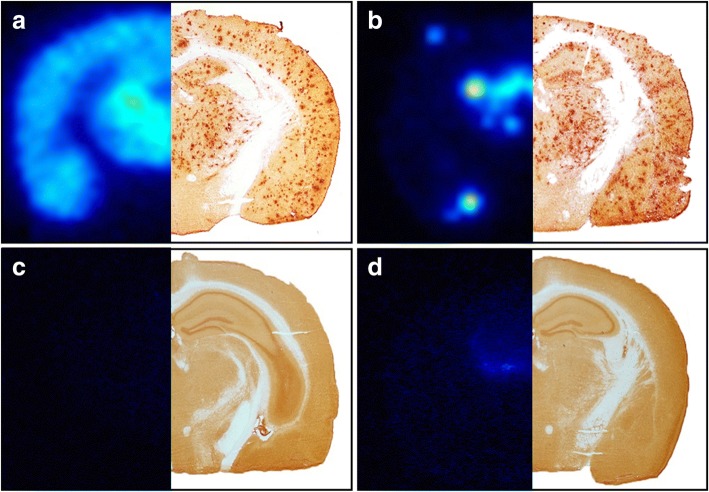
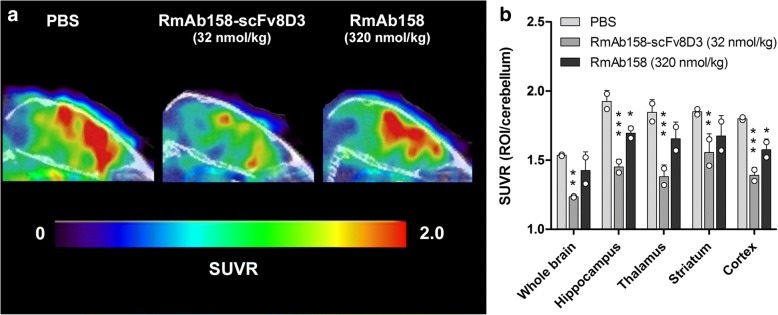
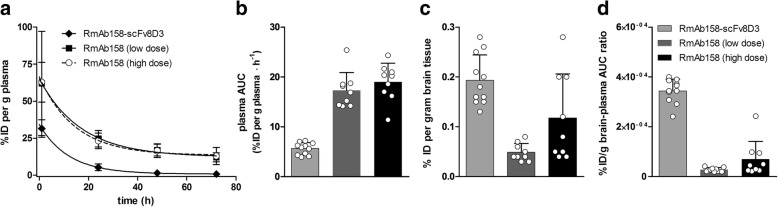
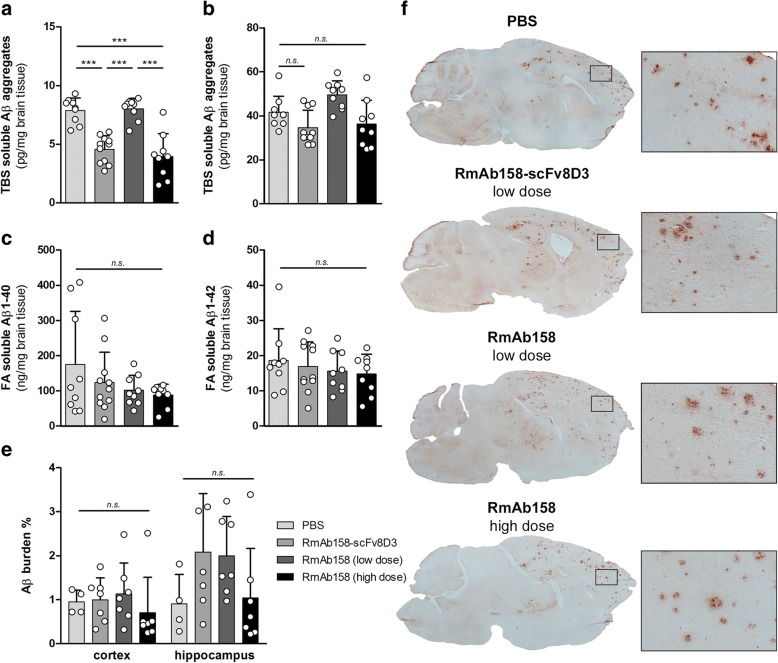
ELISA analysis of Tris-buffered saline brain extracts demonstrated a 40% reduction of soluble Aβ protofibrils in both RmAb158-scFv8D3- and high-dose RmAb158-treated mice, whereas there was no Aβ protofibril reduction in mice treated with a low dose of RmAb158. Further, ex vivo autoradiography and PET imaging revealed different brain distribution patterns of RmAb158-scFv8D3 and RmAb158, suggesting that these antibodies may affect Aβ levels by different mechanisms.
With a combination of biochemical and imaging analyses, this study demonstrates that antibodies engineered to be transported across the blood-brain barrier can be used to increase the efficacy of Aβ immunotherapy. This strategy may allow for decreased antibody doses and thereby reduced side effects and treatment costs.
淀粉样蛋白-β(Aβ)免疫疗法是治疗阿尔茨海默病(AD)最有前途的疾病修饰策略之一。尽管最近在靶向聚集形式的 Aβ方面取得了进展,但抗体的脑穿透率仍然是一个挑战。在本研究中,我们使用转铁蛋白受体(TfR)介导的转胞吞作用来促进我们之前开发的 Aβ原纤维选择性 mAb158 的脑摄取,目的是提高针对可溶性 Aβ原纤维的免疫疗法的疗效。
用 TfR 介导的转胞吞作用修饰的 mAb158(RmAb158-scFv8D3)与等摩尔剂量或十倍高剂量的未修饰重组 mAb158(RmAb158)相比,给 Aβ蛋白前体(AβPP)转基因小鼠(tg-ArcSwe)单次给药 mAb158。通过酶联免疫吸附试验(ELISA)测量脑内可溶性 Aβ原纤维和总 Aβ。通过正电子发射断层扫描(PET)和离体放射自显影术可视化放射性标记抗体的脑分布。
Tris 缓冲盐水脑提取物的 ELISA 分析表明,RmAb158-scFv8D3 和高剂量 RmAb158 处理的小鼠脑内可溶性 Aβ原纤维减少了 40%,而低剂量 RmAb158 处理的小鼠脑内 Aβ原纤维没有减少。此外,离体放射自显影术和 PET 成像显示 RmAb158-scFv8D3 和 RmAb158 的脑分布模式不同,表明这些抗体可能通过不同的机制影响 Aβ 水平。
通过生化和成像分析相结合,本研究表明,工程化以穿过血脑屏障的抗体可用于增加 Aβ 免疫疗法的疗效。这种策略可能允许减少抗体剂量,从而降低副作用和治疗成本。