Department of Medicine, College of Medicine, Seoul National University, 103 Daehakro, Jongnogu, Seoul 03080, Korea.
Department of Preventive Medicine, College of Medicine, Seoul National University, 103 Daehakro, Jongnogu, Seoul 03080, Korea.
Int J Environ Res Public Health. 2018 May 24;15(6):1070. doi: 10.3390/ijerph15061070.
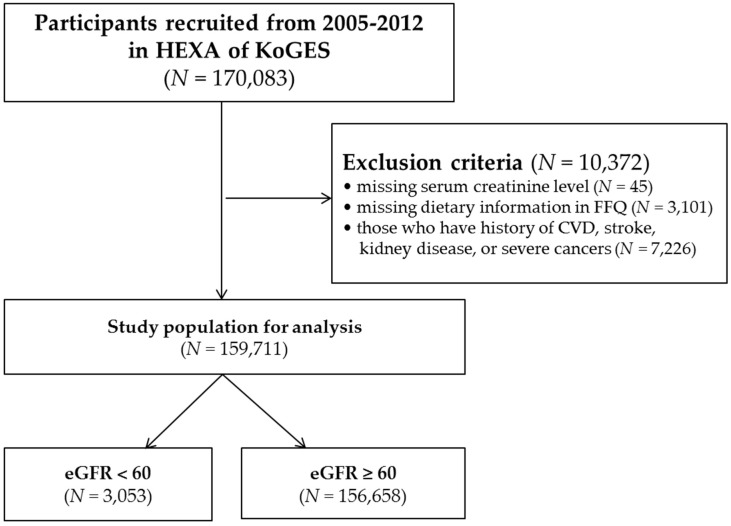
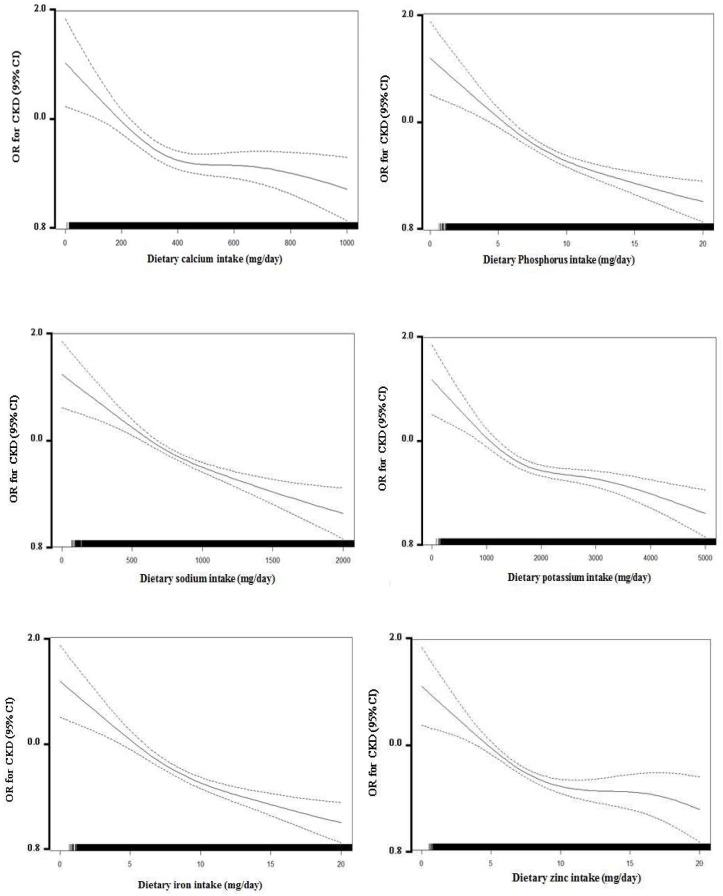
Few studies have explored the association between mineral intake and chronic kidney disease (CKD). A cross-sectional analysis investigated the association between mineral intake (calcium, phosphorus, sodium, potassium, iron, and zinc) and CKD using the Health Examinee (HEXA) cohort of the Korean Genome and Epidemiologic Study (KoGES). For 159,711 participants, mineral intake was assessed by a food frequency questionnaire. CKD was defined as an estimated glomerular filtration rate (eGFR) of less than 60 mL/min/1.73 m². Dietary intake of each mineral was divided into quartiles and the quartile including recommended dietary allowance (RDA) or adequate intake (AI) of each mineral was used as a reference. We assessed the association between the quartile of mineral intakes and CKD using polytomous logistic regression models. The lowest quartiles of phosphorus (≤663.68 mg/day, odds ratio [OR] = 1.64, 95% confidence interval [CI]: 1.25⁻2.15), potassium (≤1567.53 mg/day, OR = 1.87, 95% CI: 1.27⁻2.75), iron (≤6.93 mg/day, OR = 1.53, 95% CI: 1.17⁻2.01), and zinc (≤5.86 mg/day, OR = 1.52, 95% CI: 1.02⁻2.26) were associated with higher odds for advanced CKD compared with the references. The present study suggests that an inadequate intake of some minerals may be associated with CKD occurrence in the general population. Due to the reverse causation issue in this cross-sectional study design, further longitudinal prospective studies are needed in order to prove the results.
很少有研究探讨矿物质摄入与慢性肾脏病(CKD)之间的关系。一项横断面分析使用韩国基因组和流行病学研究(KoGES)的健康受检者(HEXA)队列,研究了矿物质摄入(钙、磷、钠、钾、铁和锌)与 CKD 之间的关系。对于 159711 名参与者,通过食物频率问卷评估矿物质摄入。CKD 的定义为估计肾小球滤过率(eGFR)<60 mL/min/1.73 m²。每种矿物质的膳食摄入量分为四分位组,将包括每种矿物质推荐膳食允许量(RDA)或适宜摄入量(AI)的四分位组作为参考。我们使用多项式逻辑回归模型评估矿物质摄入量四分位组与 CKD 之间的关系。磷的最低四分位数(≤663.68 mg/天,比值比[OR] = 1.64,95%置信区间[CI]:1.25⁻2.15)、钾(≤1567.53 mg/天,OR = 1.87,95% CI:1.27⁻2.75)、铁(≤6.93 mg/天,OR = 1.53,95% CI:1.17⁻2.01)和锌(≤5.86 mg/天,OR = 1.52,95% CI:1.02⁻2.26)与高级 CKD 的几率较高相关。本研究表明,某些矿物质摄入不足可能与普通人群 CKD 的发生有关。由于该横断面研究设计存在反向因果关系问题,因此需要进一步的纵向前瞻性研究来证明结果。