Department of Chemistry, Technische Universität München, Lichtenbergstrasse 4, Garching, 85748, Germany.
Institute for Advanced Study, Technische Universität München, Lichtenbergstrasse 2a, Garching, 85748, Germany.
Nat Commun. 2018 May 23;9(1):2044. doi: 10.1038/s41467-018-04488-y.
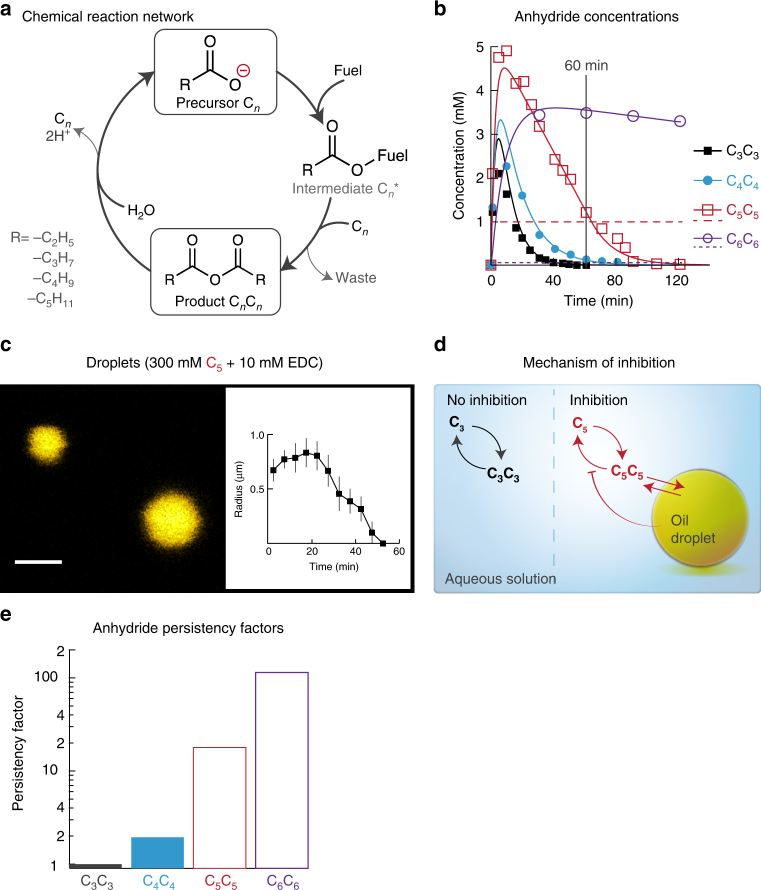
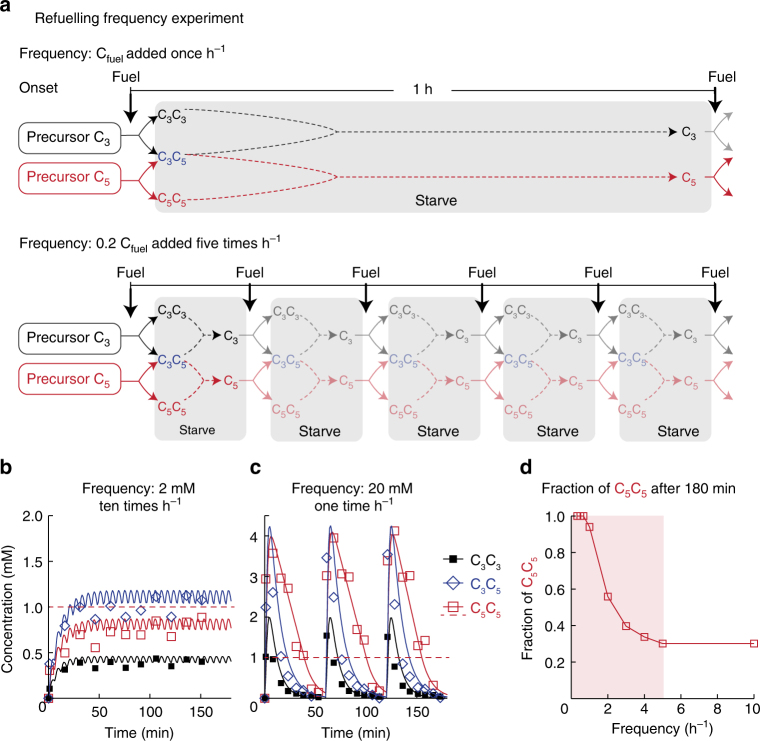
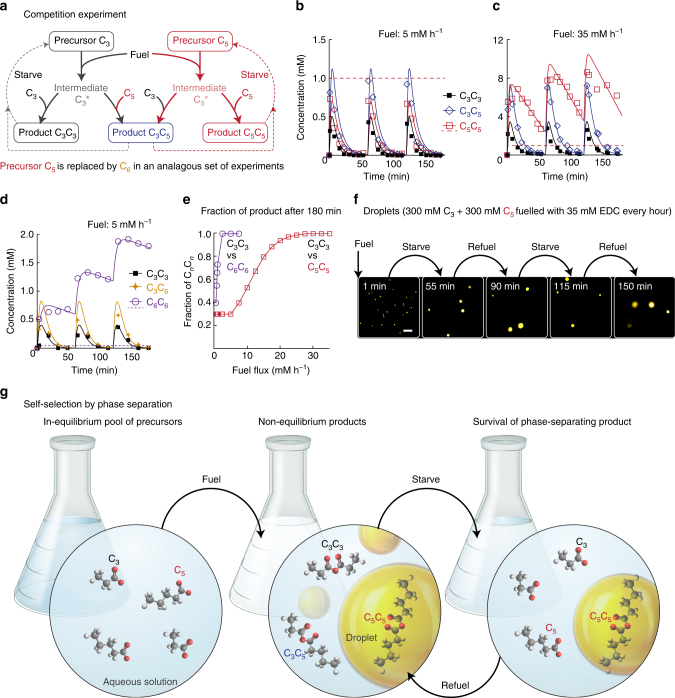
Life is a dissipative nonequilibrium structure that requires constant consumption of energy to sustain itself. How such an unstable state could have selected from an abiotic pool of molecules remains a mystery. Here we show that liquid phase-separation offers a mechanism for the selection of dissipative products from a library of reacting molecules. We bring a set of primitive carboxylic acids out-of-equilibrium by addition of high-energy condensing agents. The resulting anhydrides are transiently present before deactivation via hydrolysis. We find the anhydrides that phase-separate into droplets to protect themselves from hydrolysis and to be more persistent than non-assembling ones. Thus, after several starvation-refueling cycles, the library self-selects the phase-separating anhydrides. We observe that the self-selection mechanism is more effective when the library is brought out-of-equilibrium by periodic addition of batches as opposed to feeding it continuously. Our results suggest that phase-separation offers a selection mechanism for energy dissipating assemblies.
生命是一种耗散的非平衡结构,需要不断消耗能量来维持自身。这种不稳定的状态是如何从无生命的分子混合物中选择出来的,仍然是一个谜。在这里,我们表明液-液相分离为从反应分子库中选择耗散产物提供了一种机制。我们通过添加高能缩合剂使一组原始羧酸处于非平衡状态。在通过水解失活之前,生成的酸酐是短暂存在的。我们发现相分离成液滴的酸酐可以保护自己免受水解,并比非组装的酸酐更持久。因此,经过几次饥饿-加油循环,文库会自我选择相分离的酸酐。我们观察到,当通过周期性分批添加而不是连续进料使文库处于非平衡状态时,自我选择机制更为有效。我们的结果表明,液-液相分离为耗散组装体提供了一种选择机制。