Faculty of Veterinary Medicine, Université de Montréal, Saint-Hyacinthe, Québec, Canada.
PLoS One. 2018 May 24;13(5):e0197882. doi: 10.1371/journal.pone.0197882. eCollection 2018.
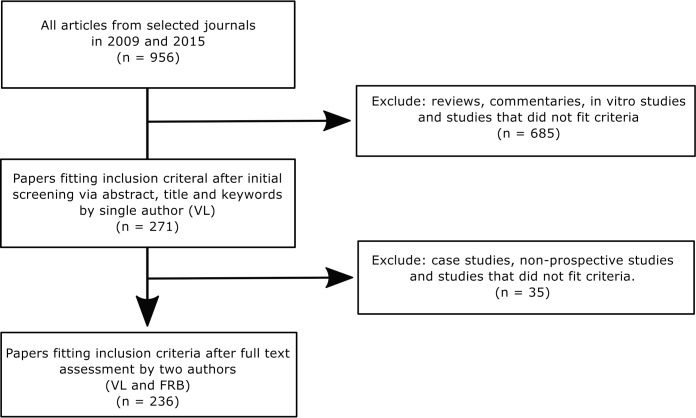
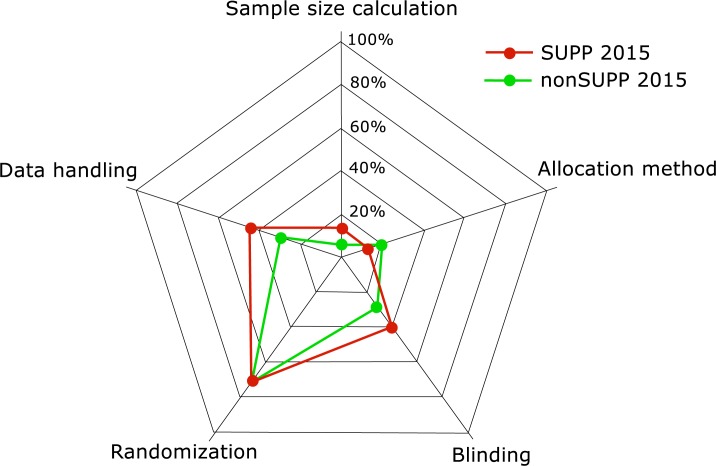
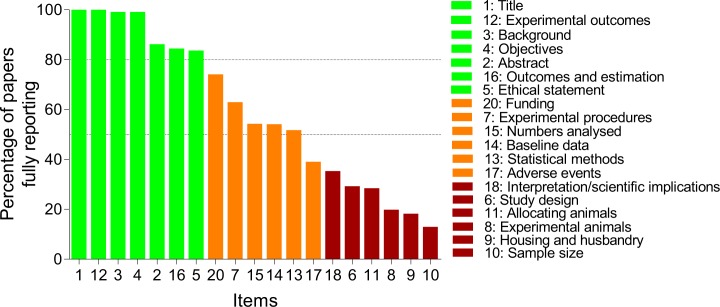
Poor research reporting is a major contributing factor to low study reproducibility, financial and animal waste. The ARRIVE (Animal Research: Reporting of In Vivo Experiments) guidelines were developed to improve reporting quality and many journals support these guidelines. The influence of this support is unknown. We hypothesized that papers published in journals supporting the ARRIVE guidelines would show improved reporting compared with those in non-supporting journals. In a retrospective, observational cohort study, papers from 5 ARRIVE supporting (SUPP) and 2 non-supporting (nonSUPP) journals, published before (2009) and 5 years after (2015) the ARRIVE guidelines, were selected. Adherence to the ARRIVE checklist of 20 items was independently evaluated by two reviewers and items assessed as fully, partially or not reported. Mean percentages of items reported were compared between journal types and years with an unequal variance t-test. Individual items and sub-items were compared with a chi-square test. From an initial cohort of 956, 236 papers were included: 120 from 2009 (SUPP; n = 52, nonSUPP; n = 68), 116 from 2015 (SUPP; n = 61, nonSUPP; n = 55). The percentage of fully reported items was similar between journal types in 2009 (SUPP: 55.3 ± 11.5% [SD]; nonSUPP: 51.8 ± 9.0%; p = 0.07, 95% CI of mean difference -0.3-7.3%) and 2015 (SUPP: 60.5 ± 11.2%; nonSUPP; 60.2 ± 10.0%; p = 0.89, 95%CI -3.6-4.2%). The small increase in fully reported items between years was similar for both journal types (p = 0.09, 95% CI -0.5-4.3%). No paper fully reported 100% of items on the ARRIVE checklist and measures associated with bias were poorly reported. These results suggest that journal support for the ARRIVE guidelines has not resulted in a meaningful improvement in reporting quality, contributing to ongoing waste in animal research.
研究报告质量差是研究可重复性低、造成资金和动物浪费的一个主要因素。ARRIVE(动物实验报告的综合标准)指南的制定是为了提高报告质量,许多期刊都支持这些指南。目前尚不清楚这种支持的影响。我们假设,在支持 ARRIVE 指南的期刊上发表的论文与在不支持的期刊上发表的论文相比,报告质量会有所提高。本研究采用回顾性观察性队列研究设计,选择了来自 5 本支持(SUPP)和 2 本不支持(nonSUPP)ARRIVE 指南的期刊在指南发布前(2009 年)和发布后 5 年(2015 年)发表的论文。两名评审员独立评估了对 20 项 ARRIVE 清单的依从性,评估项目是否完全、部分或未报告。采用方差不齐 t 检验比较不同期刊类型和年份报告项目的平均百分比。采用卡方检验比较个别项目和子项目。从最初的 956 篇论文中,纳入了 236 篇论文:2009 年的 120 篇(SUPP,n=52;nonSUPP,n=68),2015 年的 116 篇(SUPP,n=61;nonSUPP,n=55)。2009 年,SUPP 期刊和 nonSUPP 期刊完全报告的项目百分比相似(SUPP:55.3±11.5%[标准差];nonSUPP:51.8±9.0%;p=0.07,95%置信区间的均值差为-0.3-7.3%),2015 年也相似(SUPP:60.5±11.2%;nonSUPP:60.2±10.0%;p=0.89,95%置信区间-3.6-4.2%)。两种期刊类型的完全报告项目百分比都有小幅度增加(p=0.09,95%置信区间-0.5-4.3%)。没有一篇论文完全报告了 ARRIVE 清单上的 100%项目,与偏倚相关的措施也报告得很差。这些结果表明,期刊对 ARRIVE 指南的支持并没有显著提高报告质量,导致动物研究中持续存在浪费。