Vergara-Diaz Gloria, Osypiuk Kamila, Hausdorff Jeffrey M, Bonato Paolo, Gow Brian J, Miranda Jose Gv, Sudarsky Lewis R, Tarsy Daniel, Fox Michael D, Gardiner Paula, Thomas Cathi A, Macklin Eric A, Wayne Peter M
Department of Physical Medicine and Rehabilitation, Harvard Medical School, Spaulding Rehabilitation Hospital, Charlestown, Massachusetts.
Osher Center for Integrative Medicine, Harvard Medical School, Brigham and Women's Hospital, Boston, Massachusetts.
Glob Adv Health Med. 2018 May 17;7:2164956118775385. doi: 10.1177/2164956118775385. eCollection 2018.
To assess the feasibility and inform design features of a fully powered randomized controlled trial (RCT) evaluating the effects of Tai Chi (TC) in Parkinson's disease (PD) and to select outcomes most responsive to TC assessed during off-medication states.
Two-arm, wait-list controlled RCT.
Tertiary care hospital.
Thirty-two subjects aged 40-75 diagnosed with idiopathic PD within 10 years.
Six-month TC intervention added to usual care (UC) versus UC alone.
Primary outcomes were feasibility-related (recruitment rate, adherence, and compliance). Change in dual-task (DT) gait stride-time variability (STV) from baseline to 6 months was defined, a priori, as the clinical outcome measure of primary interest. Other outcomes included: PD motor symptom progression (Unified Parkinson's Disease Rating Scale [UPDRS]), PD-related quality of life (PDQ-39), executive function (Trail Making Test), balance confidence (Activity-Specific Balance Confidence Scale, ABC), and Timed Up and Go test (TUG). All clinical assessments were made in the off-state for PD medications.
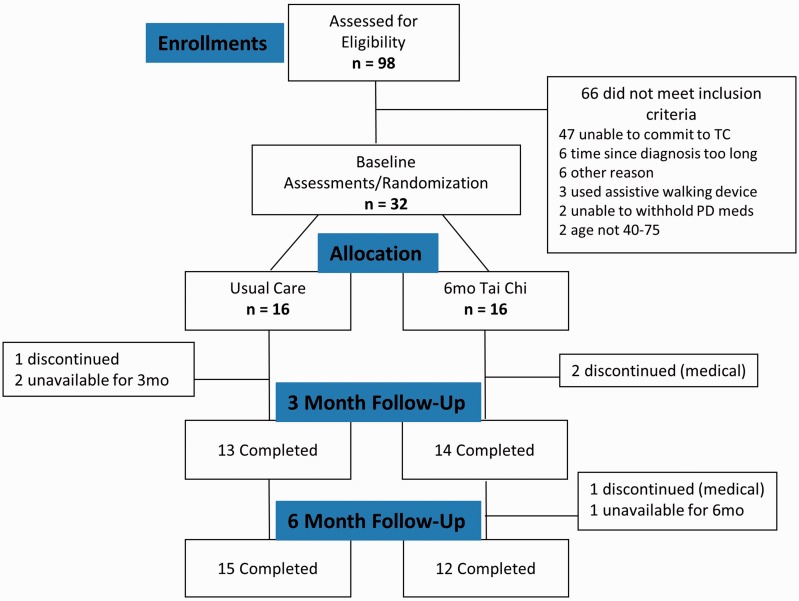
Thirty-two subjects were enrolled into 3 sequential cohorts over 417 days at an average rate of 0.08 subjects per day. Seventy-five percent (12/16) in the TC group vs 94% (15/16) in the UC group completed the primary 6-month follow-up assessment. Mean TC exposure hours overall: 52. No AEs occurred during or as a direct result of TC exercise. Statistically nonsignificant improvements were observed in the TC group at 6 months in DT gait STV (TC [20.1%] vs UC [-0.1%] group [effect size 0.49; = .47]), ABC, TUG, and PDQ-39. UPDRS progression was modest and very similar in TC and UC groups.
Conducting an RCT of TC for PD is feasible, though measures to improve recruitment and adherence rates are needed. DT gait STV is a sensitive and logical outcome for evaluating the combined cognitive-motor effects of TC in PD.
评估一项评估太极拳(TC)对帕金森病(PD)影响的全功率随机对照试验(RCT)的可行性并确定设计特点,同时选择在非服药状态下对TC反应最敏感的结局指标。
双臂、等待列表对照的RCT。
三级护理医院。
32名年龄在40 - 75岁之间、在10年内被诊断为特发性PD的患者。
在常规护理(UC)基础上增加为期6个月的TC干预与单纯UC进行对比。
主要结局指标与可行性相关(招募率、依从性和顺应性)。从基线到6个月时双任务(DT)步态步幅时间变异性(STV)的变化,预先定义为主要关注的临床结局指标。其他结局指标包括:PD运动症状进展(统一帕金森病评定量表[UPDRS])、PD相关生活质量(PDQ - 39)、执行功能(连线测验)、平衡信心(特定活动平衡信心量表,ABC)以及定时起立行走测试(TUG)。所有临床评估均在PD药物的非服药状态下进行。
在417天内,32名受试者被纳入3个连续队列,平均每天纳入0.08名受试者。TC组75%(12/16)的受试者与UC组94%(15/16)的受试者完成了为期6个月的主要随访评估。TC总体平均暴露时长:52小时。在TC锻炼期间或作为其直接结果,未发生不良事件。在6个月时,TC组在DT步态STV(TC组[20.1%]对比UC组[-0.1%][效应量0.49;P = 0.47])、ABC、TUG和PDQ - 39方面观察到虽无统计学意义但有改善。UPDRS进展适度,且在TC组和UC组中非常相似。
对PD进行TC的RCT是可行的,不过需要采取措施提高招募率和依从率。DT步态STV是评估TC对PD认知 - 运动综合影响的一个敏感且合理的结局指标。