Department of Nutrition, Gillings School of Global Public Health, University of North Carolina at Chapel Hill, Chapel Hill, North Carolina, USA.
Carolina Population Center, University of North Carolina, Chapel Hill, North Carolina, USA.
Obesity (Silver Spring). 2018 Jun;26(6):1057-1062. doi: 10.1002/oby.22178.
To examine whether the relationship between nativity and overweight/obesity has changed over time among Mexican American children and to investigate the implications of this pattern on overweight/obesity disparities relative to non-Hispanic white children.
Using cross-sectional data from Mexican American and non-Hispanic white children aged 4 to 17 years participating in the National Health and Nutrition Examination Surveys (1988-1994 [N = 4,720] and 2005-2014 [N = 7,275]) log-binomial regression was used to calculate prevalence ratios (PRs) of overweight/obesity by nativity status adjusting for sociodemographic covariates, survey period, and a nativity-by-survey period interaction. A separate covariate-adjusted model tested a three-level interaction between ethnicity, nativity, and survey period that included non-Hispanic white children.
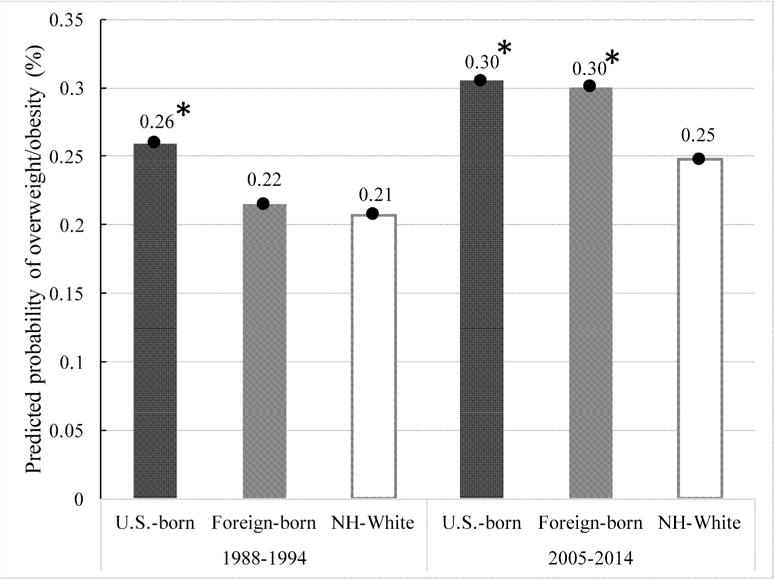
In 1988-1994, foreign-born Mexican Americans had significantly lower prevalence of overweight/obesity compared with US-born Mexican Americans (PR = 0.75, 95% CI: 0.61-0.94). However, by 2005-2014, the nativity gap in overweight/obesity had closed (PR = 0.94, 95% CI: 0.84-1.07). Moreover, while foreign-born Mexican Americans had the lowest levels of overweight/obesity in 1988-1994, by 2005-2014, foreign-born and US-born Mexican Americans had comparable estimates, both significantly higher than that of non-Hispanic white individuals.
Although overweight/obesity disparities between Mexican Americans and non-Hispanic white Americans had previously been specific to US-born Mexican Americans, disparities in more recent years have extended to foreign-born Mexican Americans.
考察墨西哥裔美国儿童的出生地与超重/肥胖之间的关系是否随时间发生了变化,并探讨这种模式对与非西班牙裔白种人儿童相比超重/肥胖差异的影响。
利用参加国家健康和营养调查(1988-1994 年[N=4720]和 2005-2014 年[N=7275])的 4 至 17 岁墨西哥裔美国人和非西班牙裔白种儿童的横断面数据,采用对数二项式回归计算按出生地状况调整社会人口学协变量、调查期和出生地与调查期相互作用后的超重/肥胖患病率比(PR)。一个单独的协变量调整模型检验了种族、出生地和调查期之间的三级交互作用,其中包括非西班牙裔白种儿童。
1988-1994 年,与美国出生的墨西哥裔美国人相比,外国出生的墨西哥裔美国人超重/肥胖的患病率显著较低(PR=0.75,95%CI:0.61-0.94)。然而,到 2005-2014 年,超重/肥胖的出生地差距已经缩小(PR=0.94,95%CI:0.84-1.07)。此外,虽然 1988-1994 年外国出生的墨西哥裔美国人的超重/肥胖率最低,但到 2005-2014 年,外国出生和美国出生的墨西哥裔美国人的估计值相当,均显著高于非西班牙裔白种人。
尽管墨西哥裔美国人和非西班牙裔白种美国人之间的超重/肥胖差异以前仅针对美国出生的墨西哥裔美国人,但近年来的差异已扩大到外国出生的墨西哥裔美国人。