Max Planck Institute for Marine Microbiology, Bremen, Germany
Department of Marine Sciences, University of North Carolina at Chapel Hill, Chapel Hill, North Carolina, USA.
Appl Environ Microbiol. 2018 Jul 17;84(15). doi: 10.1128/AEM.02860-17. Print 2018 Aug 1.
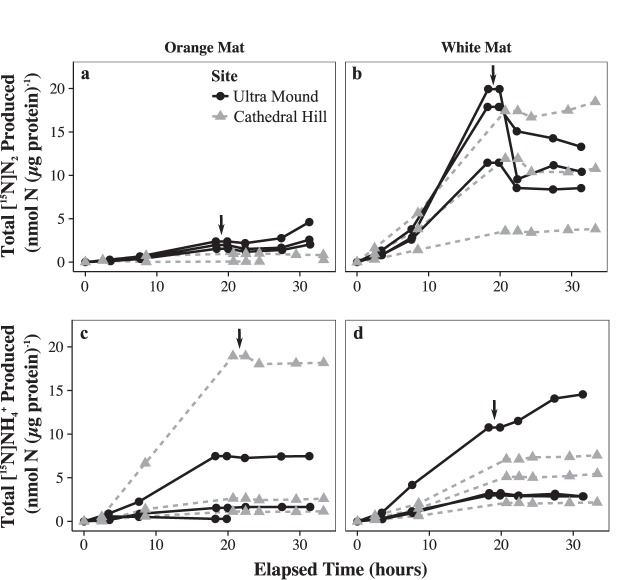
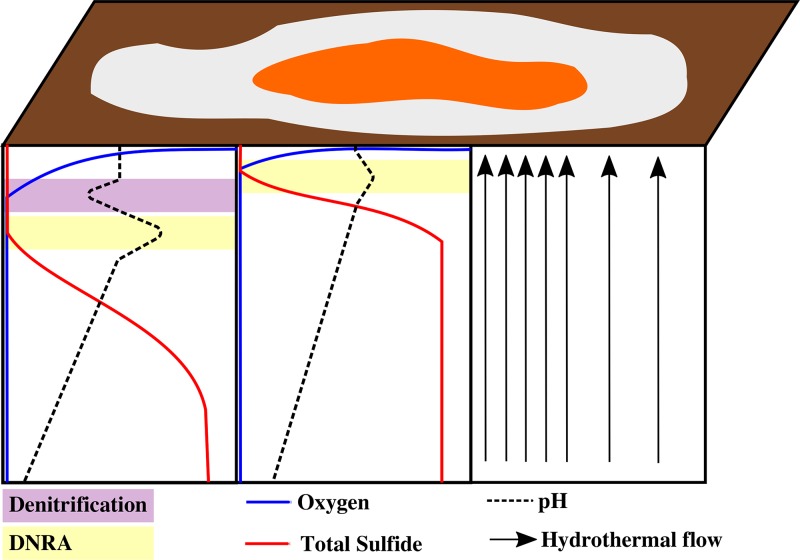
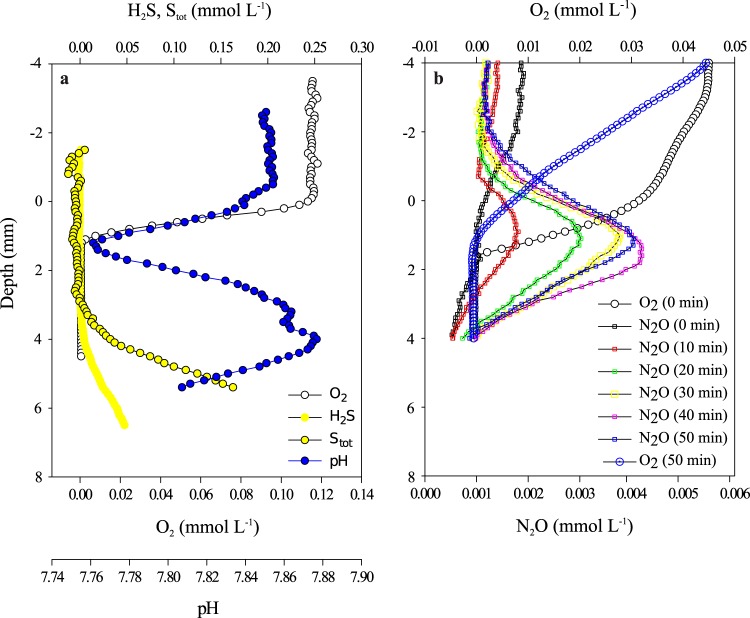
Filamentous large sulfur-oxidizing bacteria (FLSB) of the family are globally distributed aquatic bacteria that can control geochemical fluxes from the sediment to the water column through their metabolic activity. FLSB mats from hydrothermal sediments of Guaymas Basin, Mexico, typically have a "fried-egg" appearance, with orange filaments dominating near the center and wider white filaments at the periphery, likely reflecting areas of higher and lower sulfide fluxes, respectively. These FLSB store large quantities of intracellular nitrate that they use to oxidize sulfide. By applying a combination of N-labeling techniques and genome sequence analysis, we demonstrate that the white FLSB filaments were capable of reducing their intracellular nitrate stores to both nitrogen gas and ammonium by denitrification and dissimilatory nitrate reduction to ammonium (DNRA), respectively. On the other hand, our combined results show that the orange filaments were primarily capable of DNRA. Microsensor profiles through a laboratory-incubated white FLSB mat revealed a 2- to 3-mm vertical separation between the oxic and sulfidic zones. Denitrification was most intense just below the oxic zone, as shown by the production of nitrous oxide following exposure to acetylene, which blocks nitrous oxide reduction to nitrogen gas. Below this zone, a local pH maximum coincided with sulfide oxidation, consistent with nitrate reduction by DNRA. The balance between internally and externally available electron acceptors (nitrate) and electron donors (reduced sulfur) likely controlled the end product of nitrate reduction both between orange and white FLSB mats and between different spatial and geochemical niches within the white FLSB mat. Whether large sulfur bacteria of the family reduce NO to N via denitrification or to NH via DNRA has been debated in the literature for more than 25 years. We resolve this debate by showing that certain members of the use both metabolic pathways. This is important for the ecological role of these bacteria, as N production removes bioavailable nitrogen from the ecosystem, whereas NH production retains it. For this reason, the topic of environmental controls on the competition for NO between N-producing and NH-producing bacteria is of great scientific interest. Recent experiments on the competition between these two types of microorganisms have demonstrated that the balance between electron donor and electron acceptor availability strongly influences the end product of NO reduction. Our results suggest that this is also the case at the even more fundamental level of enzyme system regulation within a single organism.
丝状大型硫磺氧化菌(FLSB)是一种广泛分布于全球的水生细菌,通过其代谢活动可以控制从沉积物向水柱的地球化学通量。来自墨西哥瓜伊马斯盆地热液沉积物的 FLSB 垫通常具有“煎蛋”的外观,中心附近为橙色丝状,外围为较宽的白色丝状,可能分别反映了较高和较低的硫化物通量区域。这些 FLSB 储存大量的细胞内硝酸盐,用于氧化硫化物。通过应用组合的 N 标记技术和基因组序列分析,我们证明白色 FLSB 丝能够通过反硝化和异化硝酸盐还原为铵(DNRA)将其细胞内硝酸盐储备分别还原为氮气和铵。另一方面,我们的综合结果表明,橙色丝状主要能够进行 DNRA。通过实验室孵育的白色 FLSB 垫的微传感器剖面显示,有氧区和硫化物区之间有 2-3 毫米的垂直分离。正如在乙炔暴露后产生一氧化二氮所表明的那样,反硝化作用最为强烈,因为乙炔会阻止一氧化二氮还原为氮气。在该区域以下,局部 pH 最大值与硫化物氧化相吻合,这与 DNRA 还原硝酸盐一致。内部和外部电子受体(硝酸盐)和电子供体(还原硫)之间的平衡可能控制了硝酸盐还原的最终产物,无论是在橙色和白色 FLSB 垫之间,还是在白色 FLSB 垫内的不同空间和地球化学小生境之间。关于大型硫磺细菌科的细菌是通过反硝化作用将 NO 还原为 N 还是通过 DNRA 将 NO 还原为 NH 的问题,在文献中已经争论了 25 年以上。我们通过证明某些属的成员同时使用这两种代谢途径来解决这个争论。这对于这些细菌的生态作用很重要,因为 N 的产生会将生物可利用的氮从生态系统中去除,而 NH 的产生则保留了它。因此,关于环境对产生 N 和产生 NH 的细菌之间对 NO 的竞争的控制的主题具有重要的科学意义。最近关于这两种微生物竞争的实验表明,电子供体和电子受体可用性之间的平衡强烈影响 NO 还原的最终产物。我们的结果表明,在单个生物体的酶系统调节更基本的水平上也是如此。