
青少年情感症状与死亡率。
Adolescent affective symptoms and mortality.
机构信息
Medical Research Council Unit for Lifelong Health and Ageing,University College London,UK.
Institute of Psychiatry, Psychology & Neuroscience,King's College London,UK, andSouth London and Maudsley NHS Foundation Trust,UK.
出版信息
Br J Psychiatry. 2018 Jul;213(1):419-424. doi: 10.1192/bjp.2018.90. Epub 2018 May 28.
BACKGROUND
Little is known about the relationship between adolescent affective problems (anxiety and depression) and mortality.AimsTo examine whether adolescent affective symptoms are associated with premature mortality, and to assess whether this relationship is independent of other developmental factors.
METHOD
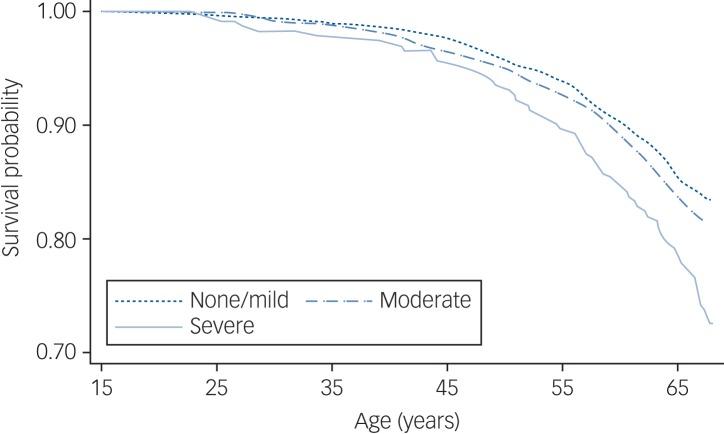
Data (n = 3884) was from Britain's oldest birth cohort study - the National Survey of Health and Development. Adolescent affective symptoms were rated by teachers at ages 13 and 15 years: scores were summed and classified into three categories: mild or no, moderate and severe symptoms (1st-50th, 51st-90th and 91st-100th percentiles, respectively). Mortality data were obtained from national registry data up to age 68 years. Potential confounders were parental social class, childhood cognition and illness, and adolescent externalising behaviour.
RESULTS
Over the 53-year follow-up period, 12.2% (n = 472) of study members died. Severe adolescent affective symptoms were associated with an increased rate of mortality compared with those with mild or no symptoms (gender adjusted hazard ratio 1.76, 95% CI 1.33-2.33). This association was only partially attenuated after adjustment for potential confounders (fully adjusted hazard ratio 1.61, 95% CI 1.20-2.15). There was suggestive evidence of an association across multiple causes of death. Moderate symptoms were not associated with mortality.
CONCLUSIONS
Severe adolescent affective symptoms are associated with an increased rate of premature mortality over a 53-year follow-up period, independent of potential confounders. These findings underscore the importance of early mental health interventions.Declaration of interestNone.
背景
青少年情感问题(焦虑和抑郁)与死亡率之间的关系鲜为人知。
目的
研究青少年情感症状是否与过早死亡有关,并评估这种关系是否独立于其他发育因素。
方法
数据(n=3884)来自英国最古老的出生队列研究——国民健康与发展调查。青少年的情感症状由教师在 13 岁和 15 岁时评定:分数相加并分为三组:轻度或无、中度和重度症状(分别为第 1-50 百分位、第 51-90 百分位和第 91-100 百分位)。死亡率数据来自国家登记处的数据,直至 68 岁。潜在的混杂因素包括父母的社会阶层、儿童认知和疾病以及青少年的外化行为。
结果
在 53 年的随访期间,12.2%(n=472)的研究对象死亡。与轻度或无症状者相比,严重青少年情感症状与死亡率增加相关(性别调整后的危险比 1.76,95%CI 1.33-2.33)。在调整潜在混杂因素后,这种关联仅部分减弱(完全调整后的危险比 1.61,95%CI 1.20-2.15)。有迹象表明,多种死因之间存在关联。中度症状与死亡率无关。
结论
在 53 年的随访期间,严重的青少年情感症状与过早死亡的风险增加相关,独立于潜在的混杂因素。这些发现强调了早期心理健康干预的重要性。
利益声明
无。
 Zotero 插件