Wageningen Bioveterinary Research (WBVR), Lelystad, the Netherlands.
GD Animal Health, Deventer, the Netherlands.
Transbound Emerg Dis. 2021 Jan;68(1):127-136. doi: 10.1111/tbed.13649. Epub 2020 Jun 7.
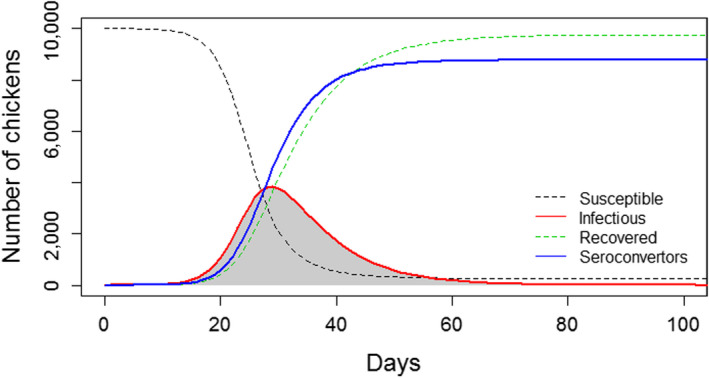
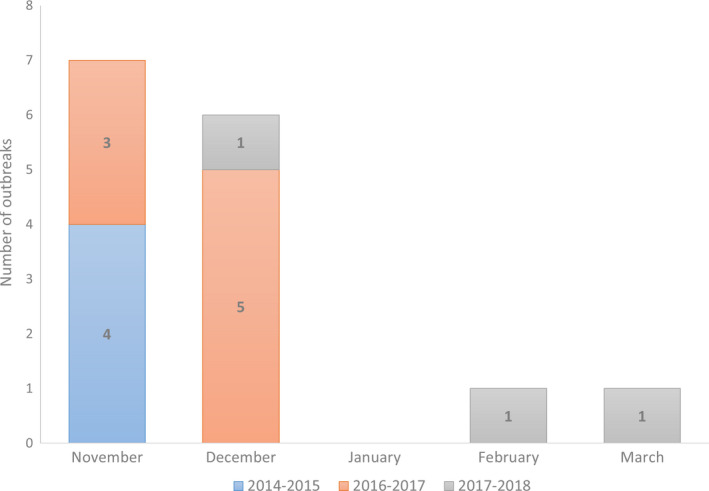
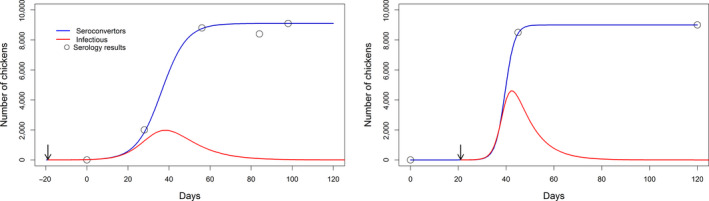
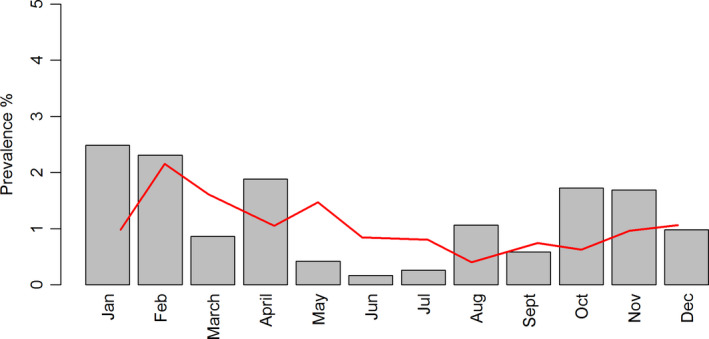
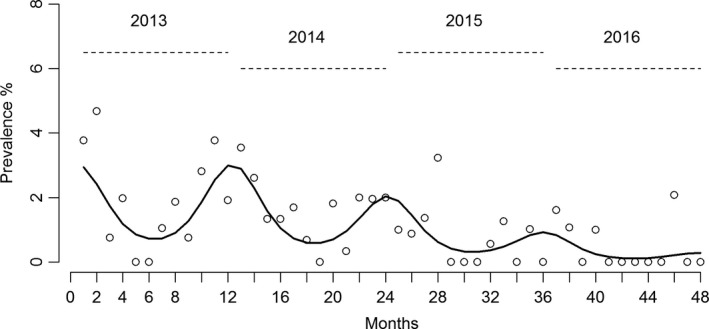
Poultry can become infected with avian influenza viruses (AIV) via (in) direct contact with infected wild birds. Free-range chicken farms in the Netherlands were shown to have a higher risk for introduction of low pathogenic avian influenza (LPAI) virus than indoor chicken farms. Therefore, during outbreaks of highly pathogenic avian influenza (HPAI), free-range layers are confined indoors as a risk mitigation measure. In this study, we characterized the seasonal patterns of AIV introductions into free-range layer farms, to determine the high-risk period. Data from the LPAI serological surveillance programme for the period 2013-2016 were used to first estimate the time of virus introduction into affected farms and then assess seasonal patterns in the risk of introduction. Time of introduction was estimated by fitting a mathematical model to seroprevalence data collected longitudinally from infected farms. For the period 2015-2016, longitudinal follow-up included monthly collections of eggs for serological testing from a cohort of 261 farms. Information on the time of introduction was then used to estimate the monthly incidence and seasonality by fitting harmonic and Poisson regression models. A significant yearly seasonal risk of introduction that lasted around 4 months (November to February) was identified with the highest risk observed in January. The risk for introduction of LPAI viruses in this period was on average four times significantly higher than the period of low risk around the summer months. Although the data for HPAI infections were limited in the period 2014-2018, a similar risk period for introduction of HPAI viruses was observed. The results of this study can be used to optimize risk-based surveillance and inform decisions on timing and duration of indoor confinement when HPAI viruses are known to circulate in the wild bird population.
家禽可通过与感染野生鸟类的直接或间接接触而感染禽流感病毒 (AIV)。与室内鸡场相比,荷兰的自由放养鸡场更有可能引入低致病性禽流感 (LPAI) 病毒。因此,在高致病性禽流感 (HPAI) 爆发期间,作为风险缓解措施,自由放养蛋鸡被圈养在室内。在这项研究中,我们对自由放养蛋鸡场中 AIV 的季节性传入进行了特征描述,以确定高风险期。使用 2013-2016 年 LPAI 血清学监测计划的数据,首先估计病毒传入受影响农场的时间,然后评估传入风险的季节性模式。通过将数学模型拟合到从感染农场收集的纵向血清阳性率数据,来估计传入时间。在 2015-2016 年期间,纵向随访包括对 261 个农场的鸡蛋进行每月采集,以进行血清学检测。然后,使用传入时间信息通过拟合调和和泊松回归模型来估计每月的发病率和季节性。确定了具有 4 个月左右持续时间(11 月至 2 月)的显著年度季节性传入风险,1 月观察到的风险最高。在此期间,LPAI 病毒传入的风险平均比夏季低风险时期高四倍。尽管在 2014-2018 年期间 HPAI 感染的数据有限,但观察到了类似的 HPAI 病毒传入风险期。本研究的结果可用于优化基于风险的监测,并为 HPAI 病毒在野生鸟类种群中传播时的室内限制的时间和持续时间做出决策提供信息。