Nursing and Midwifery Care Research Center, School of Nursing and Midwifery, Isfahan University of Medical Sciences, Isfahan, Iran.
Interventional Cardiology Research Center, Isfahan Cardiovascular Research Institute, Isfahan University of Medical Sciences, Isfahan, Iran.
Epidemiol Health. 2018 May 18;40:e2018020. doi: 10.4178/epih.e2018020. eCollection 2018.
Hypertension (HTN) is an important risk factor for cardiovascular disease. Considering the importance of this disease for public health, this study was designed in order to determine the prevalence, awareness, treatment, control, and risk factors of HTN in the Iranian adult population.
This cross-sectional study was conducted among 2,107 residents of Isfahan, Iran. Samples were selected through multi-stage random cluster sampling in 2015-2016. The outcome variable was HTN, determined by measuring blood pressure in the right arm via a digital arm blood pressure monitor. Awareness, treatment, and control of HTN were assessed by a validated and reliable researcher-developed questionnaire. Other demographic and clinical variables were assessed via a demographic questionnaire.
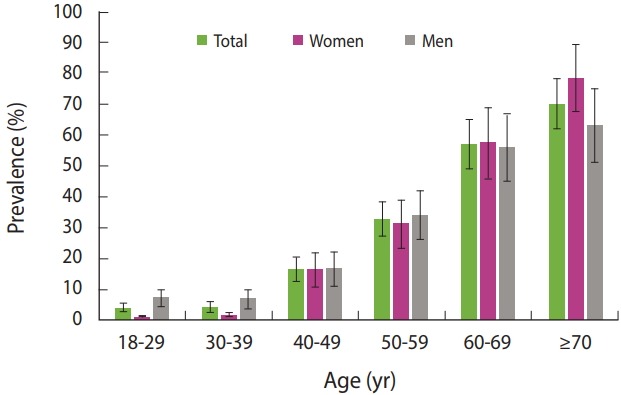
The overall prevalence of HTN was 17.3% (18.9 and 15.5% in men and women, respectively). The prevalence of HTN increased in both genders with age. The prevalence of awareness of HTN among people with HTN was 69.2%, of whom 92.4 and 59.9% were taking medication for HTN and had controlled HTN, respectively. Logistic regression identified age, body mass index, having diabetes and hyperlipidemia, and a positive family history of HTN as determinants of awareness of HTN.
The results showed that HTN was highly prevalent in the community, especially in men and in middle-aged and older adults. Approximately 30.8% of patients were unaware of their disease, and there was less awareness among younger adults. Despite the high frequency of taking medication to treat HTN, it was uncontrolled in more than 40.1% of patients. Health policy-makers should therefore consider appropriate preventive and therapeutic strategies for these high-risk groups.
高血压(HTN)是心血管疾病的一个重要危险因素。考虑到这种疾病对公众健康的重要性,本研究旨在确定伊朗成年人群中 HTN 的患病率、知晓率、治疗率、控制率和危险因素。
这是一项横断面研究,于 2015-2016 年在伊朗伊斯法罕的 2107 名居民中进行。样本通过多阶段随机聚类抽样选取。通过数字臂式血压计测量右臂血压来确定高血压这一结局变量。高血压的知晓率、治疗率和控制率通过一份经过验证和可靠的研究者开发的问卷进行评估。其他人口统计学和临床变量通过一份人口统计学问卷进行评估。
高血压的总体患病率为 17.3%(男性和女性分别为 18.9%和 15.5%)。高血压的患病率在两性中均随年龄增长而增加。高血压患者中高血压知晓率为 69.2%,其中 92.4%和 59.9%正在服用高血压药物和高血压得到控制。逻辑回归确定了年龄、体重指数、患有糖尿病和高血脂症、以及高血压家族史阳性是高血压知晓率的决定因素。
结果表明,社区中高血压患病率很高,尤其是男性和中年及老年人群。约 30.8%的患者不知道自己患有该病,而且年轻患者的知晓率较低。尽管治疗高血压的药物使用率很高,但仍有超过 40.1%的患者血压未得到控制。因此,卫生政策制定者应考虑针对这些高危人群采取适当的预防和治疗策略。