Alvarez-Mon Miguel Angel, Asunsolo Del Barco Angel, Lahera Guillermo, Quintero Javier, Ferre Francisco, Pereira-Sanchez Victor, Ortuño Felipe, Alvarez-Mon Melchor
Department of Psychiatry, Clinica Universidad de Navarra, University of Navarra, Pamplona, Spain.
Department of Surgery, Medical and Social Sciences, University of Alcala, Madrid, Spain.
J Med Internet Res. 2018 May 28;20(5):e205. doi: 10.2196/jmir.9582.
The contents of traditional communication media and new internet social media reflect the interests of society. However, certain barriers and a lack of attention towards mental disorders have been previously observed.
The objective of this study is to measure the relevance of influential American mainstream media outlets for the distribution of psychiatric information and the interest generated in these topics among their Twitter followers.
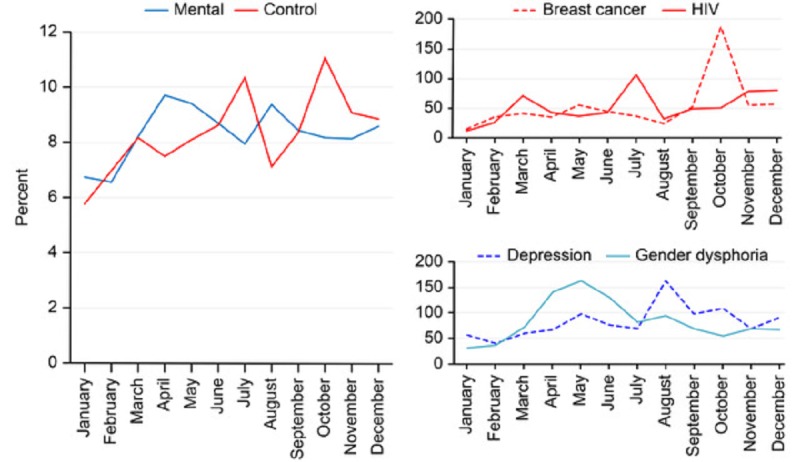
We investigated tweets generated about mental health conditions and diseases among 15 mainstream general communication media outlets in the United States of America between January 2007 and December 2016. Our study strategy focused on identifying several psychiatric terms of primary interest. The number of retweets generated from the selected tweets was also investigated. As a control, we examined tweets generated about the main causes of death in the United States of America, the main chronic neurological degenerative diseases, and HIV.
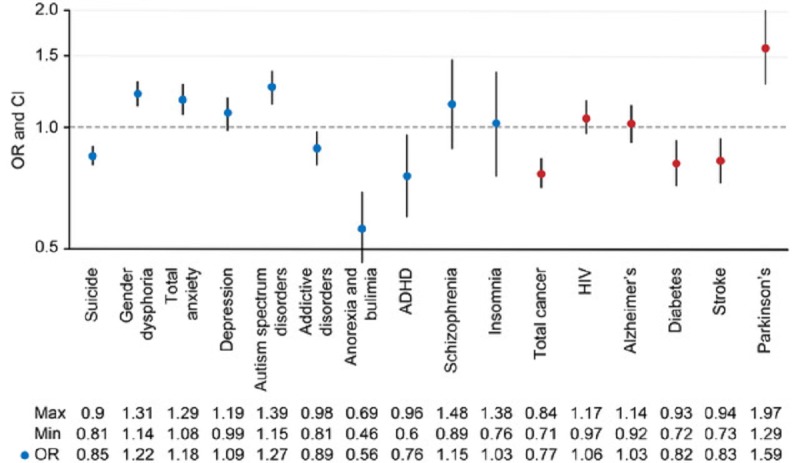
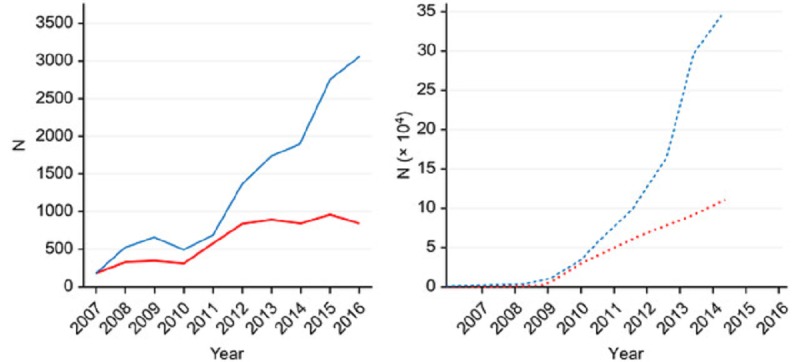
In total, 13,119 tweets about mental health disorders sent by the American mainstream media outlets were analyzed. The results showed a heterogeneous distribution but preferential accumulation for a select number of conditions. Suicide and gender dysphoria accounted for half of the number of tweets sent. Variability in the number of tweets related to each control disease was also found (5998). The number of tweets sent regarding each different psychiatric or organic disease analyzed was significantly correlated with the number of retweets generated by followers (1,030,974 and 424,813 responses to mental health disorders and organic diseases, respectively). However, the probability of a tweet being retweeted differed significantly among the conditions and diseases analyzed. Furthermore, the retweeted to tweet ratio was significantly higher for psychiatric diseases than for the control diseases (odds ratio 1.11, CI 1.07-1.14; P<.001).
American mainstream media outlets and the general public demonstrate a preferential interest for psychiatric diseases on Twitter. The heterogeneous weights given by the media outlets analyzed to the different mental health disorders and conditions are reflected in the responses of Twitter followers.
传统传播媒介和新兴互联网社交媒体的内容反映了社会的兴趣。然而,先前已观察到对精神障碍存在某些障碍和缺乏关注的情况。
本研究的目的是衡量有影响力的美国主流媒体在传播精神科信息方面的相关性以及其推特关注者对这些主题产生的兴趣。
我们调查了2007年1月至2016年12月期间美国15家主流综合传播媒体发布的关于心理健康状况和疾病的推文。我们的研究策略侧重于识别几个主要感兴趣的精神科术语。还调查了所选推文产生的转发数。作为对照,我们检查了关于美国主要死因、主要慢性神经退行性疾病和艾滋病毒的推文。
总共分析了美国主流媒体发布的13119条关于精神健康障碍的推文。结果显示分布不均,但某些特定病症有优先积累。自杀和性别焦虑症占推文发布数量的一半。还发现与每种对照疾病相关的推文数量存在差异(5998条)。分析的每种不同精神科或器质性疾病的推文发布数量与关注者产生的转发数显著相关(分别有1030974和424813条对精神健康障碍和器质性疾病的回应)。然而,在分析的病症和疾病中,推文被转发的概率差异显著。此外,精神科疾病的转发与推文比率显著高于对照疾病(优势比1.11,置信区间1.07 - 1.14;P <.001)。
美国主流媒体和公众在推特上对精神科疾病表现出优先兴趣。分析的媒体对不同精神健康障碍和状况赋予的不同权重反映在推特关注者的回应中。