Löwe Hannes, Sinner Peter, Kremling Andreas, Pflüger-Grau Katharina
Systems Biotechnology, Technical University of Munich, 85748, Garching, Germany.
Microb Biotechnol. 2020 Jan;13(1):97-106. doi: 10.1111/1751-7915.13283. Epub 2018 May 28.
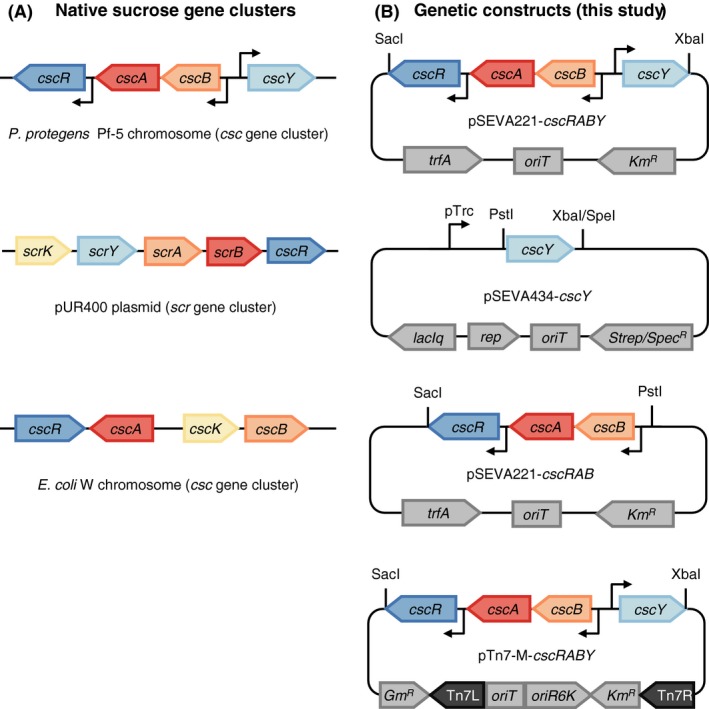
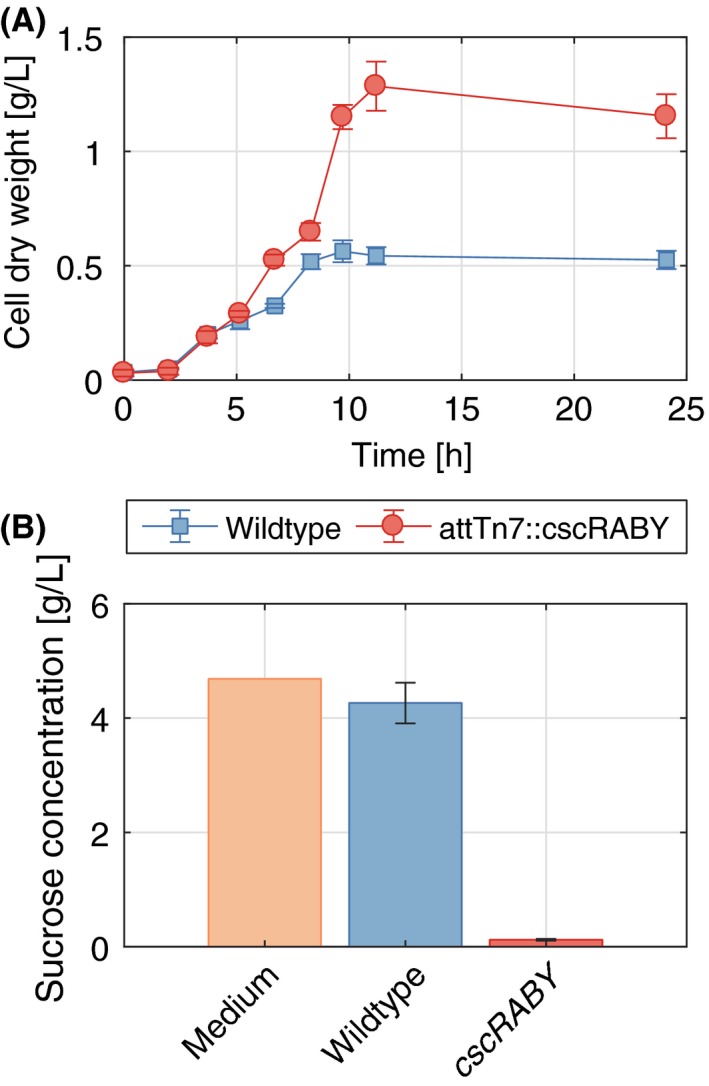
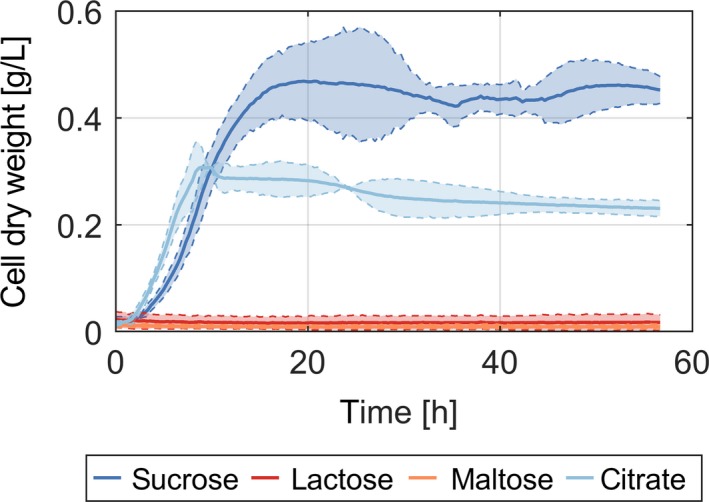
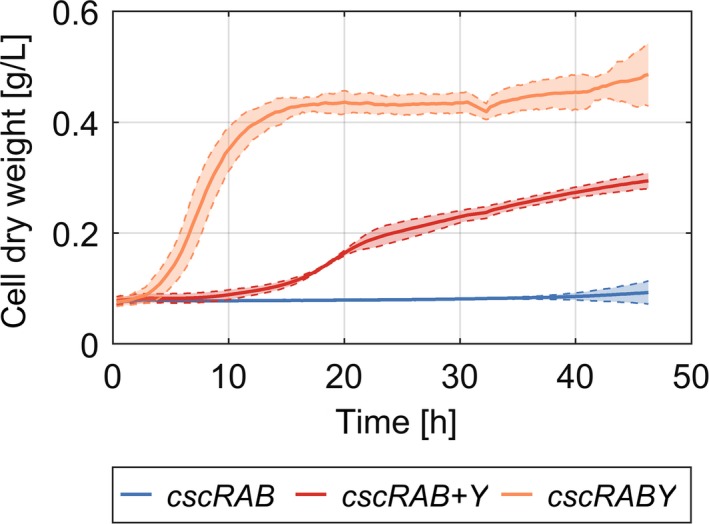
Using agricultural wastes as a substrate for biotechnological processes is of great interest in industrial biotechnology. A prerequisite for using these wastes is the ability of the industrially relevant microorganisms to metabolize the sugars present therein. Therefore, many metabolic engineering approaches are directed towards widening the substrate spectrum of the workhorses of industrial biotechnology like Escherichia coli, yeast or Pseudomonas putida. For instance, neither xylose or arabinose from cellulosic residues, nor sucrose, the main sugar in waste molasses, can be metabolized by most E. coli and P. putida wild types. We evaluated a new, so far uncharacterized gene cluster for sucrose metabolism from Pseudomonas protegens Pf-5 and showed that it enables P. putida to grow on sucrose as the sole carbon and energy source. Even when integrated into the genome of P. putida, the resulting strain grew on sucrose at rates similar to the rate of the wild type on glucose - making it the fastest growing, plasmid-free P. putida strain known so far using sucrose as substrate. Next, we elucidated the role of the porin, an orthologue of the sucrose porin ScrY, in the gene cluster and found that in P. putida, a porin is needed for sucrose transport across the outer membrane. Consequently, native porins were not sufficient to allow unlimited growth on sucrose. Therefore, we concluded that the outer membrane can be a considerable barrier for substrate transport, depending on strain, genotype and culture conditions, all of which should be taken into account in metabolic engineering approaches. We additionally showed the potential of the engineered P. putida strains by growing them on molasses with efficiencies twice as high as obtained with the wild-type P. putida. This can be seen as a further step towards the production of low-value chemicals and biofuels with P. putida from alternative and more affordable substrates in the future.
在工业生物技术中,利用农业废弃物作为生物技术过程的底物备受关注。使用这些废弃物的一个先决条件是工业相关微生物能够代谢其中存在的糖类。因此,许多代谢工程方法旨在拓宽工业生物技术主力菌株(如大肠杆菌、酵母或恶臭假单胞菌)的底物谱。例如,大多数大肠杆菌和恶臭假单胞菌野生型既不能代谢纤维素残渣中的木糖或阿拉伯糖,也不能代谢废糖蜜中的主要糖类蔗糖。我们评估了来自荧光假单胞菌Pf-5的一个新的、迄今未表征的蔗糖代谢基因簇,并表明它能使恶臭假单胞菌以蔗糖作为唯一碳源和能源生长。即使整合到恶臭假单胞菌的基因组中,所得菌株在蔗糖上的生长速率也与野生型在葡萄糖上的生长速率相似,使其成为迄今已知的以蔗糖为底物生长最快的无质粒恶臭假单胞菌菌株。接下来,我们阐明了该基因簇中孔蛋白(蔗糖孔蛋白ScrY的直系同源物)的作用,发现在恶臭假单胞菌中,蔗糖跨外膜转运需要孔蛋白。因此,天然孔蛋白不足以支持在蔗糖上的无限生长。所以,我们得出结论,外膜可能是底物转运的一个相当大的障碍,这取决于菌株、基因型和培养条件,在代谢工程方法中所有这些都应予以考虑。我们还通过在糖蜜上培养工程化的恶臭假单胞菌菌株展示了其潜力,其效率是野生型恶臭假单胞菌的两倍。这可以被视为朝着未来利用恶臭假单胞菌从替代且更经济实惠的底物生产低价值化学品和生物燃料迈出的又一步。