Grieshober Jason A, Mehran Nima, Photopolous Christos, Fishman Matthew, Lombardo Stephen J, Kharrazi F Daniel
Kerlan-Jobe Orthopaedic Clinic, Los Angeles, California, USA.
Orthop J Sports Med. 2018 May 21;6(5):2325967118774329. doi: 10.1177/2325967118774329. eCollection 2018 May.
Vitamin D is believed to play a role in influencing fracture risk and athletic performance. Insufficiency of vitamin D affects an estimated three-quarters of the United States population. Hypovitaminosis D has also been demonstrated to be quite common among professional basketball players in the National Basketball Association (NBA).
To determine whether a relationship exists between vitamin D levels and fracture risk and athletic performance (as measured by NBA draft status) among elite basketball players.
Descriptive epidemiology study.
Data were obtained from the NBA regarding combine participants from 2009 through 2013. This information included vitamin D level, demographic information, fracture history, and NBA draft status. The data were analyzed to determine associations between vitamin D level and fracture risk and NBA draft status.
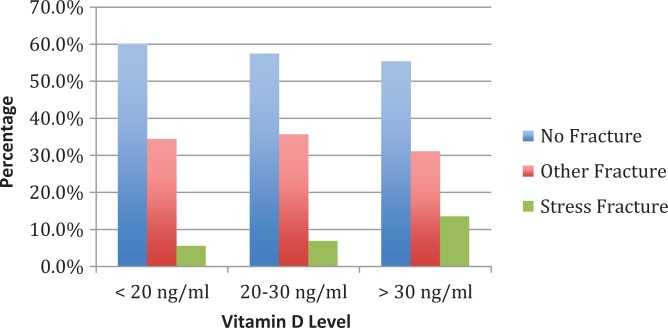
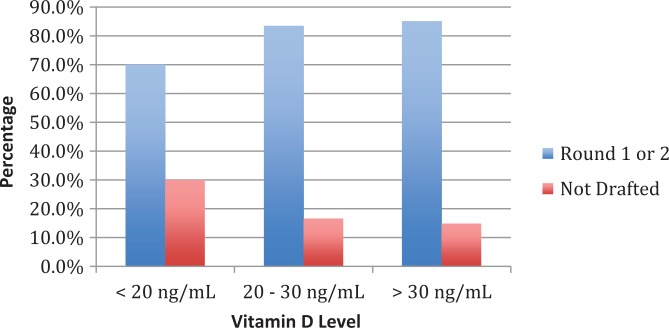
Vitamin D levels were measured for 279 players at the NBA Combine from 2009 through 2013. Vitamin D deficiency (<20 ng/mL) was seen in 32.3% of athletes, vitamin D insufficiency (20-30 ng/mL) was seen in 41.2%, and sufficient levels of vitamin D (>30 ng/mL) were present in only 26.5%. A total of 118 players had a history of at least 1 fracture. Vitamin D level was not predictive of fracture risk. Contrary to our hypothesis, players with a history of stress fracture had a significantly greater mean vitamin D level than those without such history (30.7 vs 25.1 ng/mL; = .04). A majority (79.6%) of participants were selected in the NBA draft. Players with deficient vitamin D levels had a significantly lower rate of being drafted into the NBA ( = .027). The NBA draft rate was found to increase with increasing levels of vitamin D ( = .007).
Hypovitaminosis D is quite common among NBA Combine participants, affecting 73.5%. While no significant relationship was found between vitamin D level and fracture history, patients with a history of stress fracture had significantly greater mean vitamin D levels. Additionally, participants with greater vitamin D levels were more likely to be drafted into the NBA. This information supports the potential role of vitamin D in influencing athletic performance.
维生素D被认为在影响骨折风险和运动表现方面发挥作用。据估计,维生素D不足影响了美国四分之三的人口。维生素D缺乏症在国家篮球协会(NBA)的职业篮球运动员中也很常见。
确定精英篮球运动员的维生素D水平与骨折风险和运动表现(通过NBA选秀状况衡量)之间是否存在关联。
描述性流行病学研究。
从NBA获取了2009年至2013年联合试训参与者的数据。这些信息包括维生素D水平、人口统计学信息、骨折史和NBA选秀状况。对数据进行分析以确定维生素D水平与骨折风险和NBA选秀状况之间的关联。
对2009年至2013年NBA联合试训的279名球员进行了维生素D水平测量。32.3%的运动员存在维生素D缺乏(<20 ng/mL),41.2%存在维生素D不足(20 - 30 ng/mL),仅有26.5%的运动员维生素D水平充足(>30 ng/mL)。共有118名球员有至少1次骨折史。维生素D水平不能预测骨折风险。与我们的假设相反,有应力性骨折史的球员平均维生素D水平显著高于无此类病史的球员(30.7对25.1 ng/mL;P = 0.04)。大多数(79.6%)参与者在NBA选秀中被选中。维生素D水平不足的球员被选入NBA的比例显著较低(P = 0.027)。发现NBA选秀率随着维生素D水平的升高而增加(P = 0.007)。
维生素D缺乏症在NBA联合试训参与者中相当普遍,影响了73.5%的人。虽然未发现维生素D水平与骨折史之间存在显著关联,但有应力性骨折史的患者平均维生素D水平显著更高。此外,维生素D水平较高的参与者更有可能被选入NBA。这些信息支持了维生素D在影响运动表现方面的潜在作用。