Delft Institute of Applied Mathematics, Delft University of Technology, Delft, The Netherlands.
Faculty of Biomedical Engineering, Technion-Israel Institute of Technology, 3200003, Haifa, Israel.
Biomech Model Mechanobiol. 2018 Oct;17(5):1429-1450. doi: 10.1007/s10237-018-1036-5. Epub 2018 May 29.
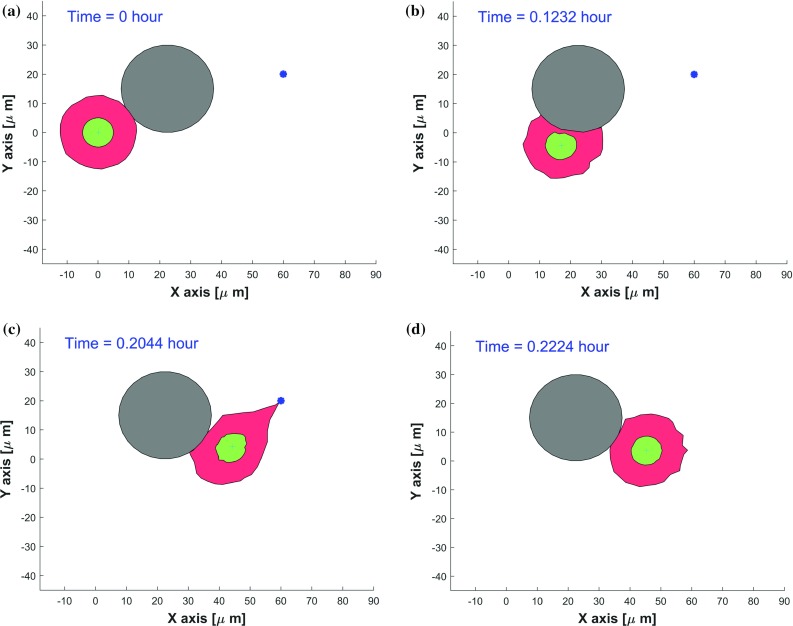
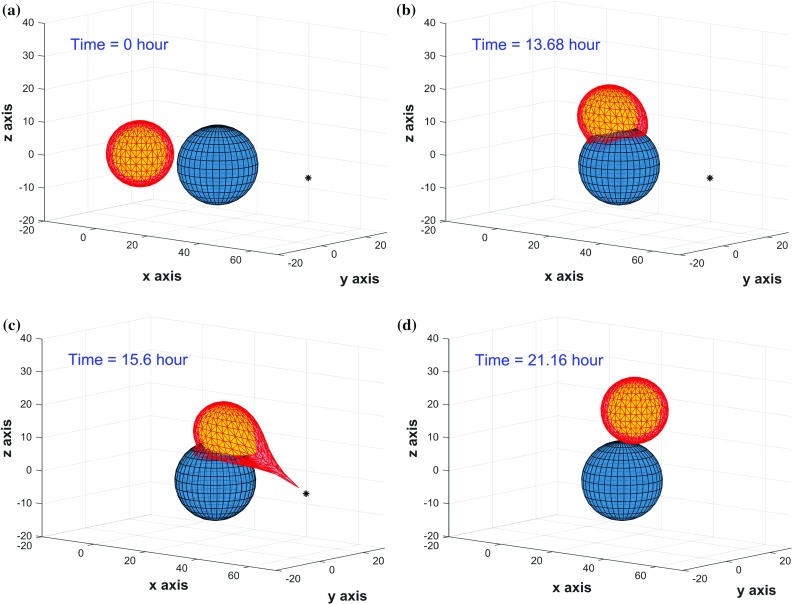
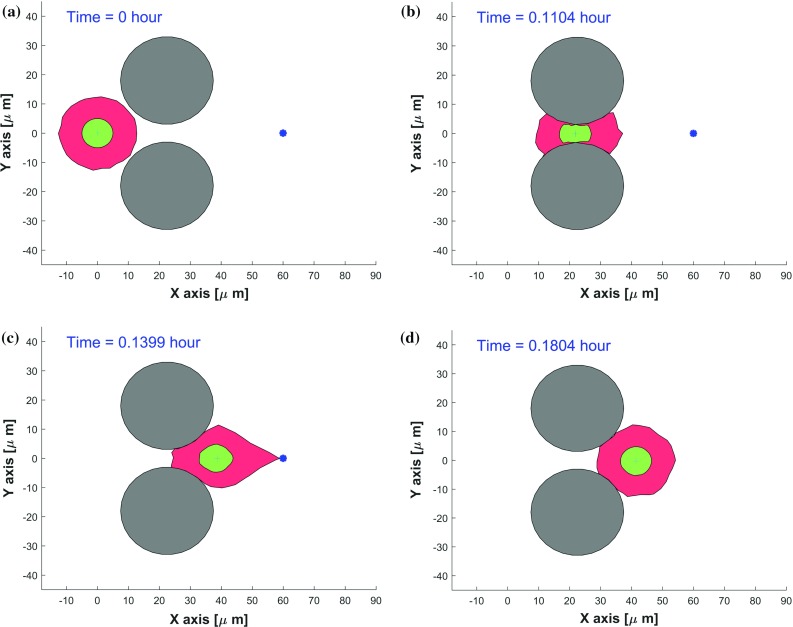
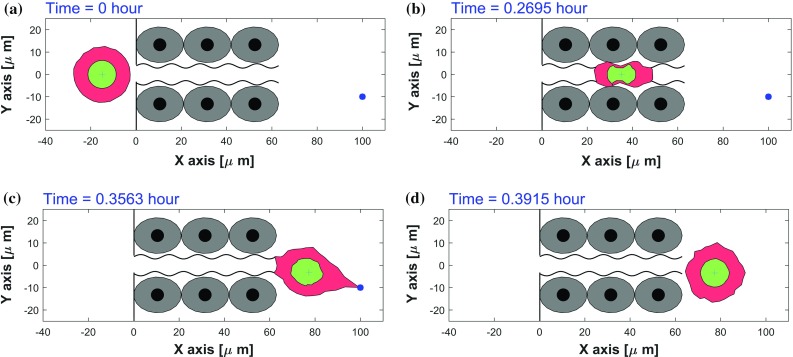
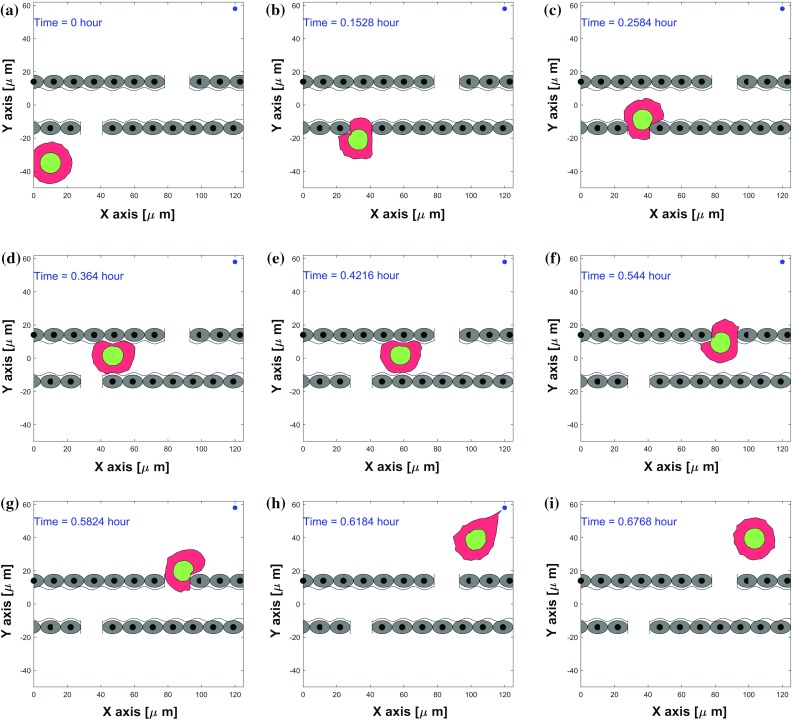
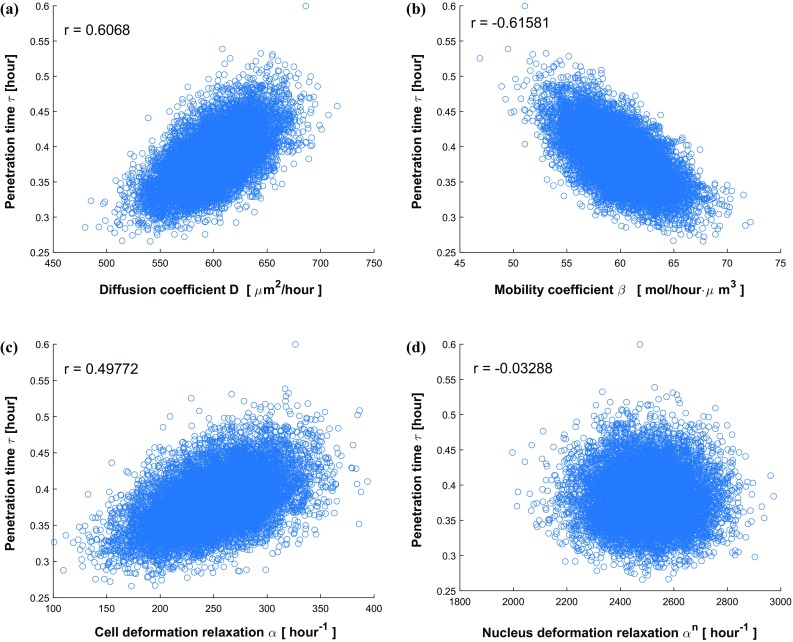
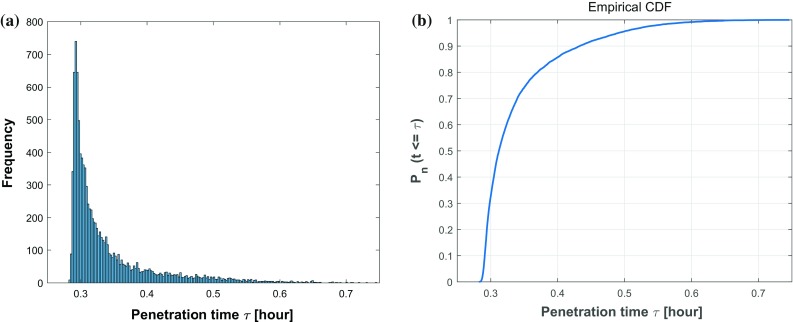
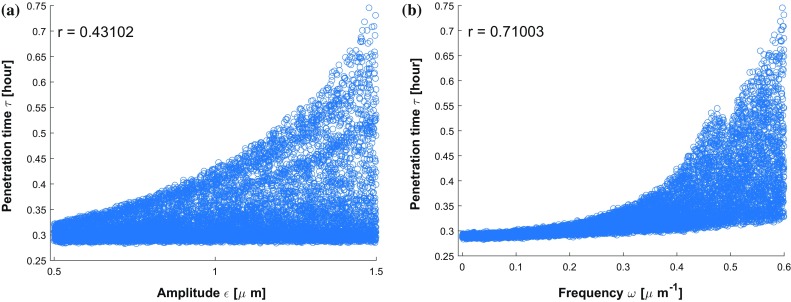
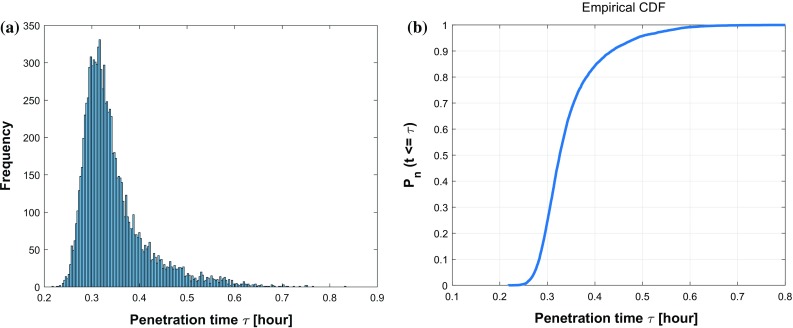
Cell migration plays an essential role in cancer metastasis. In cancer invasion through confined spaces, cells must undergo extensive deformation, which is a capability related to their metastatic potentials. Here, we simulate the deformation of the cell and nucleus during invasion through a dense, physiological microenvironment by developing a phenomenological computational model. In our work, cells are attracted by a generic emitting source (e.g., a chemokine or stiffness signal), which is treated by using Green's Fundamental solutions. We use an IMEX integration method where the linear parts and the nonlinear parts are treated by using an Euler backward scheme and an Euler forward method, respectively. We develop the numerical model for an obstacle-induced deformation in 2D or/and 3D. Considering the uncertainty in cell mobility, stochastic processes are incorporated and uncertainties in the input variables are evaluated using Monte Carlo simulations. This quantitative study aims at estimating the likelihood for invasion and the length of the time interval in which the cell invades the tissue through an obstacle. Subsequently, the two-dimensional cell deformation model is applied to simplified cancer metastasis processes to serve as a model for in vivo or in vitro biomedical experiments.
细胞迁移在癌症转移中起着至关重要的作用。在癌症通过受限空间的侵袭过程中,细胞必须经历广泛的变形,这是与它们的转移潜力相关的能力。在这里,我们通过开发一种唯象计算模型来模拟细胞和核在致密生理微环境中的入侵变形。在我们的工作中,细胞被一个通用的发射源(例如趋化因子或刚度信号)所吸引,我们使用 Green 的基本解来处理这个源。我们使用一个 IMEX 积分方法,其中线性部分和非线性部分分别采用 Euler 向后差分法和 Euler 向前法进行处理。我们开发了用于 2D 或/和 3D 障碍物诱导变形的数值模型。考虑到细胞迁移的不确定性,我们引入了随机过程,并使用蒙特卡罗模拟评估输入变量的不确定性。这项定量研究旨在估计细胞通过障碍物入侵的可能性以及细胞入侵组织的时间间隔长度。随后,我们将二维细胞变形模型应用于简化的癌症转移过程,作为体内或体外生物医学实验的模型。