1 Dipartimento di Psicologia dello Sviluppo e della Socializzazione, Università degli Studi di Padova , Padova, Italy.
2 Division of Psychology, School of Applied Sciences, London South Bank University , London, UK.
J Behav Addict. 2018 Jun 1;7(2):276-283. doi: 10.1556/2006.7.2018.32. Epub 2018 May 30.
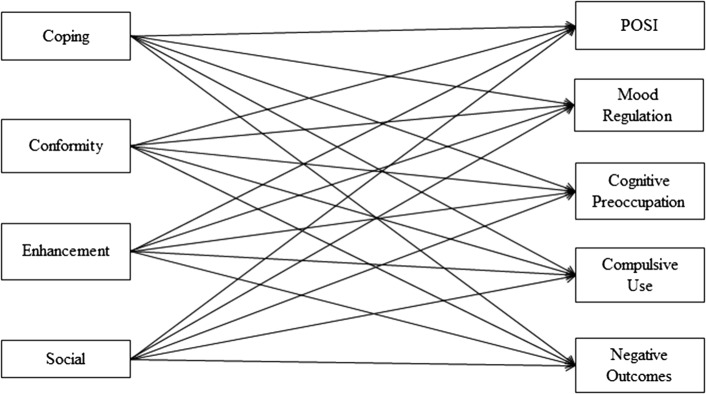
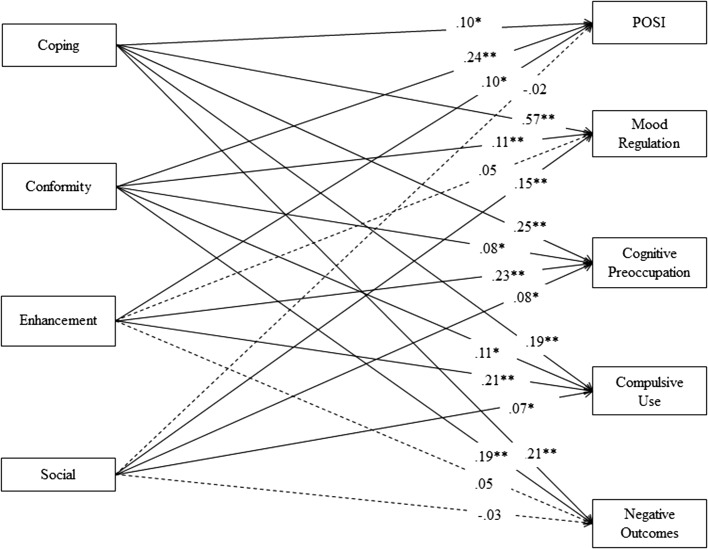
Background and aims There is a growing body of evidence suggesting that problematic Facebook use (PFU) is an emerging problem, particularly among adolescents. Although a number of motivations explaining why people engage in frequent Facebook use have been identified, less is known about the specific psychological needs underlying PFU. The aim of this study is to test a model designed to assess the unique contribution of psychological motives for using Facebook to the different PFU dimensions in a sample of adolescents. Methods A total of 864 Italian adolescents participated in the study. Multivariate multiple regression was run to test whether the four motives were differently associated with problematic dimensions. Results The results showed that the two motives with negative valence (coping and conformity) were significantly linked to the five dimensions of PFU, whereas the two motives with positive valence (enhancement and social) appeared to be weaker predictors for three out of these five dimensions. Discussion and conclusion In conclusion, psychological motives for using Facebook appeared to significantly contribute to explaining PFU among adolescents, and should be considered by researchers and educational practitioners.
背景与目的 越来越多的证据表明,问题性 Facebook 使用(PFU)是一个新兴问题,尤其是在青少年中。尽管已经确定了一些解释人们频繁使用 Facebook 的动机,但对于 PFU 背后的特定心理需求知之甚少。本研究旨在测试一个模型,该模型旨在评估使用 Facebook 的心理动机对青少年样本中不同 PFU 维度的独特贡献。 方法 共有 864 名意大利青少年参与了这项研究。进行了多元多重回归分析,以检验这四个动机是否与问题性维度有不同的关联。 结果 结果表明,两个具有负面效价的动机(应对和从众)与 PFU 的五个维度显著相关,而两个具有正面效价的动机(增强和社交)对于这五个维度中的三个维度似乎是较弱的预测因素。 讨论与结论 总之,使用 Facebook 的心理动机似乎可以显著解释青少年中的 PFU,因此研究人员和教育工作者应该考虑这些动机。