National Human Genome Research Institute (L.D.H.)
National Institutes of Health, Bethesda, MD. The Henry M. Jackson Foundation for the Advancement of Military Medicine, Inc, Collaborative Health Initiative Research Program, Uniformed Services University of the Health Sciences and Walter Reed National Military Medical Center, Bethesda, MD (L.D.H.).
Circ Genom Precis Med. 2018 Jun;11(6):e001975. doi: 10.1161/CIRCGEN.117.001975.
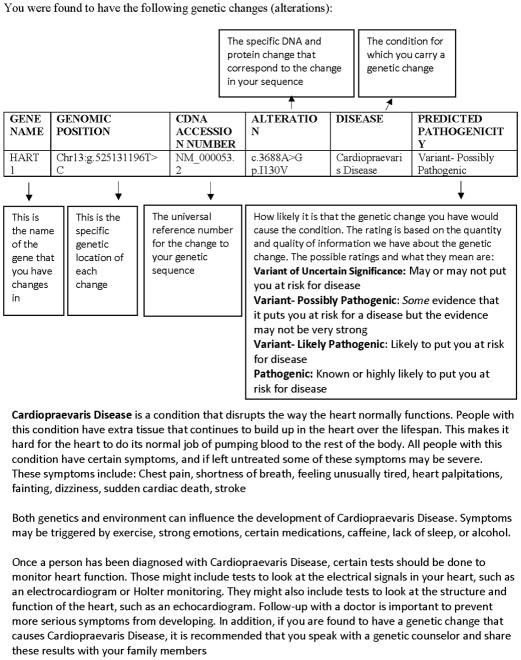
Clinical genetic testing for heritable cardiovascular disease has become a widely used tool to aid in the management of patients and their families. A 5-category variant classification system is commonly used for genetic test results, but some laboratories further subclassify variants of uncertain significance. How and whether patients perceive differences among the variant categories or subclassifications of variants of uncertain significance is unknown.
We tested whether participants perceived differences in genetic variant subclassifications on outcomes including risk comprehension, risk perception, worry, perceived uncertainty, and intentions. Order-randomized hypothetical cardiovascular genetic results were given to 289 participants enrolled in a genome sequencing study. Three categories of variants were presented to participants: variants of uncertain significance, possibly pathogenic, and likely pathogenic. Responses to the first variant presented were analyzed in a between-groups analysis, and responses to all 3 variants were analyzed in a within-groups analysis.
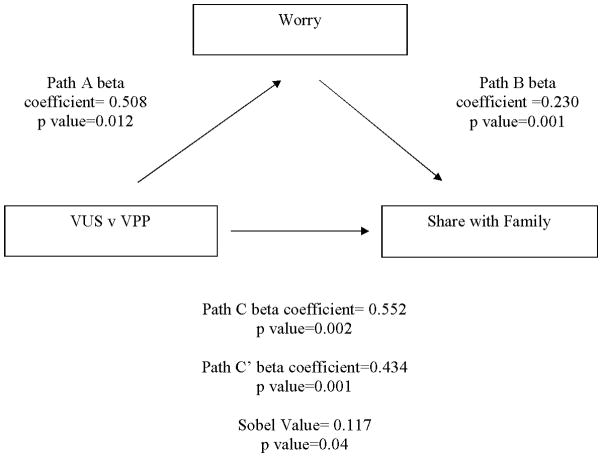
When presented with all 3 results, participants distinguished among the subclassifications on all outcomes (<0.001). When given only a possibly pathogenic result, their risk perceptions were similar to those of variants of uncertain significance, but they were more worried and intended to behave as if they had received a likely pathogenic result. Individuals depended more on their affective responses such as worry when they received only one result (<0.05).
Participants are better able to distinguish pathogenicity subclassifications when presented with multiple categories. Individuals who receive a single uncertain result in a cardiovascular disease gene may benefit from interventions to decrease worry, calibrate risk perceptions, and motivate variant-appropriate behaviors.
遗传性心血管疾病的临床基因检测已成为辅助患者及其家属管理的常用工具。遗传检测结果通常采用 5 类变异分类系统,但一些实验室进一步对意义不明的变异进行亚分类。患者如何以及是否感知到变异类别或意义不明变异的亚分类之间的差异尚不清楚。
我们测试了参与者是否感知到遗传变异亚分类在风险理解、风险感知、担忧、感知不确定性和意向等结果上的差异。将假设的心血管遗传检测结果按顺序随机分发给参加基因组测序研究的 289 名参与者。向参与者呈现了三类变异:意义不明的变异、可能致病性的变异和可能致病性的变异。对呈现的第一个变异的反应进行了组间分析,对所有 3 个变异的反应进行了组内分析。
当呈现所有 3 个结果时,参与者在所有结果上都能区分亚分类(<0.001)。当仅呈现一个可能致病性的结果时,他们的风险感知与意义不明的变异相似,但他们更担心,并打算表现得好像收到了一个可能致病性的结果。当只收到一个结果时,个体更多地依赖于他们的情感反应,如担忧(<0.05)。
当呈现多个类别时,参与者更能区分致病性亚分类。在心血管疾病基因中仅收到一个不确定结果的个体可能受益于干预措施,以减少担忧、校准风险感知,并激励适当的变异行为。