Department of Community Medicine and Rehabilitation, Physiotherapy, Umeå University, Umeå, Sweden.
Department of Community Medicine and Rehabilitation, Geriatric Medicine, Umeå University, Umeå, Sweden.
J Geriatr Phys Ther. 2019 Oct/Dec;42(4):E16-E24. doi: 10.1519/JPT.0000000000000199.
Exercise programs for people with dementia need to be optimized. We therefore evaluated the applicability of a high-intensity functional exercise program among people with dementia in nursing homes with regard to attendance, achieved exercise intensity, adverse events, a focus on dementia type, and whether symptoms of dementia or other medical conditions common in this population were associated with program applicability.
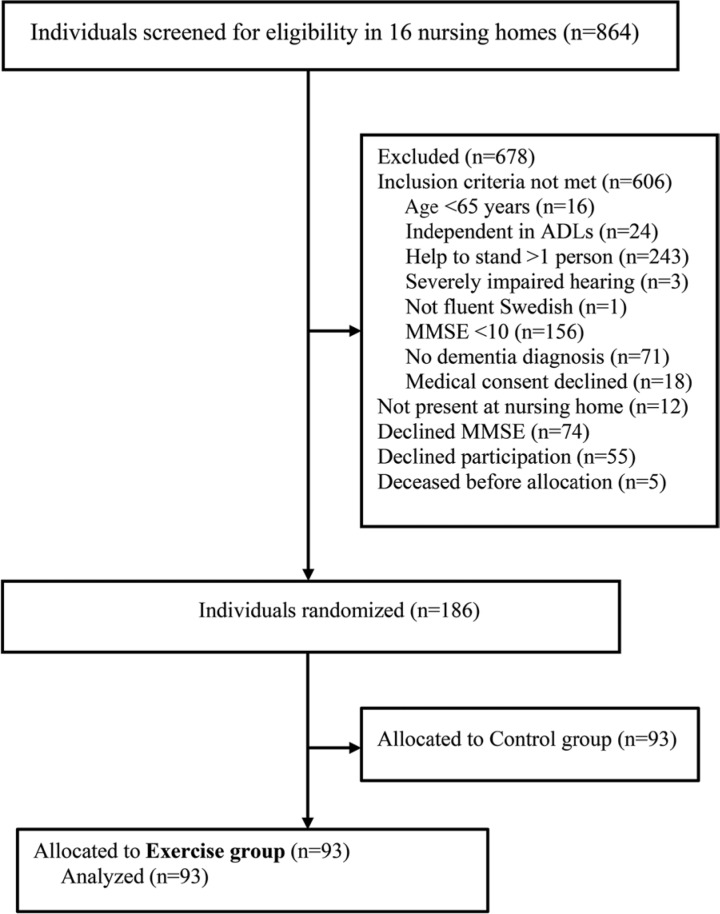
The Umeå Dementia and Exercise study, a cluster-randomized controlled trial set in 16 nursing homes in Umeå, Sweden. Ninety-three people with dementia (mean [SD] Mini-Mental State Examination score of 15.4 [3.4]) were randomized to the exercise intervention. Thirty-four participants had Alzheimer's disease (AD) and 59 non-Alzheimer's dementia (non-AD). High-Intensity Functional Exercise (HIFE) program was conducted in groups of 3 to 8 participants. Two physiotherapists led 5 sessions (45 minutes each) per fortnight for 4 months (total 40 sessions).
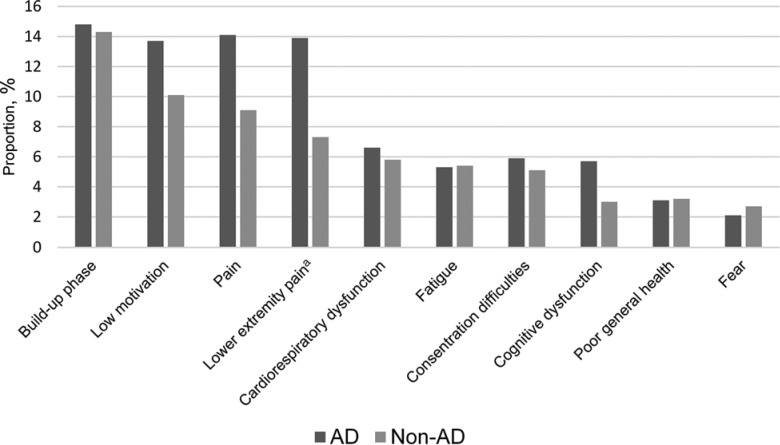
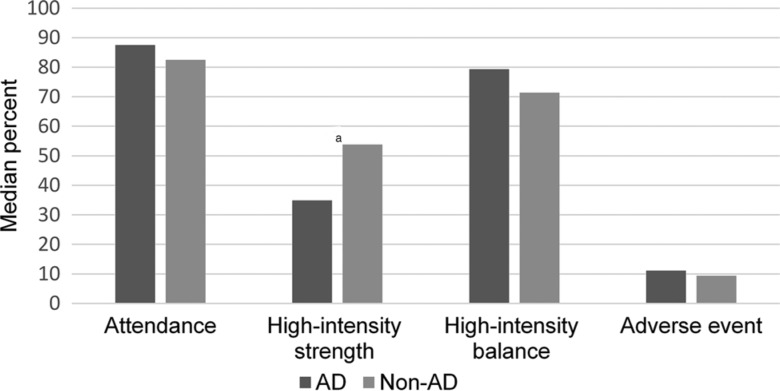
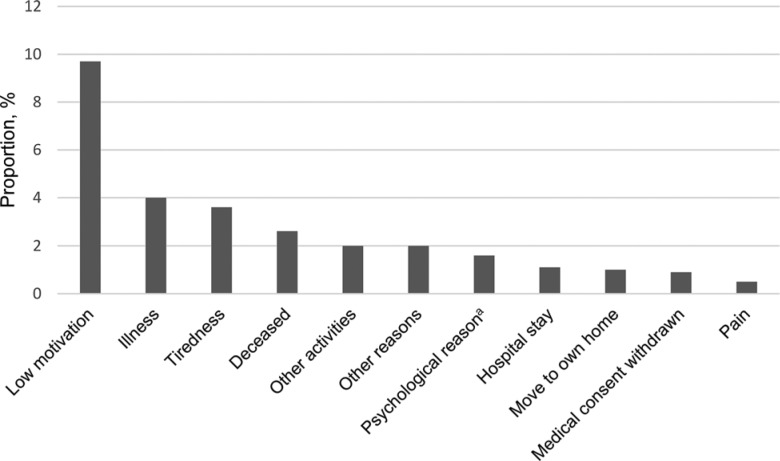
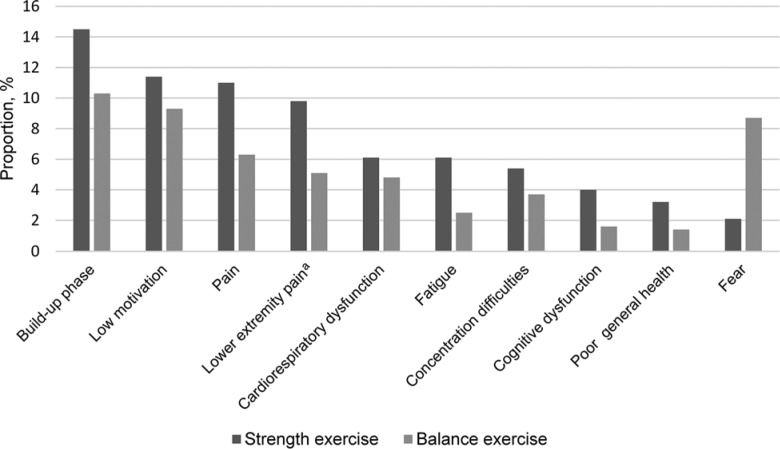
Median attendance rate was 82.5%. Lower limb strength exercises were performed at high or medium intensity at a median interquartile range of 94.7% (77.8%-100%) of attended sessions. Participants with non-AD performed more sessions with high intensity in strength exercises than participants with AD (median interquartile range, 53.8% [25.7%-80%] vs 34.9% [2.02%-62.9%]; P = .035). Balance exercises were performed at high intensity at a median interquartile range of 75% (33.3%-88.6%). Adverse events (all minor and temporary, mostly musculoskeletal) occurred during the exercise sessions in 16% of attended sessions. Low motivation was the most common barrier for attendance. Buildup period, low motivation, and pain were common barriers for achieving high intensity in balance and strength exercises, and fear was a barrier in balance exercises. Of medical conditions, only behavioral and psychological symptoms of dementia, including apathy, were negatively associated with applicability.
A group-based, supervised, and individualized high-intensity functional exercise program seems to be applicable with regard to attendance, achieved intensity, and adverse events during the exercise sessions, in people with mild to moderate dementia in nursing homes. Effective strategies to enhance motivation to participate in exercise, as well as prevention and treatment of pain and behavioral and psychological symptoms of dementia, are important when promoting exercise participation in this population.
需要优化针对痴呆患者的运动项目。因此,我们评估了高强度功能性运动项目在有痴呆症的养老院人群中的适用性,主要考虑参与度、所达到的运动强度、不良事件、对痴呆症类型的关注以及痴呆症或该人群中常见的其他医学病症是否与项目适用性相关。
这是一项在瑞典于默奥的 16 家养老院开展的集群随机对照试验,即于默奥痴呆症与运动研究。93 名痴呆症患者(平均[标准差]简易精神状态检查评分为 15.4[3.4])被随机分配到运动干预组。34 名参与者患有阿尔茨海默病(AD),59 名患有非阿尔茨海默病痴呆症(非 AD)。高强度功能性运动(HIFE)项目以 3 至 8 人的小组形式进行,每两周开展 5 次(每次 45 分钟),为期 4 个月(共 40 次)。
中位出席率为 82.5%。下肢力量训练在出席的课程中以高或中强度进行,中位数为 94.7%(77.8%-100%)。非 AD 患者在力量训练中进行高强度训练的课程比 AD 患者多(中位数,53.8%[25.7%-80%]比 34.9%[2.02%-62.9%];P=.035)。平衡训练在中位数为 75%(33.3%-88.6%)的课程中以高强度进行。在出席的课程中,16%的课程发生了不良事件(均为轻微且暂时的,主要为肌肉骨骼相关)。低动力是出席的最常见障碍。准备期、低动力、疼痛是平衡和力量训练中达到高强度的常见障碍,而恐惧是平衡训练的障碍。在医学病症中,只有行为和心理症状的痴呆症,包括淡漠,与适用性呈负相关。
在养老院中,对于轻度至中度痴呆症患者,以小组为基础、监督和个体化的高强度功能性运动项目在参与度、达到的强度和运动课程中的不良事件方面似乎具有适用性。为了促进该人群的运动参与,增强参与运动的动力以及预防和治疗疼痛和行为及心理症状的有效策略非常重要。