Ge Zhenyang, Duan Zhijun, Yang Hang, Zhang Shengai, Zhang Shuang, Wang Lixia, Yang Dong, Sun Xiaoyu, Zhang Zhifeng, Su Liping, Zhu Hong, Zhou Dongdong, Liu Bojia, Shi Honggang, Yu Jun, Yang Hui, Chang Qingyong, Zhang Nina, Wu Dongsheng, Chen Jiande D Z
Neurogastroenterology and Motility Center of China-US Cooperation, The Second Department of Gastroenterology, College of Integrative Medicine, The First Affiliated Hospital of Dalian Medical University, No. 222 Zhongshan Road, Dalian, Liaoning 116011, China.
Clinical Laboratory, The First Affiliated Hospital of Dalian Medical University, No. 222 Zhongshan Road, Dalian, Liaoning 116011, China.
Evid Based Complement Alternat Med. 2018 Apr 29;2018:2086163. doi: 10.1155/2018/2086163. eCollection 2018.
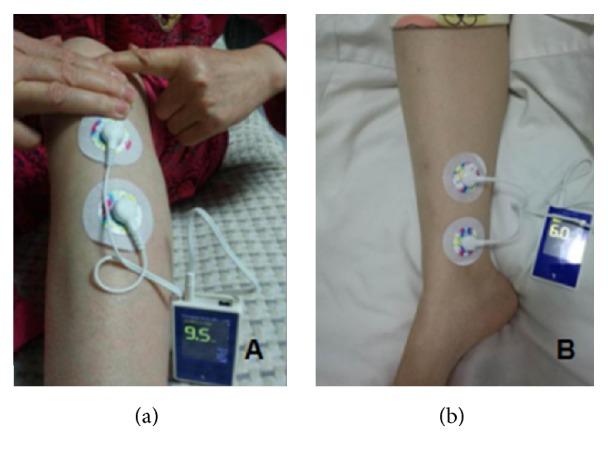
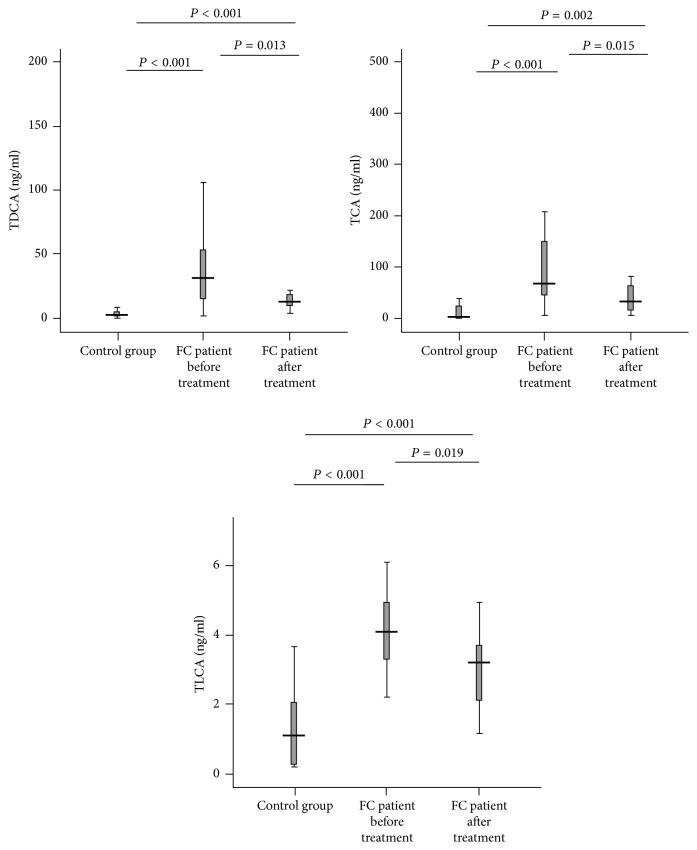
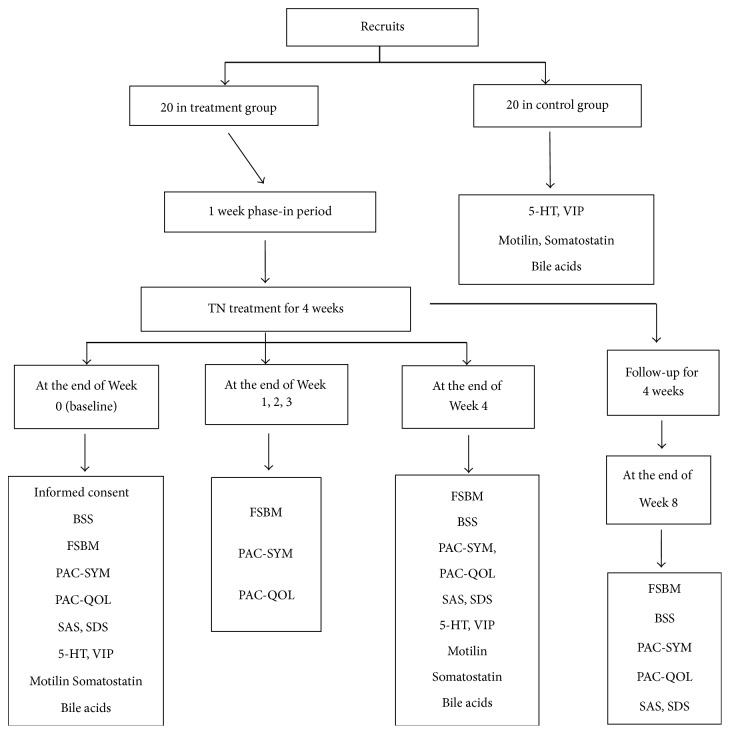
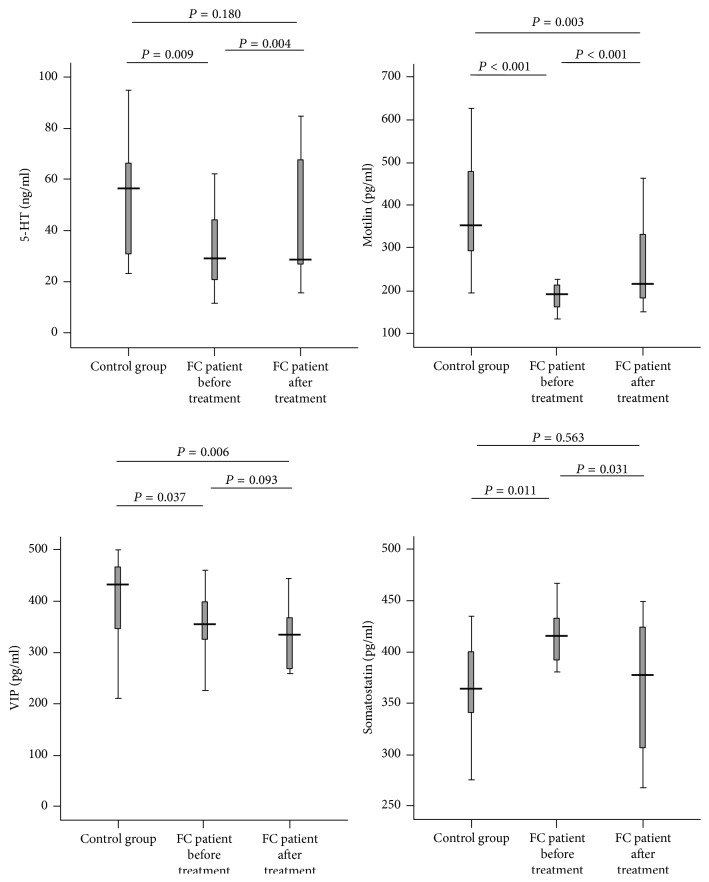
This study aims to investigate the role of transcutaneous neuromodulation (TN) on the regulation of gastrointestinal hormones and bile acids in patients with functional constipation (FC). Twenty FC patients were treated with TN for four weeks. The effects of TN on symptoms were evaluated by questionnaires. Plasma levels of serotonin (5-HT), motilin, somatostatin, and vasoactive intestinal peptide (VIP) were measured by ELISA and 12 individual bile acids assayed by liquid chromatography tandem mass spectrometry. Results were as follows. (1) TN treatment increased the frequency of spontaneous bowel movement, improved the Bristol Stool Score, and reduced Patient Assessment of Constipation Symptom score and Patient Assessment of Constipation Quality of Life score. (2) FC patients showed decreased plasma levels of 5-HT, motilin, and VIP and an increased plasma level of somatostatin ( < 0.05). Four-week TN treatment increased plasma levels of 5-HT and motilin and decreased the plasma level of somatostatin in the FC patients ( < 0.05). (3) Taurocholic deoxycholate, taurocholic acid, and taurocholic lithocholic acid were increased in the FC patients ( < 0.005) but reduced by TN treatment ( < 0.05). This study has suggested that the therapy may improve the symptoms of FC by alleviating the disorders of gastrointestinal hormones and bile acids.
本研究旨在探讨经皮神经调节(TN)对功能性便秘(FC)患者胃肠激素和胆汁酸调节的作用。20例FC患者接受了为期四周的TN治疗。通过问卷调查评估TN对症状的影响。采用酶联免疫吸附测定法(ELISA)测定血浆中5-羟色胺(5-HT)、胃动素、生长抑素和血管活性肠肽(VIP)的水平,并用液相色谱串联质谱法测定12种个体胆汁酸。结果如下:(1)TN治疗增加了自发排便频率,改善了布里斯托大便评分,并降低了便秘症状患者评估评分和便秘生活质量患者评估评分。(2)FC患者血浆中5-HT、胃动素和VIP水平降低,生长抑素血浆水平升高(<0.05)。为期四周的TN治疗使FC患者血浆中5-HT和胃动素水平升高,生长抑素血浆水平降低(<0.05)。(3)FC患者中牛磺胆酸脱氧胆酸、牛磺胆酸和牛磺胆酸石胆酸增加(<0.005),但经TN治疗后降低(<0.05)。本研究表明,该疗法可能通过缓解胃肠激素和胆汁酸紊乱来改善FC症状。