Schei Jørgen, Fuskevåg Ole-Martin, Stefansson Vidar Tor Nyborg, Solbu Marit Dahl, Jenssen Trond Geir, Eriksen Bjørn Odvar, Melsom Toralf
Department of Nephrology, University Hospital of North Norway, Tromsø, Norway.
Metabolic and Renal Research Group, UiT The Arctic University of Norway, Tromsø, Norway.
Kidney Int Rep. 2017 Dec 7;3(3):573-582. doi: 10.1016/j.ekir.2017.11.020. eCollection 2018 May.
Markers of oxidative stress increase with age and are prevalent with chronic kidney disease. However, the role of oxidative stress markers as predictors for kidney function decline in the general population is unclear.
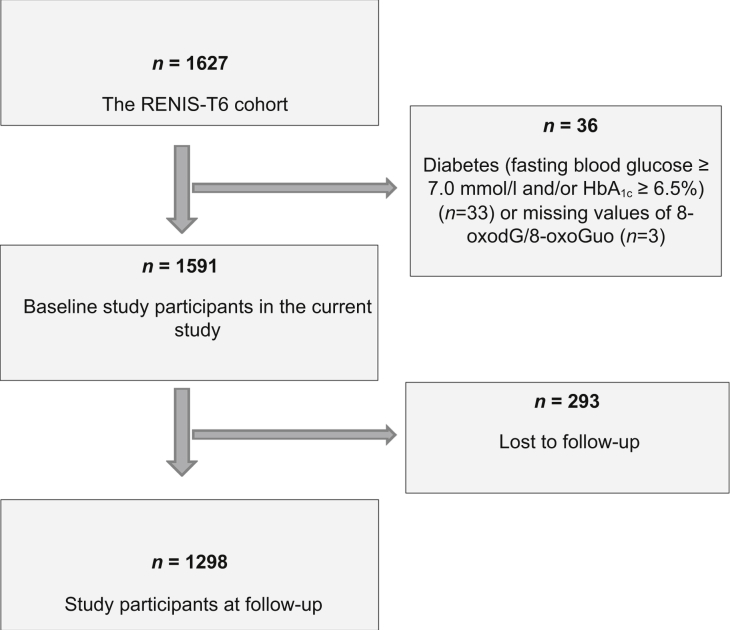
We investigated whether a baseline urinary excretion of oxidative DNA damage (8-oxo-7,8-dihydro-2'-deoxyguanosine [8-oxodG]) and oxidative RNA damage (8-oxo-7,8-dihydroguanosine [8-oxoGuo]) was associated with the age-related glomerular filtration rate (GFR) decline or incident low-grade albuminuria during a median of 5.6 years of follow-up. In the Renal Iohexol Clearance Survey in the Sixth Tromsø Study, we measured GFR using iohexol clearance in 1591 participants without renal disease, diabetes, or cardiovascular disease. Low-grade albuminuria was defined as an albumin-creatinine ratio >1.13 mg/mmol.
The mean (SD) annual GFR change was -0.84 (2.00) ml/min per 1.73 m per year. In linear mixed models, urinary 8-oxodG and 8-oxoGuo levels were not associated with the GFR change rate. In a multivariable adjusted logistic regression model, a baseline urinary 8-oxoGuo in the highest quartile was associated with an increased risk of low-grade albuminuria at follow-up (odds ratio: 2.64; 95% confidence interval: 1.50-4.65). When the highest quartile of urinary 8-oxoGuo was added to the baseline model, the area under the receiver operating characteristics curve for predicting low-grade albuminuria at follow-up improved from 0.67 to 0.71 ( = 0.002).
Oxidative stress measured as urinary 8-oxoGuo excretion was independently associated with incident low-grade albuminuria, but neither 8-oxoGuo nor 8-oxodG predicted an accelerated age-related GFR decline in a cohort representative of the middle-aged general population during almost 6 years of follow-up.
氧化应激标志物随年龄增长而增加,在慢性肾脏病中也很常见。然而,氧化应激标志物作为一般人群肾功能下降预测指标的作用尚不清楚。
我们调查了氧化DNA损伤(8-氧代-7,8-二氢-2'-脱氧鸟苷[8-氧代脱氧鸟苷])和氧化RNA损伤(8-氧代-7,8-二氢鸟苷[8-氧代鸟苷])的基线尿排泄量是否与在中位随访5.6年期间与年龄相关的肾小球滤过率(GFR)下降或新发轻度蛋白尿相关。在第六次特罗姆瑟研究的肾碘海醇清除率调查中,我们对1591名无肾脏疾病、糖尿病或心血管疾病的参与者使用碘海醇清除率测量GFR。轻度蛋白尿定义为白蛋白-肌酐比值>1.13mg/mmol。
平均(标准差)每年GFR变化为每1.73平方米每年-0.84(2.00)ml/min。在线性混合模型中,尿8-氧代脱氧鸟苷和8-氧代鸟苷水平与GFR变化率无关。在多变量调整逻辑回归模型中,基线尿8-氧代鸟苷处于最高四分位数与随访时轻度蛋白尿风险增加相关(比值比:2.64;95%置信区间:1.50-4.65)。当将尿8-氧代鸟苷的最高四分位数添加到基线模型中时,预测随访时轻度蛋白尿的受试者工作特征曲线下面积从0.67提高到0.71(P=0.002)。
以尿8-氧代鸟苷排泄量衡量的氧化应激与新发轻度蛋白尿独立相关,但在近6年随访期间,在代表中年一般人群的队列中,8-氧代鸟苷和8-氧代脱氧鸟苷均未预测与年龄相关的GFR加速下降。