Instituto de Investigaciones de Enfermedades Tropicales, Universidad Nacional de Salta/CONIECT-Oran, Argentina.
Clinical Sciences Department, Liverpool School of Tropical Medicine, Liverpool, United Kingdom.
PLoS Negl Trop Dis. 2018 Jun 1;12(6):e0006550. doi: 10.1371/journal.pntd.0006550. eCollection 2018 Jun.
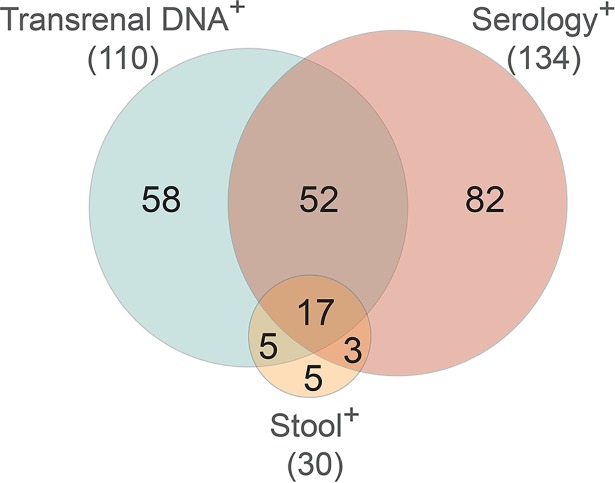
For epidemiological work with soil transmitted helminths the recommended diagnostic approaches are to examine fecal samples for microscopic evidence of the parasite. In addition to several logistical and processing issues, traditional diagnostic approaches have been shown to lack the sensitivity required to reliably identify patients harboring low-level infections such as those associated with effective mass drug intervention programs. In this context, there is a need to rethink the approaches used for helminth diagnostics. Serological methods are now in use, however these tests are indirect and depend on individual immune responses, exposure patterns and the nature of the antigen. However, it has been demonstrated that cell-free DNA from pathogens and cancers can be readily detected in patient's urine which can be collected in the field, filtered in situ and processed later for analysis. In the work presented here, we employ three diagnostic procedures-stool examination, serology (NIE-ELISA) and PCR-based amplification of parasite transrenal DNA from urine-to determine their relative utility in the diagnosis of S. stercoralis infections from 359 field samples from an endemic area of Argentina. Bayesian Latent Class analysis was used to assess the relative performance of the three diagnostic procedures. The results underscore the low sensitivity of stool examination and support the idea that the use of serology combined with parasite transrenal DNA detection may be a useful strategy for sensitive and specific detection of low-level strongyloidiasis.
对于土壤传播性蠕虫的流行病学研究,推荐的诊断方法是检查粪便样本中是否存在寄生虫的微观证据。除了一些后勤和处理问题外,传统的诊断方法已经被证明缺乏敏感性,无法可靠地识别出低水平感染的患者,如与有效大规模药物干预计划相关的感染。在这种情况下,需要重新思考用于寄生虫诊断的方法。现在已经使用了血清学方法,但是这些测试是间接的,取决于个体的免疫反应、暴露模式和抗原的性质。然而,已经证明可以从患者尿液中容易地检测到病原体和癌症的无细胞 DNA,这些尿液可以在现场采集,原位过滤,然后进行分析。在本文中,我们采用了三种诊断程序——粪便检查、血清学(NIE-ELISA)和基于 PCR 的寄生虫跨肾 DNA 扩增——来确定它们在诊断阿根廷流行地区 359 个现场样本中的 S. stercoralis 感染中的相对效用。贝叶斯潜在类别分析用于评估三种诊断程序的相对性能。结果强调了粪便检查的低敏感性,并支持了使用血清学结合寄生虫跨肾 DNA 检测可能是敏感和特异性检测低水平旋毛虫病的有用策略的想法。