Ministry of Agriculture and Food Security, Juba, South Sudan.
African Centre for Crop Improvement, School of Agricultural Sciences and Agribusiness, University of KwaZulu-Natal, Pietermaritzburg, South Africa.
PLoS One. 2018 Jun 1;13(6):e0198012. doi: 10.1371/journal.pone.0198012. eCollection 2018.
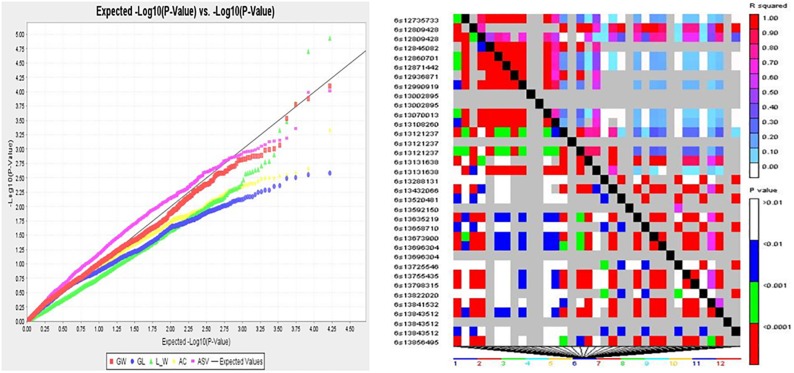
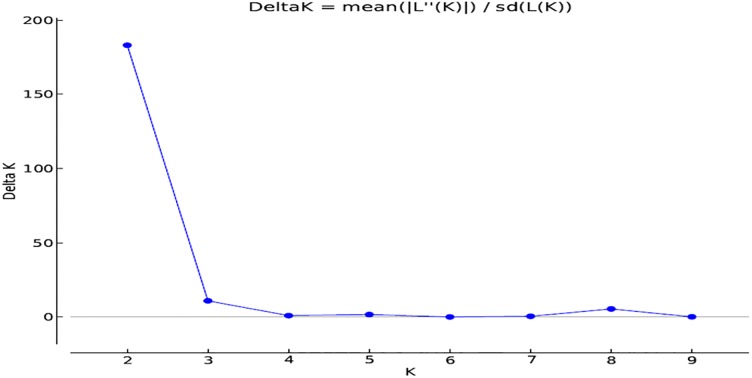
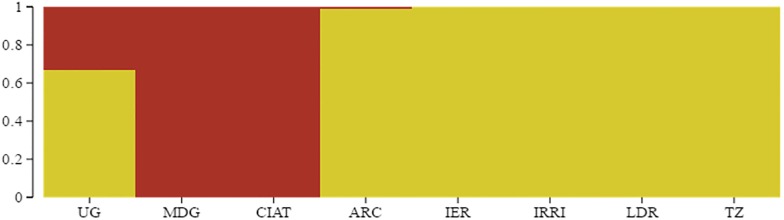
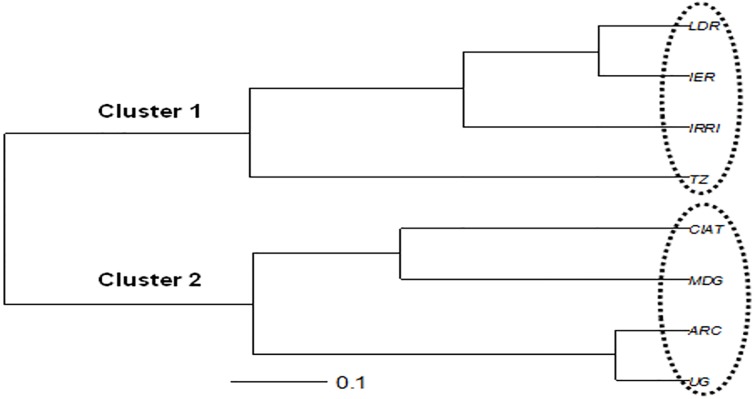
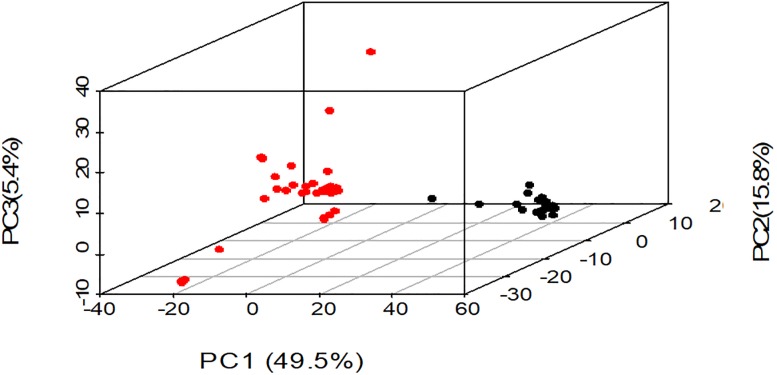
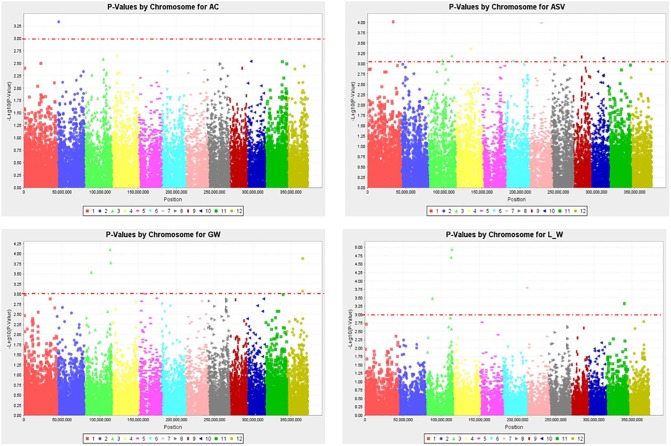
Microarray-based markers such as Diversity Arrays Technology (DArT) have become the genetic markers of choice for construction of high-density maps, quantitative trait loci (QTL) mapping and genetic diversity analysis based on their efficiency and low cost. More recently, the DArT technology was further developed in combination with high-throughput next-generation sequencing (NGS) technologies to generate the DArTseq platform representing a new sequencing tool of complexity-reduced representations. In this study, we used DArTseq markers to investigate genetic diversity and genome-wide association studies (GWAS) of grain quality traits in rice (Oryza sativa L.). The study was performed using 59 rice genotypes with 525 SNPs derived from DArTseq platform. Population structure analysis revealed only two distinct genetic clusters where genotypes were grouped based on environmental adaptation and pedigree information. Analysis of molecular variance indicated a low degree of differentiation among populations suggesting the need for broadening the genetic base of the current germplasm collection. GWAS revealed 22 significant associations between DArTseq-derived SNP markers and rice grain quality traits in the test genotypes. In general, 2 of the 22 significant associations were in chromosomal regions where the QTLs associated with the given traits had previously been reported, the other 20 significant SNP marker loci were indicative of the likelihood discovery of novel alleles associated with rice grain quality traits. DArTseq-derived SNP markers that include SNP12_100006178, SNP13_3052560 and SNP14_3057360 individually co-localised with two functional gene groups that were associated with QTLs for grain width and grain length to width ratio on chromosome 3, indicating trait dependency or pleiotropic-effect loci. This study demonstrated that DArTseq markers were useful genomic resources for genome-wide association studies of rice grain quality traits to accelerate varietal development and release.
基于微阵列的标记物,如多样性阵列技术(DArT),由于其效率高、成本低,已成为构建高密度图谱、数量性状基因座(QTL)作图和遗传多样性分析的首选遗传标记物。最近,DArT 技术与高通量下一代测序(NGS)技术相结合,进一步开发了 DArTseq 平台,代表了一种新的简化复杂性的测序工具。在本研究中,我们使用 DArTseq 标记物研究了水稻(Oryza sativa L.)的遗传多样性和全基因组关联研究(GWAS)。研究使用了来自 DArTseq 平台的 525 个 SNP 的 59 个水稻基因型。群体结构分析显示,只有两个明显的遗传群,基因型是根据环境适应和系谱信息分组的。分子方差分析表明,群体之间的分化程度较低,表明需要扩大当前种质资源收集的遗传基础。GWAS 揭示了 59 个测试基因型中 22 个 DArTseq 衍生 SNP 标记物与水稻籽粒品质性状之间的显著关联。一般来说,22 个显著关联中有 2 个位于与给定性状相关的 QTL 先前报道过的染色体区域,其他 20 个显著 SNP 标记物位点表明可能发现与水稻籽粒品质性状相关的新等位基因。包括 SNP12_100006178、SNP13_3052560 和 SNP14_3057360 的 DArTseq 衍生 SNP 标记物分别与与第 3 号染色体上粒宽和粒长与宽比相关的两个功能基因群共定位,表明性状依赖性或多效性效应位点。本研究表明,DArTseq 标记物是水稻籽粒品质性状全基因组关联研究的有用基因组资源,可加速品种的开发和推广。