Experimental Eye Research, University Eye Hospital, Ruhr-University Bochum, In der Schornau 23-25, 44892 Bochum, Germany.
Int J Mol Sci. 2018 May 31;19(6):1636. doi: 10.3390/ijms19061636.
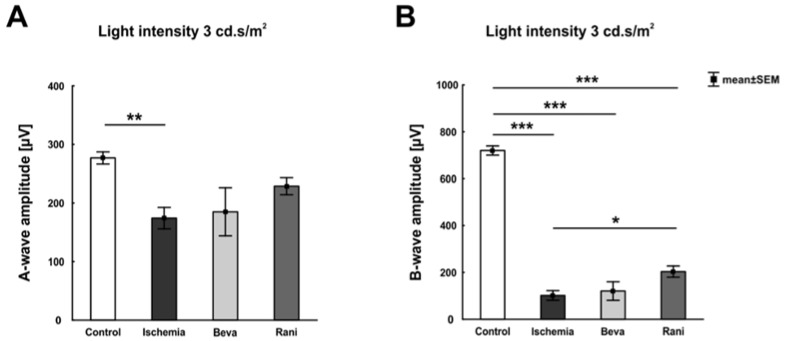
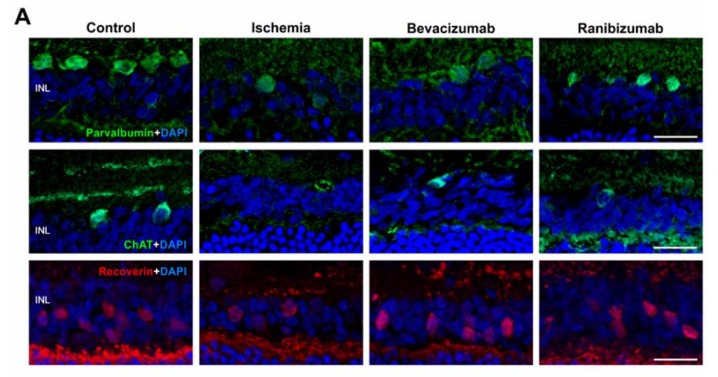
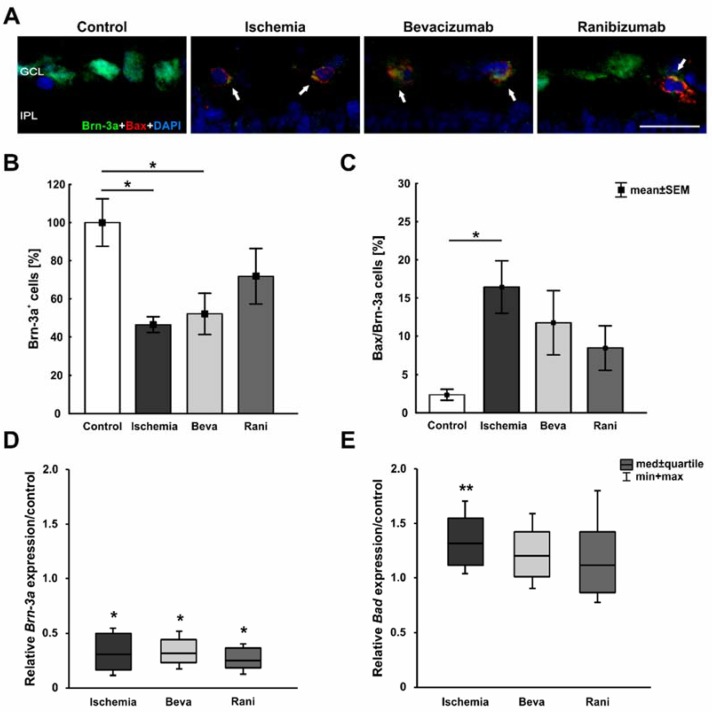
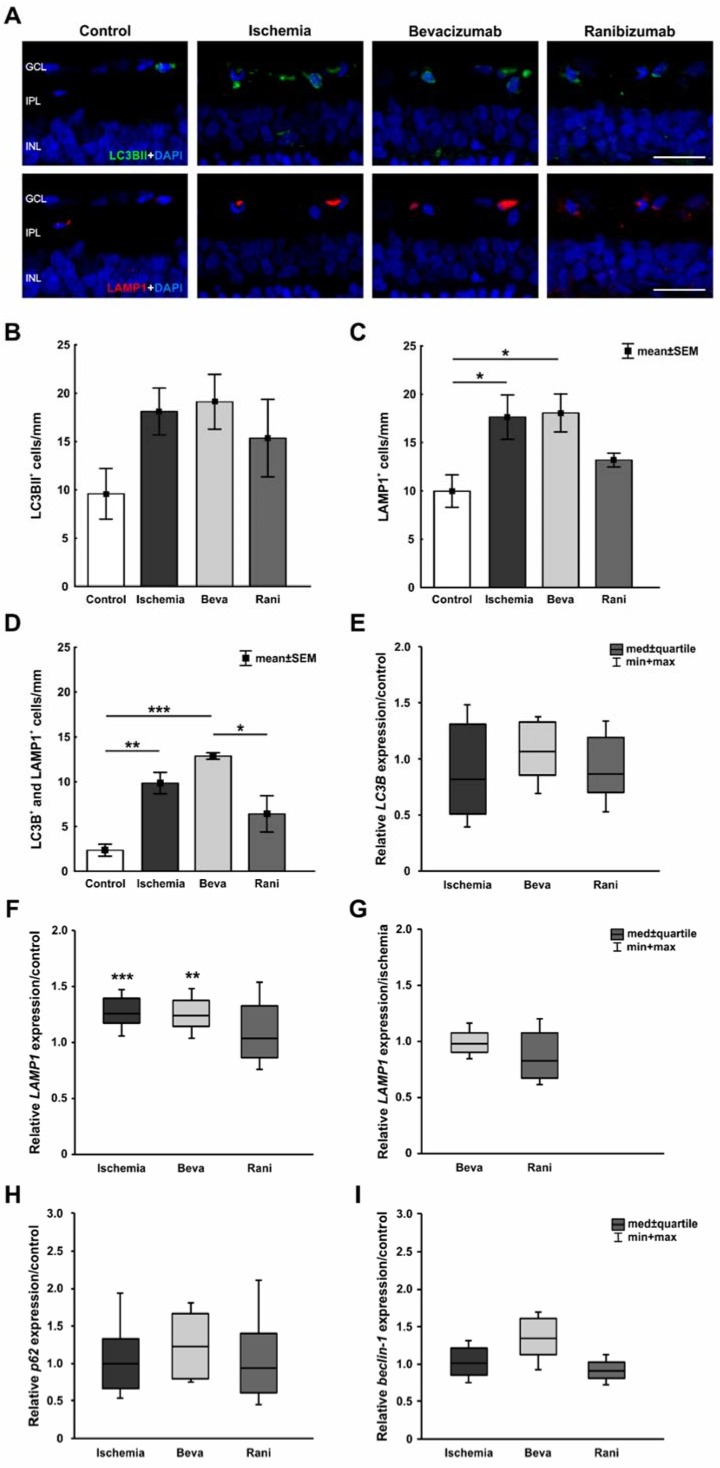
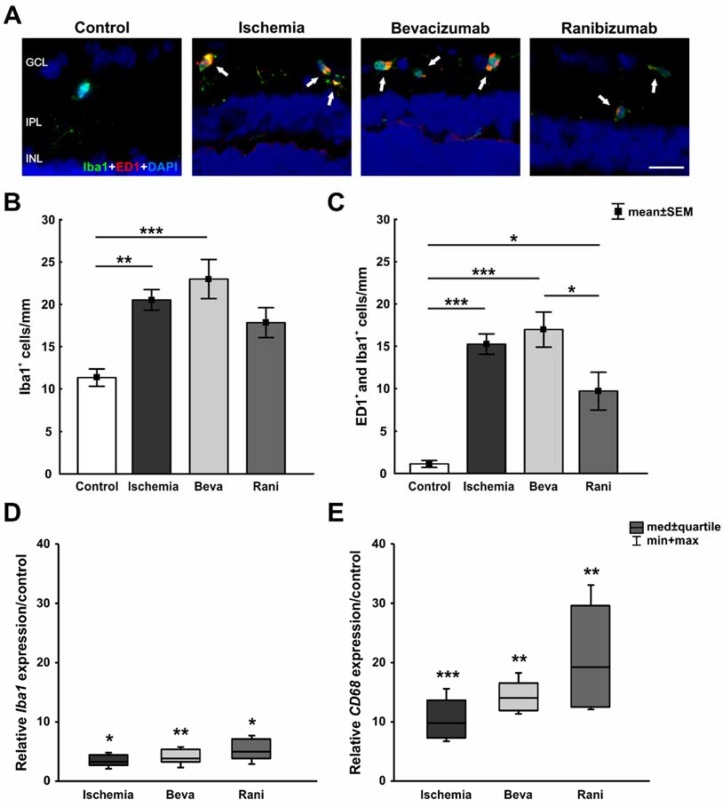
Retinal ischemia is an important factor in several eye disorders. To investigate the impact of VEGF inhibitors, as a therapeutic option, we studied these in a retinal ischemia animal model. Therefore, animals received bevacizumab or ranibizumab intravitreally one day after ischemia induction. Via electroretinography, a significant decrease in a- and b-wave amplitudes was detected fourteen days after ischemia, but they were reduced to a lesser extent in the ranibizumab group. Ischemic and bevacizumab retinae displayed fewer retinal ganglion cells (RGCs), while no significant cell loss was noted in the ranibizumab group. Apoptosis was reduced after therapy. More autophagocytotic cells were observed in ischemic and bevacizumab eyes, but not in ranibizumab eyes. Additionally, more microglia, as well as active ones, were revealed in all ischemic groups, but the increase was less prominent under ranibizumab treatment. Fewer cone bipolar cells were detected in ischemic eyes, in contrast to bevacizumab and ranibizumab-treated ones. Our results demonstrate a reduced apoptosis and autophagocytosis rate after ranibizumab treatment. Furthermore, a certain protection was seen regarding functionality, RGC, and bipolar cell availability, as well as microglia activation by ranibizumab treatment after ischemic damage. Thus, ranibizumab could be an option for treatment of retinal ischemic injury.
视网膜缺血是几种眼部疾病的重要因素。为了研究血管内皮生长因子抑制剂作为一种治疗选择的影响,我们在视网膜缺血动物模型中对此进行了研究。因此,动物在缺血诱导后一天接受贝伐单抗或雷珠单抗玻璃体内注射。通过视网膜电图,发现缺血后 14 天 a 波和 b 波幅度显著降低,但雷珠单抗组的降低幅度较小。缺血和贝伐单抗视网膜显示出较少的视网膜神经节细胞(RGC),而雷珠单抗组则没有明显的细胞丢失。治疗后细胞凋亡减少。在缺血和贝伐单抗眼中观察到更多的自噬细胞,但在雷珠单抗眼中则没有。此外,所有缺血组均显示出更多的小胶质细胞,以及更活跃的小胶质细胞,但在雷珠单抗治疗下,这种增加不太明显。与贝伐单抗和雷珠单抗治疗的眼睛相比,缺血眼睛中检测到更少的视锥双极细胞。我们的结果表明,雷珠单抗治疗后细胞凋亡和自噬率降低。此外,雷珠单抗治疗对缺血损伤后的功能、RGC 和双极细胞的存活以及小胶质细胞的激活具有一定的保护作用。因此,雷珠单抗可能是治疗视网膜缺血性损伤的一种选择。