Laboratory of Experimental Medicine and Pediatrics, University of Antwerp, Universiteitsplein 1, T3.34, 2610 Antwerp, Belgium.
Department of Pediatric Nephrology, Antwerp University Hospital, Wilrijkstraat 10, 2650 Edegem, Belgium.
Nutrients. 2018 May 27;10(6):677. doi: 10.3390/nu10060677.
It was shown in animal models and adults that the epidermal growth factor (EGF) is involved in the pathophysiology of calcineurin inhibitor (CNI) induced renal magnesium loss. In children, however, the exact mechanism remains unclear, which was set as the purpose of the present study.
Children with nephrotic syndrome and renal transplant children treated with CNI ( = 50) and non-CNI treated children ( = 46) were included in this study. Urine and serum samples were collected at three time points to determine magnesium, creatinine, and EGF. The magnesium intake was calculated from a food frequency questionnaire.
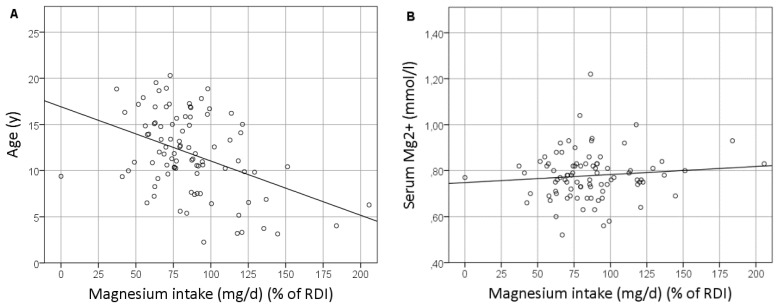
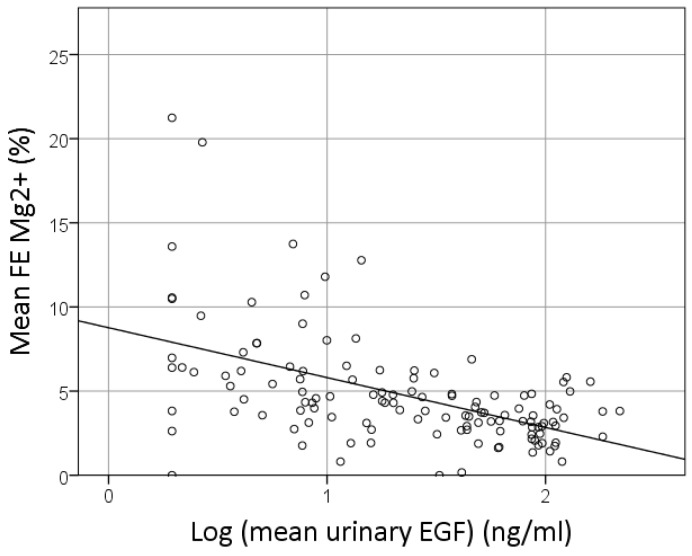
Serum Mg and urinary EGF/creatinine were significantly lower in the CNI treated children, with significantly more CNI-treated children developing hypomagnesaemia. In the latter patients, the fractional excretion of magnesium (FE Mg) was significantly higher. Urinary EGF, age, renal function, and serum magnesium were independent predictors of the FE Mg. Only 29% of the children reached the recommended daily intake of magnesium. The magnesium intake did not differ between hypomagnesemic and normomagnesemic patients and was not a predictor of the FE Mg.
In CNI-treated children who developed hypomagnesemia, the FE Mg was increased. The urinary EGF concentration, age, and renal function are independent predictors of the FE Mg.
在动物模型和成人中已经表明,表皮生长因子(EGF)参与了钙调神经磷酸酶抑制剂(CNI)诱导的肾脏镁丢失的病理生理学。然而,在儿童中,确切的机制仍不清楚,这就是本研究的目的。
本研究纳入了 50 例接受 CNI 治疗的肾病综合征儿童和 46 例接受非 CNI 治疗的儿童。在三个时间点采集尿液和血清样本,以测定镁、肌酐和 EGF。通过食物频率问卷计算镁的摄入量。
CNI 治疗组儿童的血清 Mg 和尿 EGF/肌酐显著降低,且 CNI 治疗组发生低镁血症的儿童明显更多。在这些患者中,镁的滤过分数(FE Mg)显著升高。尿 EGF、年龄、肾功能和血清镁是 FE Mg 的独立预测因子。只有 29%的儿童达到了镁的推荐日摄入量。低镁血症和正常镁血症患者的镁摄入量没有差异,也不是 FE Mg 的预测因子。
在发生低镁血症的 CNI 治疗儿童中,FE Mg 增加。尿 EGF 浓度、年龄和肾功能是 FE Mg 的独立预测因子。