Kar Ipsita, Mishra Amit, Behera Basudev, Khanda Chandramani, Kumar Virender, Kumar Ashok
Orissa University of Agriculture and Technology, Bhubaneshwar, Odisha, India.
International Rice Research Institute, Los Baños, Philippines.
Field Crops Res. 2018 Jun 1;222:218-229. doi: 10.1016/j.fcr.2017.10.007.
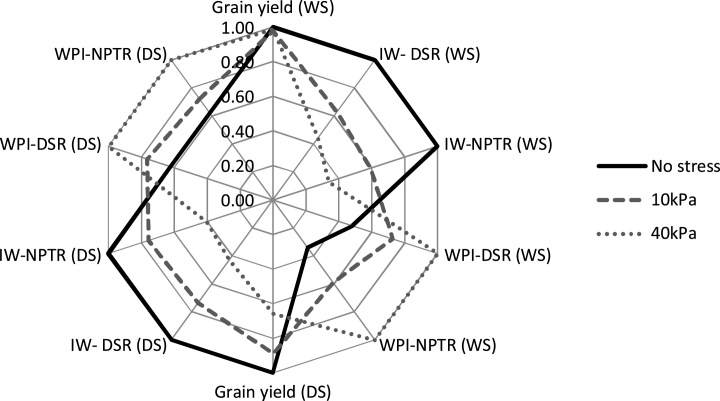
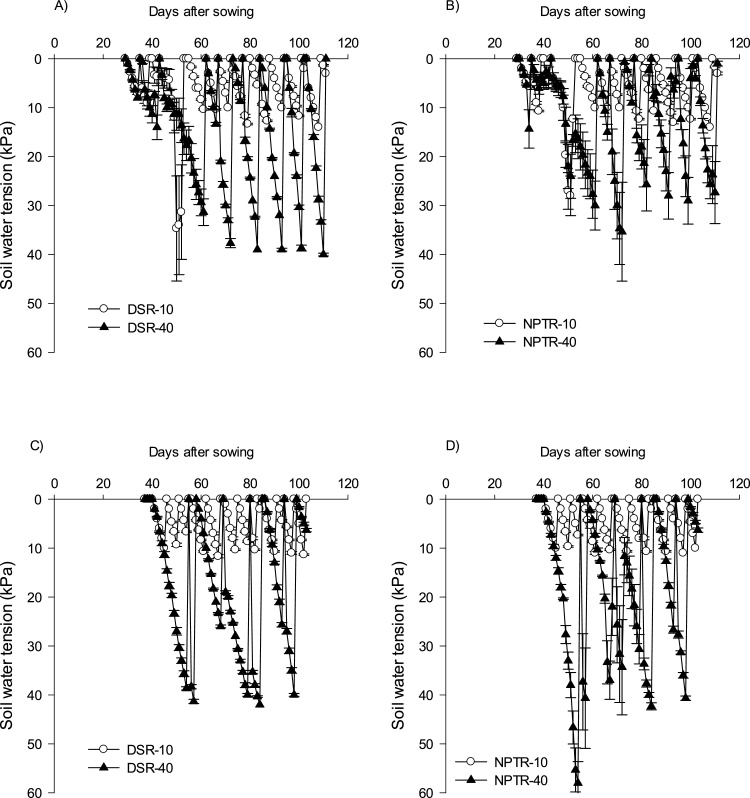
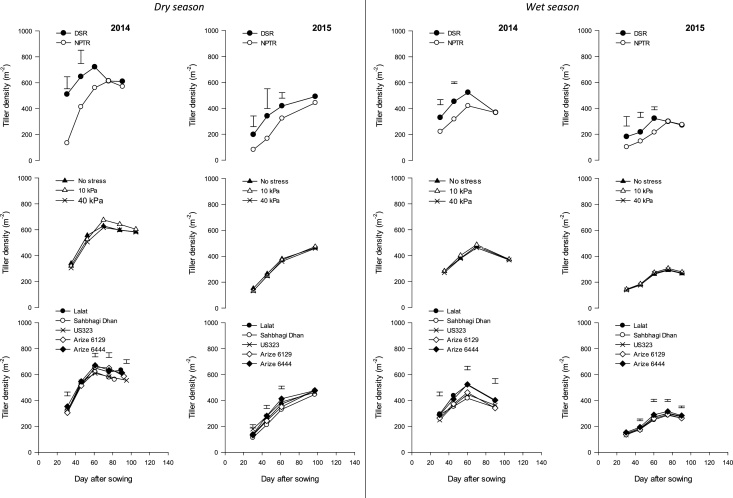
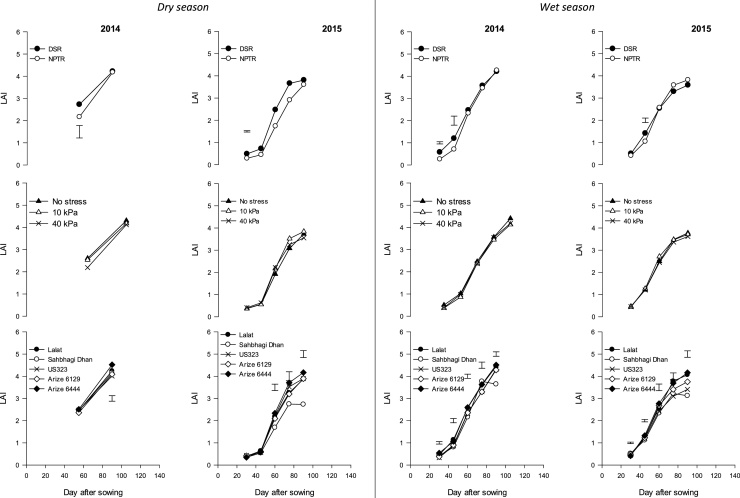
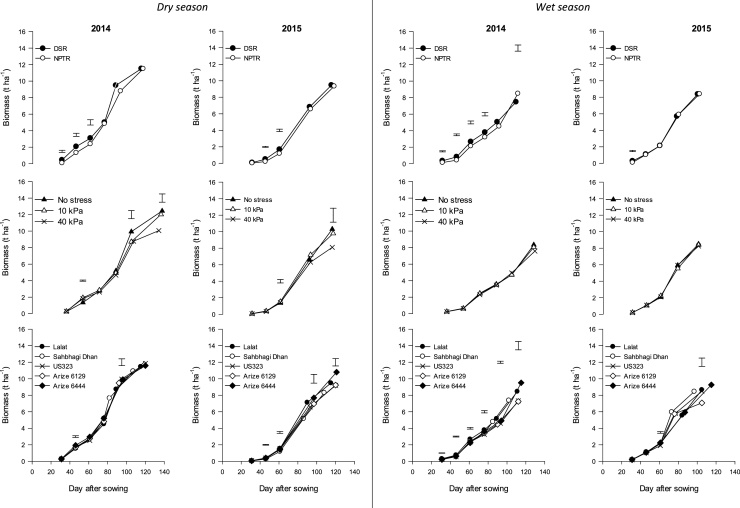
Increasing farm labor scarcity and depletion of natural resources such as water are posing a major threat to the sustainability of traditional puddled transplanted rice (PTR) farming in Eastern India. Dry-seeded rice (DSR) or non-puddled transplanted rice (NPTR) could be used as an alternative to PTR. To understand the trade-off with different water management and rice genotypes under non-puddled conditions, a field experiment was conducted during 2014-2015 on a sandy clay loam soil of Bhubaneswar, Odisha. The treatments for water regimes were based on soil water tension (no stress, 10 kPa, and 40 kPa) at 15-cm soil depth and the cultivars used in the study were inbreds (Lalat and Sahbhagi Dhan) and hybrids (Arize 6129, 6444, and US 323). In both years, rice yields were higher in the dry season than in the wet season. However, both establishment methods performed similarly in all the seasons. With an increase in water stress, there was a significant decline in yield and yield attributes in the dry season. Irrigation input in the dry season was roughly more than double that in the wet season. Irrigation input was relatively higher in DSR than in NPTR in all the seasons, which might be because of an extra irrigation required for DSR crop establishment than for transplanting in non-puddled conditions where watering is done only for ease of transplanting. There was irrigation saving of 25% and 58% in 10 kPa and 40 kPa, respectively, compared to no stress in the dry season. A consistent trend of an increase in irrigation water productivity (WP) and input water productivity (WP) was observed with an increase in stress. Arize 6444 produced the highest grain yield, irrigation and input water productivity, and its performance was also better in terms of tiller density, LAI, and biomass. Our findings highlight the potential of hybrids compared with inbreds and their performance under DSR was found to be superior. Even though the yield in no stress was slightly higher than in 10and kPa, the irrigation water savings in 10 kPa were distinctly significant.
农场劳动力日益稀缺以及水资源等自然资源的枯竭,正对印度东部传统水育移栽水稻(PTR)种植的可持续性构成重大威胁。旱直播水稻(DSR)或非水育移栽水稻(NPTR)可作为PTR的替代方法。为了解非水育条件下不同水分管理和水稻基因型之间的权衡,于2014 - 2015年在奥里萨邦布巴内斯瓦尔的砂质粘壤土上进行了田间试验。水分处理基于15厘米土壤深度处的土壤水张力(无胁迫、10千帕和40千帕),研究中使用的品种有自交系(Lalat和Sahbhagi Dhan)以及杂交种(Arize 6129、6444和US 323)。在这两年中,旱季的水稻产量均高于雨季。然而,两种种植方式在所有季节的表现相似。随着水分胁迫的增加,旱季的产量和产量构成因素显著下降。旱季的灌溉投入大致是雨季的两倍多。在所有季节中,DSR的灌溉投入相对高于NPTR,这可能是因为与在非水育条件下仅为便于移栽而浇水的移栽方式相比,DSR作物的种植需要额外灌溉。与旱季无胁迫相比,在10千帕和40千帕条件下分别节水25%和58%。随着胁迫增加,灌溉水生产率(WP)和投入水生产率(WP)呈现持续上升趋势。Arize 6444的籽粒产量、灌溉水生产率和投入水生产率最高,其在分蘖密度、叶面积指数和生物量方面的表现也更好。我们的研究结果凸显了杂交种相较于自交系的潜力,并且发现它们在DSR条件下的表现更优。尽管无胁迫条件下的产量略高于10千帕时的产量,但10千帕条件下的灌溉节水效果明显显著。