Tremblay Gabriel, Chandiwana David, Dolph Mike, Hearnden Jaclyn, Forsythe Anna, Monaco Mauricio
Purple Squirrel Economics, New York, NY, USA.
Novartis Pharmaceutical Corporation, East Hanover, NJ, USA.
Cancer Manag Res. 2018 May 22;10:1319-1327. doi: 10.2147/CMAR.S163478. eCollection 2018.
Ribociclib (RIBO) and palbociclib (PALBO), combined with letrozole (LET), have been evaluated as treatments for hormone receptor-positive, human epidermal growth factor receptor 2-negative advanced breast cancer in separate Phase III randomized controlled trials (RCTs), but not head-to-head. Population differences can lead to biased results by classical indirect treatment comparison (ITC). Matching-adjusted indirect comparison (MAIC) aims to correct these differences. We compared RIBO and PALBO in hormone receptor-positive/human epidermal growth factor receptor 2-negative advanced breast cancer using MAIC.
Patient-level data were available for RIBO (MONALEESA-2), while only published summary data were available for PALBO (PALOMA-2). Weights were assigned to MONALEESA-2 patient data such that mean baseline characteristics matched those reported for PALOMA-2; the resulting matched cohort was used in comparisons. Limited by the results reported in PALOMA-2, progression-free survival (PFS) was the primary comparison. Cox regression models were used to calculate adjusted hazard ratios (HRs) for PFS, before indirect treatment comparison (ITC) was performed with 95% confidence intervals. An exploratory analysis was performed similarly for overall survival using earlier PALBO data (PALOMA-1). Grade 3/4 adverse events were also compared.
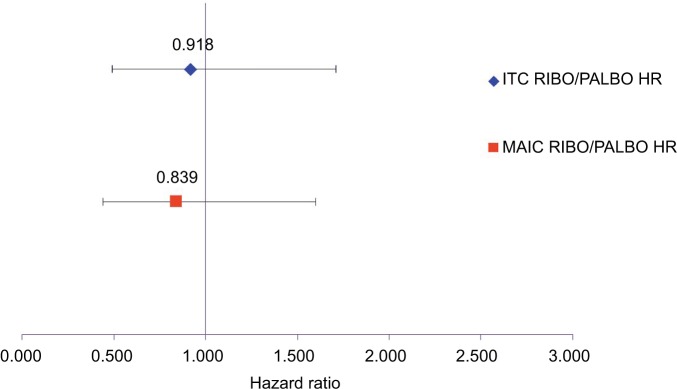
Racial characteristics, prior chemotherapy setting, and the extent of metastasis were the most imbalanced baseline characteristics. The unadjusted PFS HRs were 0.556 (0.429, 0.721) for RIBO+LET versus LET alone and 0.580 (0.460, 0.720) for PALBO+LET versus LET alone. MAIC adjustment resulted in an HR of 0.524 (0.406, 0.676) for RIBO+LET versus LET. PFS ITC using unadjusted trial data produced an HR of 0.959 (0.681, 1.350) for RIBO versus PALBO, or 0.904 (0.644, 1.268) with MAIC. Unadjusted overall survival HR of RIBO versus PALBO was 0.918 (0.492, 1.710); while exploratory MAIC was 0.839 (0.440, 1.598). ITC of grade 3/4 adverse events yielded a risk ratio of 0.806 (0.604, 1.076).
MAIC was performed for RIBO and PALBO in the absence of a head-to-head trial: though not statistically significant, the results favored RIBO.
在两项单独的III期随机对照试验(RCT)中,已对瑞博西尼(RIBO)和哌柏西利(PALBO)联合来曲唑(LET)治疗激素受体阳性、人表皮生长因子受体2阴性的晚期乳腺癌进行了评估,但未进行直接对比。人群差异可能导致经典间接治疗比较(ITC)产生有偏差的结果。匹配调整间接比较(MAIC)旨在纠正这些差异。我们使用MAIC比较了RIBO和PALBO在激素受体阳性/人表皮生长因子受体2阴性晚期乳腺癌中的疗效。
有瑞博西尼(MONALEESA - 2)的患者水平数据,而哌柏西利(PALOMA - 2)仅有已发表的汇总数据。对MONALEESA - 2患者数据进行加权,使平均基线特征与PALOMA - 2报告的特征相匹配;将得到的匹配队列用于比较。受PALOMA - 2报告结果的限制,无进展生存期(PFS)为主要比较指标。在进行间接治疗比较(ITC)并计算95%置信区间之前,使用Cox回归模型计算PFS的调整风险比(HRs)。使用早期哌柏西利数据(PALOMA - 1)对总生存期进行了类似的探索性分析。还比较了3/4级不良事件。
种族特征、既往化疗情况和转移程度是最不均衡的基线特征。未调整的PFS HRs,RIBO + LET对比单独使用LET为0.556(0.429,0.721),PALBO + LET对比单独使用LET为0.580(0.460,0.720)。MAIC调整后,RIBO + LET对比LET的HR为0.524(0.406,0.676)。使用未调整试验数据的PFS ITC,RIBO对比PALBO的HR为0.959(0.681,1.350),MAIC调整后为0.904(0.644,1.268)。RIBO对比PALBO未调整的总生存期HR为0.918(0.492,1.710);探索性MAIC为0.839(0.440,1.598)。3/4级不良事件的ITC产生的风险比为0.806(0.604,1.076)。
在没有直接对比试验的情况下,对RIBO和PALBO进行了MAIC:尽管无统计学意义,但结果倾向于RIBO。