Yoon Jeong-Kee, Kang Mi-Lan, Park Joo Hyun, Lee Kyoung-Mi, Shin Young Min, Lee Jin Woo, Kim Hyun Ok, Sung Hak-Joon
Division of Cardiology, Severance Cardiovascular Hospital, Yonsei University College of Medicine, Seoul, Republic of Korea.
Severance Biomedical Science Institute, College of Medicine, Yonsei University, Seoul, Republic of Korea.
Stem Cells Int. 2018 May 10;2018:8642989. doi: 10.1155/2018/8642989. eCollection 2018.
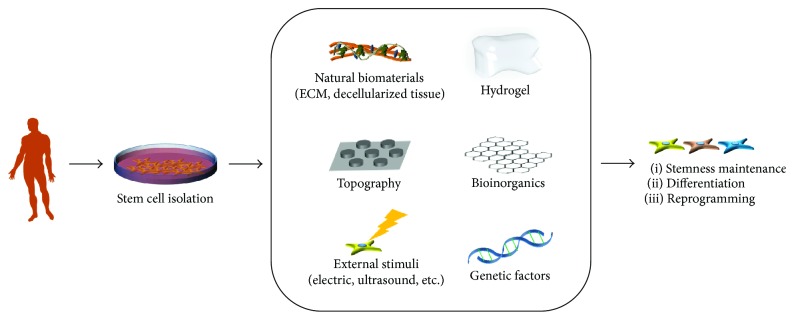
Stem cells have recently emerged as an important candidate for cell therapy. However, some major limitations still exist such as a small quantity of cell supply, senescence, and insufficient differentiation efficiency. Therefore, there is an unmet need to control stem cell behavior for better clinical performance. Since native microenvironment factors including stem cell niche, genetic factors, and growth factors direct stem cell fate cooperatively, user-specified settings are required to understand the regulatory roles and effects of each factor, thereby applying the factors for improved cell therapy. Among others, various types of biomaterials and transfection method have been employed as key tools for development of the settings. This review focuses on the current strategies to improve stemness maintenance, direct differentiation, and reprogramming using biomaterials and genetic factors without any aids from additional biochemicals and growth factors.
干细胞最近已成为细胞治疗的重要候选者。然而,仍然存在一些主要限制,例如细胞供应量少、衰老以及分化效率不足。因此,迫切需要控制干细胞行为以获得更好的临床效果。由于包括干细胞微环境、遗传因素和生长因子在内的天然微环境因素协同指导干细胞命运,因此需要用户指定的设置来了解每个因素的调节作用和效果,从而将这些因素应用于改进细胞治疗。其中,各种类型的生物材料和转染方法已被用作开发这些设置的关键工具。本综述重点关注当前使用生物材料和遗传因素来改善干性维持、直接分化和重编程的策略,无需额外生化物质和生长因子的任何辅助。