Laker Fortunate, Agaba Arnold, Akatukunda Andrew, Gazet Robert, Barasa Joshua, Nanyonga Sarah, Wendiro Deborah, Wacoo Alex Paul
Department of Chemistry, Faculty of Science, Kyambogo University, P.O. Box 1, Kyambogo, Uganda.
Department of Microbiology and Biotechnology Centre, Product Development Directory, Uganda Industrial Research Institute, P.O. Box 7086, Kampala, Uganda.
J Lipids. 2018 May 16;2018:1578720. doi: 10.1155/2018/1578720. eCollection 2018.
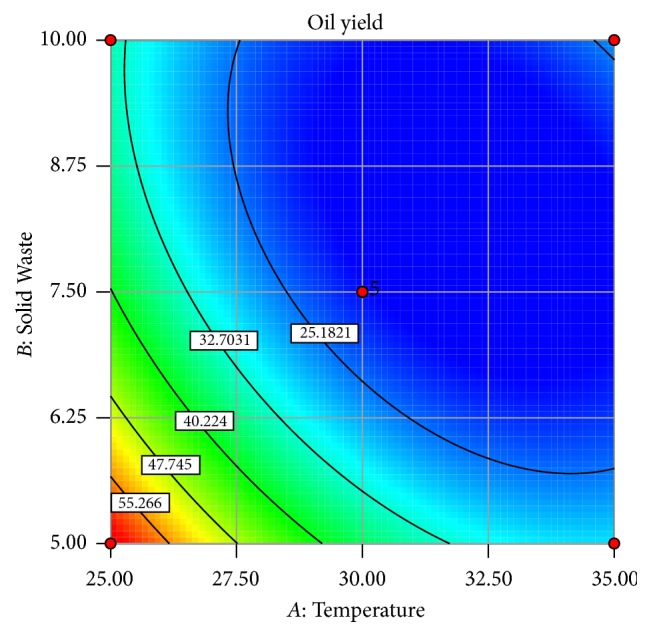
The overwhelming demand of oil and fats to meet the ever increasing needs for biofuel, cosmetics production, and other industrial purposes has enhanced a number of innovations in this industry. One such innovation is the use of microorganisms as alternative sources of oil and fats. Organic solid waste that is causing a big challenge of disposal worldwide is biodegradable and can be utilized as substrate for alternative oil production. The study evaluated the potential of isolated yeast-like colonies to grow and accumulate oil by using organic solid waste as substrate. Of the 25 yeast-like colonies isolated from the soil samples collected from three different suburbs in Kampala district, Uganda, 20 were screened positive for accumulation of lipid but only 2 were oleaginous. The NHC isolate with the best oil accumulation potential of 48.8% was used in the central composite design (CCD) experiments. The CCD experimental results revealed a maximum oil yield of 61.5% from 1.25 g/L cell biomass at 10 g/L of solid waste and temperature of 25°C. The study revealed that organic solid waste could be used as a substrate for microbial oil production.
对油脂的巨大需求以满足生物燃料、化妆品生产及其他工业用途不断增长的需求,推动了该行业的多项创新。其中一项创新是利用微生物作为油脂的替代来源。在全球范围内造成巨大处置挑战的有机固体废物是可生物降解的,可作为替代油脂生产的底物。该研究评估了分离出的类酵母菌落利用有机固体废物作为底物生长和积累油脂的潜力。从乌干达坎帕拉区三个不同郊区采集的土壤样本中分离出的25个类酵母菌落中,有20个被筛选出脂质积累呈阳性,但只有2个是产油的。具有48.8%最佳油脂积累潜力的NHC分离株用于中心复合设计(CCD)实验。CCD实验结果显示,在10 g/L固体废物和25°C温度下,1.25 g/L细胞生物量的最大油脂产量为61.5%。该研究表明,有机固体废物可作为微生物油脂生产的底物。