Coughlin Steven S
Department of Clinical and Digital Health Sciences, Augusta University, Augusta, GA.
Research Service, Charlie Norwood VA Medical Center, Augusta, GA.
J Environ Health Sci. 2017;3. doi: 10.15436/2378-6841.17.1665. Epub 2017 Nov 21.
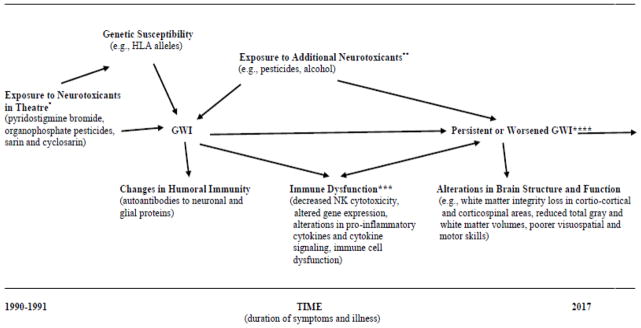
Several studies have implicated immune system disruption in the pathophysiology of GWI. In addition, alterations in brain structure and functioning have been associated with specific exposures in theater, including pyridostigmine bromide and nerve gas agents. Recent studies conducted up to 25 years after the 1991 conflict have examined factors associated with the continuation or worsening of GWI. Drawing upon published studies of neural and immune system abnormalities in veterans with GWI, this paper proposes a model of GWI that takes into account neurologic and immunologic pathways, neuroimmune mechanisms of disease pathophysiology, individual predisposition due to sex and genetic background, and comorbid factors including neurological conditions such as neuritis/neuralgia and epilepsy that may occur along a continuum with GWI. The proposed neuroimmune model of GWI is likely to be useful for designing new research studies, clarifying factors involved in the continuation or worsening of GWI, and identifying biomarker screening algorithms for the illness. The proposed model goes beyond previously proposed frameworks for GWI by taking into account potential differences in risk based upon female male sex, time elapsed since exposure to neurotoxicants, duration and severity of illness, comorbid conditions, and genotype.
多项研究表明,免疫系统紊乱与海湾战争综合征(GWI)的病理生理学有关。此外,脑结构和功能的改变与战区的特定暴露有关,包括溴化吡啶斯的明和神经毒气制剂。在1991年冲突发生后的25年里进行的最新研究,考察了与GWI持续或恶化相关的因素。借鉴已发表的关于患有GWI的退伍军人神经和免疫系统异常的研究,本文提出了一个GWI模型,该模型考虑了神经和免疫途径、疾病病理生理学的神经免疫机制、因性别和遗传背景导致的个体易感性,以及包括神经炎/神经痛和癫痫等神经系统疾病在内的共病因素,这些共病因素可能与GWI在一个连续体上发生。所提出的GWI神经免疫模型可能有助于设计新的研究、阐明与GWI持续或恶化有关的因素,以及识别该疾病的生物标志物筛查算法。所提出的模型超越了先前提出的GWI框架,它考虑了基于男女性别、接触神经毒剂后的时间、疾病的持续时间和严重程度、共病情况以及基因型的潜在风险差异。