Health Effects Laboratory Division, Centers for Disease Control and Prevention - National Institute for Occupational Safety and Health, Morgantown, WV, USA.
School of Public Health, Boston University, Boston, MA, USA.
Neuropharmacology. 2020 Jul;171:108073. doi: 10.1016/j.neuropharm.2020.108073. Epub 2020 Apr 2.
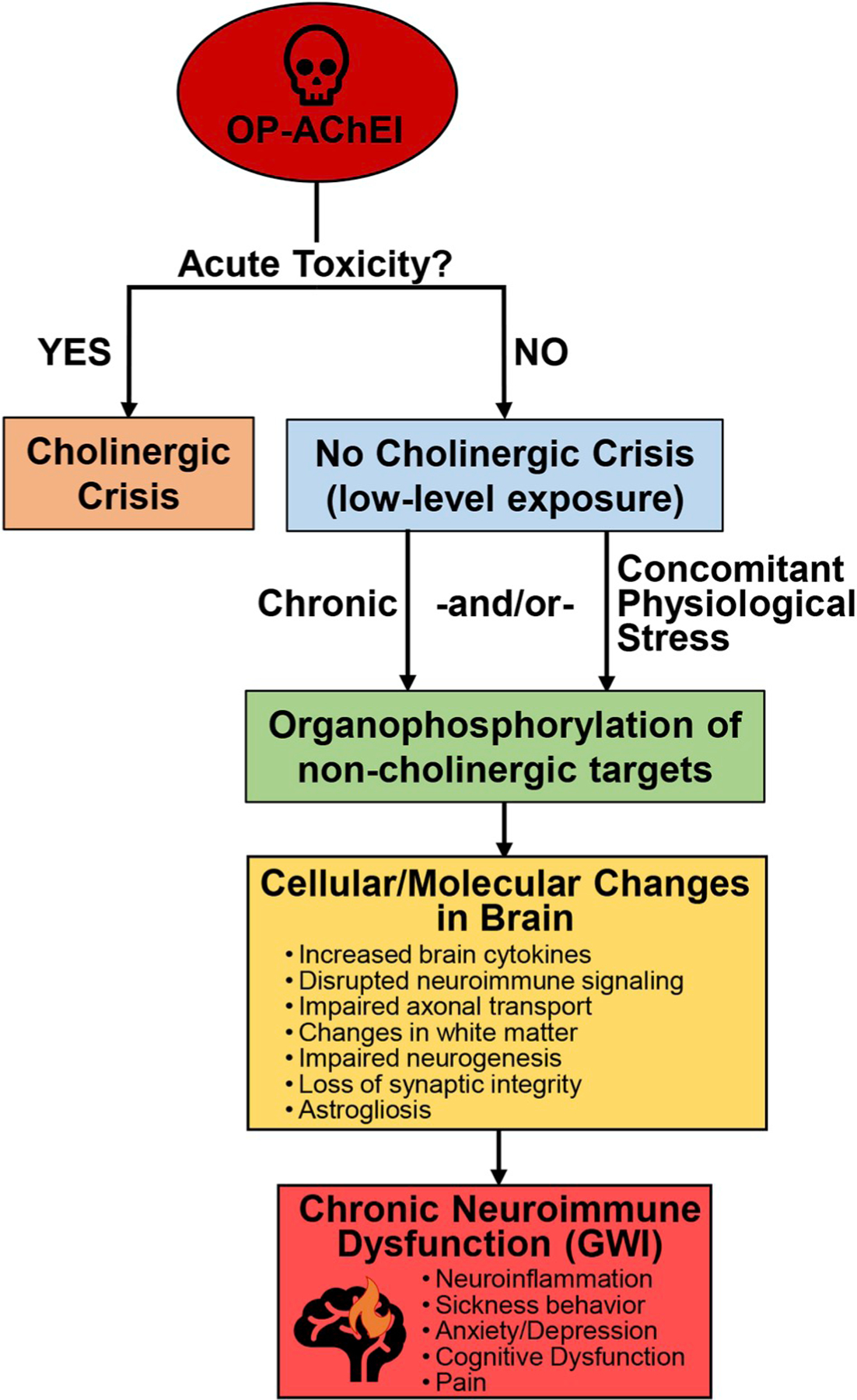
Gulf War Illness (GWI) is a chronic multi-symptom disorder, characterized by symptoms such as fatigue, pain, cognitive and memory impairment, respiratory, skin and gastrointestinal problems, that is experienced by approximately one-third of 1991 Gulf War veterans. Over the nearly three decades since the end of the war, investigators have worked to elucidate the initiating factors and underlying causes of GWI. A significant portion of this research has indicated a strong correlation between GWI and exposure to a number of different acetycholinesterase inhibitors (AChEIs) in theater, such as sarin and cyclosarin nerve agents, chlorpyrifos and dichlorvos pesticides, and the anti-nerve agent prophylactic pyridostigmine bromide. Through studying these exposures and their relationship to the symptoms presented by ill veterans, it has become increasingly apparent that GWI is the likely result of an underlying neuroimmune disorder. While evidence indicates that AChEIs are a key exposure in the development of GWI, particularly organophosphate AChEIs, the mechanism(s) by which these chemicals instigate illness appears to be related to "off-target", non-cholinergic effects. In this review, we will discuss the role of AChEI exposure in the development and persistence of GWI; in particular, how these chemicals, combined with other exposures, have led to a chronic neuroimmune disorder. This article is part of the special issue entitled 'Acetylcholinesterase Inhibitors: From Bench to Bedside to Battlefield'.
海湾战争病(GWI)是一种慢性多症状疾病,其特征是疲劳、疼痛、认知和记忆障碍、呼吸、皮肤和胃肠道问题等症状,约有三分之一的 1991 年海湾战争老兵患有这种疾病。自战争结束近三十年来,研究人员一直致力于阐明 GWI 的起始因素和根本原因。这部分研究表明,GWI 与在战区接触多种不同的乙酰胆碱酯酶抑制剂(AChEIs)之间存在很强的相关性,例如沙林和梭曼神经毒剂、氯吡磷和敌敌畏杀虫剂,以及抗神经毒剂预防药物溴吡斯的明。通过研究这些暴露及其与患病退伍军人表现出的症状之间的关系,越来越明显的是,GWI 很可能是一种潜在的神经免疫紊乱。虽然有证据表明 AChEIs 是 GWI 发展的关键暴露因素,特别是有机磷 AChEIs,但这些化学物质引发疾病的机制似乎与“非靶标”、非胆碱能效应有关。在这篇综述中,我们将讨论 AChEI 暴露在 GWI 的发展和持续中的作用;特别是这些化学物质与其他暴露因素相结合,如何导致慢性神经免疫紊乱。本文是题为“乙酰胆碱酯酶抑制剂:从实验室到病床到战场”的特刊的一部分。