Veterans Health Research Program, Yudofsky Division of Neuropsychiatry, Department of Psychiatry and Behavioral Sciences (MS 350), Baylor College of Medicine, One Baylor Plaza, Houston, TX, 77030, USA.
Million Veteran Program (MVP) Coordinating Center, VA Boston Healthcare System, Boston, MA, 02130, USA.
Environ Health. 2024 Oct 25;23(1):92. doi: 10.1186/s12940-024-01118-7.
Veterans of the 1990-1991 Gulf War have experienced excess health problems, most prominently the multisymptom condition Gulf War illness (GWI). The Department of Veterans Affairs (VA) Cooperative Studies Program #2006 "Genomics of Gulf War Illness in Veterans" project was established to address important questions concerning pathobiological and genetic aspects of GWI. The current study evaluated patterns of chronic ill health/GWI in the VA Million Veteran Program (MVP) Gulf War veteran cohort in relation to wartime exposures and key features of deployment, 27-30 years after Gulf War service.
MVP participants who served in the 1990-1991 Gulf War completed the MVP Gulf War Era Survey in 2018-2020. Survey responses provided detailed information on veterans' health, Gulf War exposures, and deployment time periods and locations. Analyses determined associations of three defined GWI/ill health outcomes with Gulf War deployment characteristics and exposures.
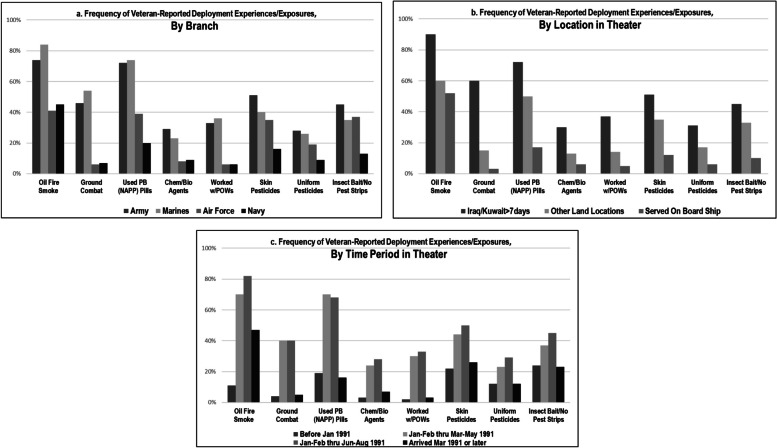
The final cohort included 14,103 veterans; demographic and military characteristics of the sample were similar to the full population of U.S. 1990-1991 Gulf War veterans. Overall, a substantial number of veterans experienced chronic ill health, as indicated by three defined outcomes: 49% reported their health as fair or poor, 31% met Centers for Disease Control and Prevention criteria for severe GWI, and 20% had been diagnosed with GWI by a healthcare provider. Health outcomes varied consistently with veterans' demographic and military characteristics, and with exposures during deployment. All outcomes were most prevalent among youngest veterans (< 50 years), Army and Marine Corps veterans, enlisted personnel (vs. officers), veterans located in Iraq and/or Kuwait for at least 7 days, and veterans who remained in theater from January/February 1991 through the summer of 1991. In multivariable models, GWI/ill health was most strongly associated with three exposures: chemical/biological warfare agents, taking pyridostigmine bromide pills, and use of skin pesticides.
Results from this large cohort indicate that GWI/chronic ill health continues to affect a large proportion of Gulf War veterans in patterns associated with 1990-1991 Gulf War deployment and exposures. Findings establish a foundation for comprehensive evaluation of genetic factors and deployment exposures in relation to GWI risk and pathobiology.
1990-1991 年海湾战争的退伍军人经历了过多的健康问题,其中最为突出的是多症状疾病海湾战争病(GWI)。退伍军人事务部(VA)合作研究计划#2006“海湾战争退伍军人疾病的基因组学”项目的成立是为了解决与 GWI 的病理生物学和遗传方面有关的重要问题。本研究评估了退伍军人百万计划(MVP)海湾战争退伍军人队列中慢性健康/海湾战争病的模式与战时暴露和部署的关键特征之间的关系,这是在海湾战争服务 27-30 年后进行的。
在 1990-1991 年海湾战争中服役的 MVP 参与者在 2018-2020 年完成了 MVP 海湾战争时代调查。调查答复提供了退伍军人健康、海湾战争暴露和部署时间段和地点的详细信息。分析确定了三个定义的 GWI/健康不良结果与海湾战争部署特征和暴露的关联。
最终队列包括 14103 名退伍军人;样本的人口统计学和军事特征与美国 1990-1991 年海湾战争退伍军人的总体情况相似。总体而言,大量退伍军人经历了慢性健康不良,表现在三个定义的结果中:49%的人报告他们的健康状况为一般或较差,31%的人符合疾病控制和预防中心对严重 GWI 的标准,20%的人被医疗保健提供者诊断为 GWI。健康结果与退伍军人的人口统计学和军事特征以及部署期间的暴露情况一致。所有结果在年龄最小的退伍军人(<50 岁)、陆军和海军陆战队退伍军人、 enlisted 人员(与军官相比)、至少在伊拉克和/或科威特驻扎 7 天的退伍军人以及从 1991 年 1 月/2 月至 1991 年夏季一直留在战区的退伍军人中最为普遍。在多变量模型中,GWI/健康不良与三种暴露的关系最为密切:化学/生物战剂、服用溴化吡啶斯的明片和使用皮肤杀虫剂。
来自这个大型队列的结果表明,GWI/慢性健康不良继续影响很大一部分海湾战争退伍军人,其模式与 1990-1991 年海湾战争部署和暴露有关。研究结果为全面评估与 GWI 风险和病理生物学有关的遗传因素和部署暴露奠定了基础。