James Lisa M, Georgopoulos Apostolos P
Department of Veterans Affairs Health Care System, Brain Sciences Center, Minneapolis, MN, USA.
Department of Neuroscience, University of Minnesota Medical School, Minneapolis, MN, USA.
Neurosci Insights. 2022 Jul 22;17:26331055221114817. doi: 10.1177/26331055221114817. eCollection 2022.
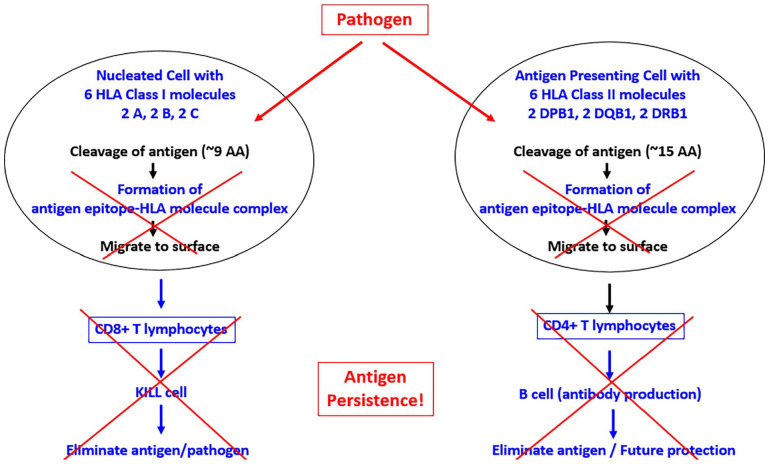
Several foreign antigens such as those derived from viruses and bacteria have been linked to long-term deleterious effects on the brain and other organs; yet, health outcomes subsequent to foreign antigen exposure vary depending in large part on the host's immune system, in general, and on human leukocyte antigen (HLA) composition, in particular. Here we first provide a brief description of 3 conditions characterized by persistent long-term symptoms, namely long-COVID-19, myalgic encephalomyelitis/chronic fatigue syndrome (ME/CFS), and Gulf War Illness (GWI), followed by a brief overview of the role of HLA in the immune response to foreign antigens. We then discuss our Persistent Antigen (PA) hypothesis and highlight associations between antigen persistence due to HLA-antigen incongruence and chronic health conditions in general and the 3 "long" diseases above in particular. This review is not intended to cover the breadth and depth of symptomatology of those diseases but is specifically focused on the hypothesis that the presence of persistent antigens underlies their pathogenesis.
几种外来抗原,如那些源自病毒和细菌的抗原,已被证明与对大脑和其他器官的长期有害影响有关;然而,接触外来抗原后的健康结果在很大程度上取决于宿主的免疫系统,特别是人类白细胞抗原(HLA)的组成。在这里,我们首先简要描述三种以持续长期症状为特征的病症,即新冠后综合征、肌痛性脑脊髓炎/慢性疲劳综合征(ME/CFS)和海湾战争综合征(GWI),随后简要概述HLA在对外来抗原的免疫反应中的作用。然后,我们讨论我们的持续抗原(PA)假说,并强调由于HLA-抗原不一致导致的抗原持续存在与一般慢性健康状况,特别是上述三种“长期”疾病之间的关联。本综述并非旨在涵盖这些疾病症状学的广度和深度,而是特别关注持续抗原的存在是其发病机制基础这一假说。