Hughes M, Moore T, Manning J, Wilkinson J, Watson S, Samraj P, Dinsdale G, Roberts C, Rhodes L E, Herrick A L, Murray A
a Centre for Musculoskeletal Research , The University of Manchester, Salford Royal NHS Foundation Trust, Manchester Academic Health Science Centre , Manchester , UK.
b Department of Rheumatology , Salford Royal NHS Foundation Trust , Salford , UK.
J Dermatolog Treat. 2019 May;30(3):251-257. doi: 10.1080/09546634.2018.1484875. Epub 2018 Jul 31.
Locally acting, well-tolerated treatments for systemic sclerosis (SSc) digital ulcers (DUs) are needed.
Our primary aim was to investigate the safety, feasibility, and tolerability of a novel low-level light therapy (LTTT). A secondary aim was to tentatively assess efficacy.
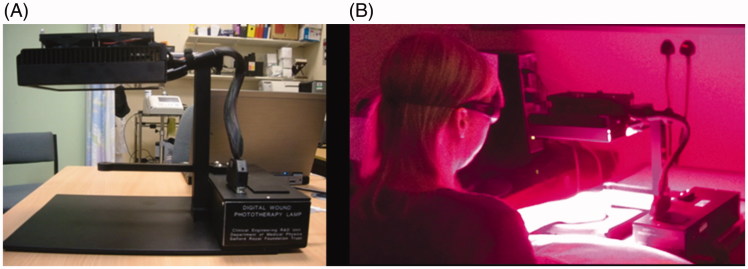
A custom-built device comprising infrared (850 nm), red (660 nm), and violet (405 nm) LEDs was utilized. DUs were irradiated with 10 J/cm twice weekly for 3 weeks, with follow-up at weeks 4 and 8. Any safety concerns were documented. Patient opinion on time to deliver, feasibility, and pain visual analogue score (VAS; 0-100, 100 most severe) was collected. Patient and clinician DU global assessment VAS were documented. DUs were evaluated by laser Doppler perfusion imaging pre- and post-irradiation.
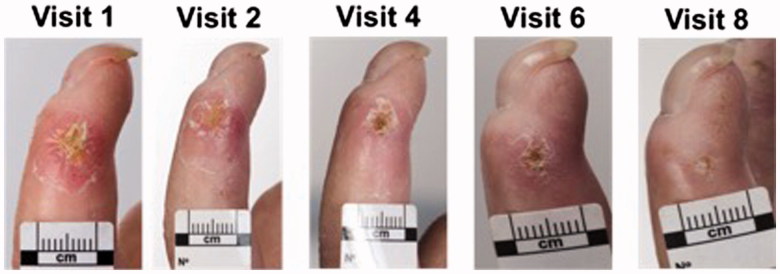
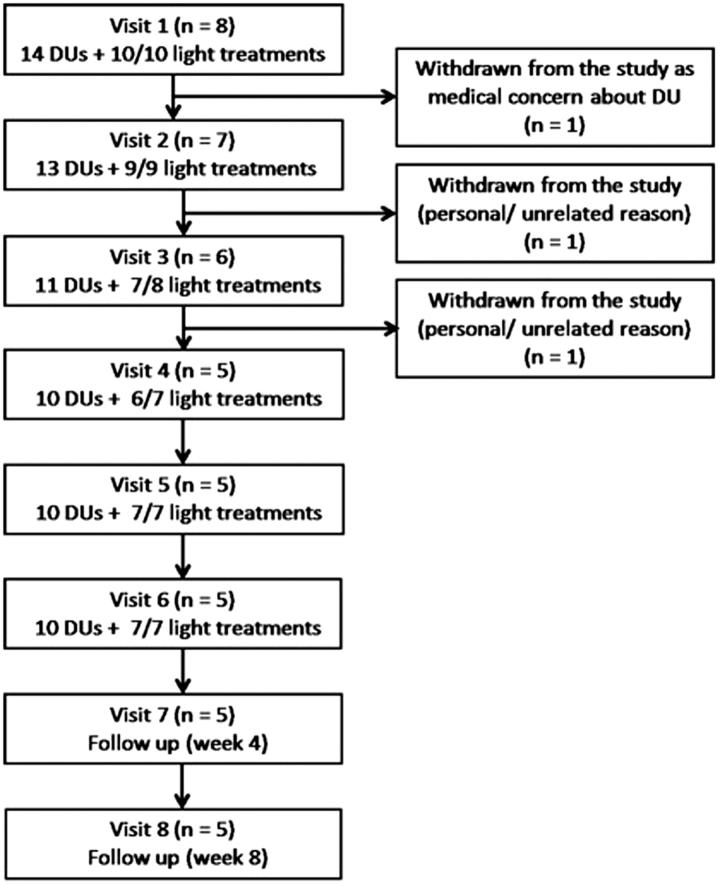
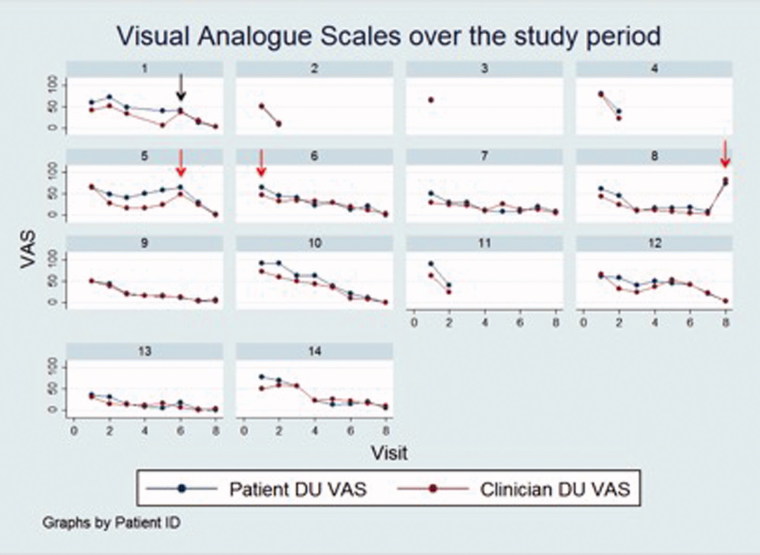
In all, 14 DUs in eight patients received a total of 46 light exposures, with no safety concerns. All patients considered LTTT 'took just the right amount of time' and was 'feasible', with a low associated mean pain VAS of 1.6 (SD: 5.2). Patient and clinician global DC VAS improved during the study (mean change: -7.1 and -5.2, respectively, both p < .001). DU perfusion significantly increased post-irradiation.
LTTT for DUs is safe, feasible, and well tolerated. There was an early tentative suggestion of treatment efficacy.
系统性硬化症(SSc)指端溃疡(DU)需要局部作用且耐受性良好的治疗方法。
我们的主要目的是研究一种新型低强度光疗法(LTTT)的安全性、可行性和耐受性。次要目的是初步评估其疗效。
使用一种定制设备,该设备包含红外(850nm)、红色(660nm)和紫色(405nm)发光二极管。每周两次对指端溃疡照射,剂量为10J/cm²,共照射3周,在第4周和第8周进行随访。记录任何安全问题。收集患者对治疗时间、可行性和疼痛视觉模拟评分(VAS;0-100,100表示最严重)的意见。记录患者和临床医生对指端溃疡的整体评估VAS。在照射前后通过激光多普勒灌注成像对指端溃疡进行评估。
8名患者的14个指端溃疡共接受了46次光照,未出现安全问题。所有患者都认为LTTT“时间恰到好处”且“可行”,相关的平均疼痛VAS较低,为1.6(标准差:5.2)。在研究期间,患者和临床医生的整体指端溃疡VAS有所改善(平均变化分别为-7.1和-5.2,均p<0.001)。照射后指端溃疡灌注显著增加。
指端溃疡的低强度光疗法安全、可行且耐受性良好。有早期初步迹象表明该治疗方法有效。