Tariq Anam, Wert Yijin, Cheriyath Pramil, Joshi Renu
From the Departments of Internal Medicine, Research and Biostatistical Analysis, and Endocrinology, UPMC Pinnacle Health, Harrisburg, Pennsylvania.
South Med J. 2018 Jun;111(6):363-369. doi: 10.14423/SMJ.0000000000000823.
Hypothyroidism results in decreased mood and neurocognition, weight gain, fatigue, and many other undesirable symptoms. The American Association of Clinical Endocrinologists, the American Thyroid Association (ATA), and The Endocrine Society recommend levothyroxine (LT4) monotherapy as the treatment for hypothyroidism; however, after years of monotherapy, some patients continue to experience impaired quality of life. Combination LT4 and synthetic liothyronine (LT3) therapy or the use of desiccated thyroid extract (DTE), has not been suggested for this indication based on short-duration studies with no significant benefits. Our first observational study examined the role of combination therapy for 6 years in improving quality of life in a subset of a hypothyroid population without adverse effects and cardiac mortality.
An observational retrospective study examining patients prescribed thyroid replacements with serum triiodothyronine (FT3), LT4 with LT3 (synthetic therapy) or DTE (natural therapy), compared with LT4 alone in the United States from 2010 to 2016. Thyroid-stimulating hormone (TSH), serum thyroxine (FT4), and FT3 levels were documented for each patient in addition to any admissions of myxedema coma, thyrotoxicosis, or cardiovascular complications, such as arrhythmias, atrial fibrillation, and mortality. At the conclusion of the study, a cross-sectional interview assessed quality of life for each combination therapy through the Medical Outcomes Study Short Form-20 questionnaire.
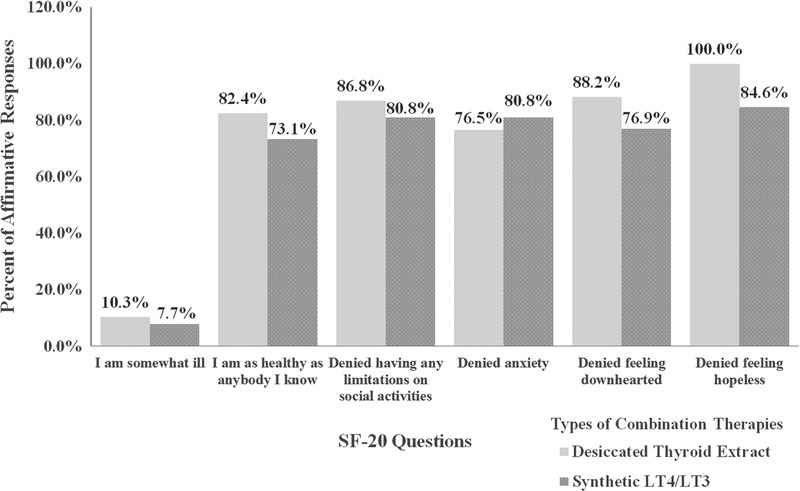
Compared with patients taking only LT4, 89.47% using synthetic therapy had therapeutic TSH ( < 0.05). Similarly, 96.49% using natural therapy had therapeutic TSH ( < 0.05). Less than 5% of patients had supratherapeutic FT3. None of the patients who had abnormally low TSH or elevated FT3 or FT4 levels had hospitalizations for arrhythmias or thyrotoxicosis. On the Medical Outcomes Study Short Form-20 questionnaire, >92% answered feeling "excellent, very good, or good" when questioned about their health while undergoing thyroid replacement compared with levothyroxine alone.
This is the only retrospective study reported to use long-term (mean 27 months) thyroid replacements with combination therapy and to compare between the two forms of therapy: synthetic and natural. For patients undergoing either therapy, we did not identify additional risks of atrial fibrillation, cardiovascular disease, or mortality in patients of all ages with hypothyroidism.
甲状腺功能减退会导致情绪低落、神经认知能力下降、体重增加、疲劳以及许多其他不良症状。美国临床内分泌医师协会、美国甲状腺协会(ATA)和内分泌学会推荐左甲状腺素(LT4)单药治疗作为甲状腺功能减退的治疗方法;然而,经过多年的单药治疗,一些患者的生活质量仍然受损。基于短期研究且无显著益处,联合使用LT4和合成三碘甲状腺原氨酸(LT3)疗法或使用干燥甲状腺提取物(DTE)尚未被建议用于此适应症。我们的第一项观察性研究考察了联合治疗6年对一部分甲状腺功能减退患者生活质量改善的作用,且无不良反应和心脏死亡率。
一项观察性回顾性研究,对2010年至2016年在美国接受甲状腺替代治疗的患者进行研究,这些患者接受血清三碘甲状腺原氨酸(FT3)、LT4联合LT3(合成疗法)或DTE(天然疗法)治疗,并与单独使用LT4的患者进行比较。记录每位患者的促甲状腺激素(TSH)、血清甲状腺素(FT4)和FT3水平,以及任何黏液性水肿昏迷、甲状腺毒症或心血管并发症(如心律失常、心房颤动和死亡率)的入院情况。在研究结束时,通过医疗结局研究简表-20问卷进行横断面访谈,评估每种联合治疗的生活质量。
与仅服用LT4的患者相比,89.47%接受合成疗法的患者TSH治疗达标(<0.05)。同样,96.49%接受天然疗法的患者TSH治疗达标(<0.05)。不到5%的患者FT3高于治疗水平。TSH异常低或FT3或FT4水平升高的患者均未因心律失常或甲状腺毒症住院。在医疗结局研究简表-20问卷中,与单独使用左甲状腺素相比,>92%的患者在接受甲状腺替代治疗时回答感觉“极好、非常好或良好”。
这是唯一一项报告使用长期(平均27个月)联合治疗的甲状腺替代疗法并比较两种治疗方式(合成和天然)的回顾性研究。对于接受任何一种治疗的患者,我们未发现所有年龄段甲状腺功能减退患者发生心房颤动、心血管疾病或死亡的额外风险。